

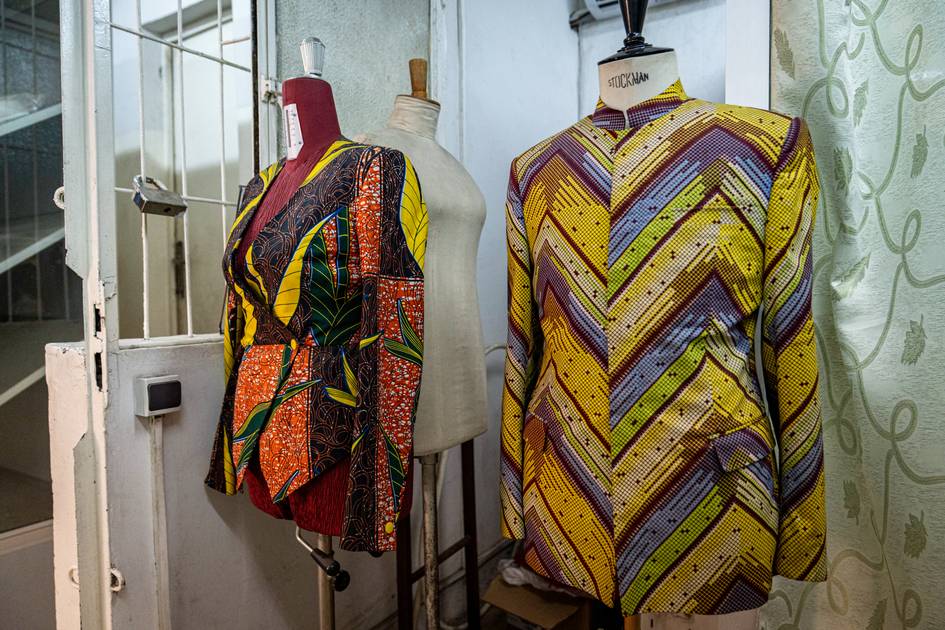
Sewing machines buzz through striking fabrics in a studio in Kinshasa. Here, Congolese tailors and their fashion-conscious customers breathe new life into a suit long associated with life under a dictator.
The “abacost” is a jacket with a closed front, often with a Mao collar and worn without a tie. Ideal for the sweltering equatorial heat.
It was the signature attire, along with his leopard hat, of President Mobuto Sese Seko. He started wearing the jacket in the 1970s, when Western shirts and ties were virtually banned.
The authoritarian ruler forced officials to do the same. It served as a symbol of national identity and a break with the norms of the former colonial powers.
Even the name, short for “a bas le costume” or “down with the suit”, was an act of defiance.
After Mobutu’s fall in 1997, after more than three decades in power, the suit fell out of favor. It was seen as a symbol of the old elite.
Now, almost three decades later, it’s back.
“It’s the trend now,” says Serge Okasol, one of Kinshasa’s best-known tailors. He adds that orders are pouring in from both old and young.
Hidden behind a gas station in the center of the capital of the Democratic Republic of Congo, the Okasol workshop gives the suit a new meaning, stitch by stitch.
After fashion studies in Paris, Serge and his brother Auguy returned home to take over the family business founded by their father.
Ministers, generals, executives and diplomats are now regular customers. Some order up to fifteen packs at a time, costing about $1,000 each.
‘Make it our own’
“There are many of these types of workshops, but Okasol does it the best,” a customer tells AFP after picking up a valuable order.
Another customer, Percy Losso, says the most sought-after designs use African fabrics. This makes the suits an expression of ‘cultural identity’.
“We take a classic style and make it our own language,” says Serge Okasol.
The modern abacost often has elaborate embroidery or bright patterns. This is in stark contrast to the modest appearance of Western suits.
The design starts with the customer. Many bring ideas inspired by Congolese musicians and influencers who contributed to the return of the Mobutu-era suit.
“When you sent me the model on your phone, it had a pointed collar. But here I opted for a more classic version,” Auguy says to a young customer as he takes his measurements.
For high-profile events, wealthier customers order abacosts decorated with floral motifs or beads.
Others go even further and add their initials, or even their own portrait, to the jacket.
The tailors say they live by one rule: “Express your identity.”
‘The real secret’
Behind the company, a large hangar buzzes full of high-quality machines, imported from Germany and Japan.
About 30 workers perform a variety of tasks, from jackets and pants to sleeves and buttonholes.
“People here attach great importance to the details,” says Serge. “You can judge a suit by its finish.”
A few blocks away, rows of cheaper suits from Asia hang on makeshift racks along a muddy road.
The mass-produced abacost-style jackets sell for around $50, with the tailoring done on site in dimly lit rooms.
Local tailors say the difference is in the quality. They claim that the imported products use low-quality fabrics, often mixed with polyester.
“The fabric is the real secret of a good suit,” says Auguy. “The imitation variants retain heat. With real fabric you can breathe.”
In one of the poorest countries in the world, style remains a powerful way to express identity, status and pride.
Kinshasa is known for its flamboyantly dressed dandies, or “sapeurs”. These are followers of a cult movement who spend enormous amounts of money on designer clothing.
Whether one is rich or struggling on the outskirts of the city, clothing in Kinshasa is more than fashion, Auguy emphasizes.
“For a man from Kinshasa, dressing well is like putting on armor,” Serge agrees. “It’s about self-confidence and credibility.”
This article has been translated into Dutch using an AI tool.
FashionUnited uses AI language tools to speed up the translation of (news) articles and proofread the translations to improve the end result. This saves our human journalists time that they can spend on research and writing their own articles. Articles translated using AI are checked and edited by a human desk editor before going online. If you have any questions or comments about this process, please email info@fashionunited.com.
