


At a crucial moment for the European textile and fashion industry, the Amsterdam University of Applied Sciences (HvA) welcomes the international Textile ETP Conference from 26 to 28 May 2026; the European platform for future-proof clothing and textiles. Science and industry in Amsterdam are considering the drastic changes that await the sector, thanks to new European legislation and regulations. The ‘digital product passport’ that Europe is introducing is an example of this.
Science and industry are coming together in Amsterdam this month to discuss the need for digitalization and data-driven models for the textile and clothing industry. Because new legislation from Brussels forces companies to design, produce and sell differently.
“The ‘Digital Product Passport’ that the EU is introducing digitizes a sector that actually does not want to be digitized,” says Troy Nachtigall, lecturer in Fashion Research and Technology. “The industry is not yet doing much about this. For example, we see that the shoe industry was less willing to change than hoped. But this passport, based on the ‘Ecodesign for Sustainable Products Regulation’, and the extended producer responsibility will drastically change the playing field.”
Forerunners
The ETP conference in Amsterdam is crucial so that science and industry can help each other with this change. Together with the network, the Nachtigall professorship has been studying the future for the past 10 years, and that knowledge is now coming in handy.
“We investigate ideas that still seem impossible or just feasible, and then help companies to further develop and apply them. We do this with pioneers such as Knitwear Lab and ByBorre.”
Microfactory
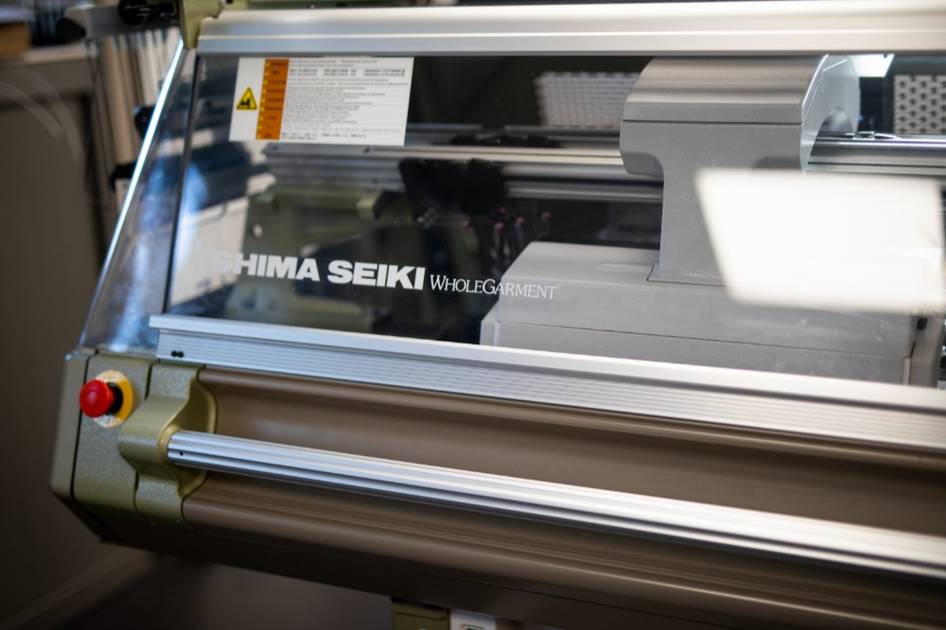
The AUAS has a ‘microfactory’ in which researchers and students can produce custom-made sweaters, fully robotically. Robotization and automation are becoming increasingly important, according to Nachtigall.
“We see fewer and fewer people who want to end up in textile engineering or manual textile work, even in China or Bangladesh. One of the most striking developments is that no generation wants their children to work in the textile industry anymore. That is why I think the move towards robots and automation is the way forward.”
Nachtigall sketches a future in which designers first test garments before they are produced. “A designer can create a design, put it on Instagram and sell ten copies before it goes into production. And if such a garment is made by someone closer to you, I think a stronger bond is created with the product.”
Global players
Worldwide, there are only a few knowledge institutions that focus on the possibilities of robots and digitalization for the clothing industry. In addition to the AUAS, Nachtigall mentions Politecnico di Milano, the Swedish School of Textiles and MIT, among others. “It’s a small group of people who already work this way, and we actually all know each other.”
The fact that Amsterdam can host this conference of European pioneers offers the Fashion Research & Technology professorship and AMFI an international platform to make the power of practice-oriented research and their expertise visible.
“The holistic perspective is unique to our research group: we do not zoom in on one part of the clothing industry, but look at the entire ecosystem,” says Nachtigall. The AUAS does this in the NewTexEco network, together with other knowledge partners: for the task of sustainability, the researchers look at the entire chain – from fiber to sales and residual product.
The AUAS also trains students for this changing field, with its Fashion Research and Technology professorship, AMFI and the Digital Fashion Technology master’s program.
The anniversary conference in Amsterdam is organized by AMFI, the HvA and Modint in collaboration with the European network for textile and clothing innovation.
About the new EU regulations
The European Union is working on new rules that should make sustainable clothing and textiles the norm. An important part of this is the Digital Product Passport (DPP): a digital passport that states exactly what a garment is made of, where the materials come from, how it was produced and how it can be repaired or recycled.
The passport is part of the ‘Ecodesign sustainable product regulation’. The rules will apply to all brands that sell clothing, textiles or shoes within the EU. In addition, major fashion companies will no longer be allowed to destroy unsold clothing and shoes from 2026. This ban will apply to medium-sized companies from 2030. Small brands are excluded for the time being.
The EU expects to establish the final rules on textiles and the Digital Product Passport in 2027.
