


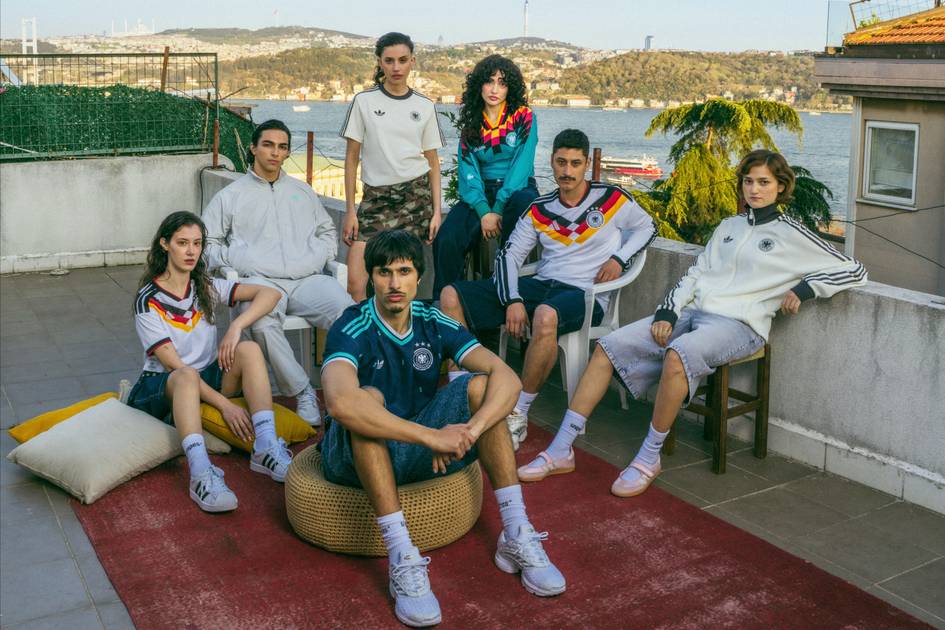
Football is no longer a trend, but an integral part of streetwear. The uniforms and styles have become indispensable in the streets, even outside major tournaments. Sports certainly seem to be experiencing a peak in fashion. This ranges from growing lifestyle categories and the hype surrounding the Men’s World Cup to the racing bike as an accessory at the Louis Vuitton show in Paris.
Mara Osterfeld, senior category manager for sportswear, and Mark Petereit, senior head of purchasing and planning at the Cologne streetwear retailer, reveal how Snipes is tapping into the football cult. They also discuss what other trends are influencing streetwear and which sneakers are a must-have for summer.
The World Cup is in full swing. Which football styles are popular with your customers?
Petery: Football’s influence on fashion is currently stronger than ever. The boundaries between sportswear, streetwear and fashion are increasingly blurring. Retro uniforms, 1990s/2000s-style training jackets and shirts are particularly popular. These are consciously worn as fashion items and are no longer just fan merchandise.
And which uniforms sell particularly well?
Petery: Shirts from national teams with global appeal, such as Brazil or the German Football Association (DFB), are currently selling well. This includes current tournament kits, retro versions and creative away kits. The latter often have a higher fashion factor and are specifically integrated into streetwear looks. In general, the stronger the connection between football, music and street culture, the more relevant the kit is for our target group.
Blokecore has been a theme in streetwear for a few seasons now. Is it still a trend or has it become a permanent part of the scene?
Osterfeld: Definitely a permanent fixture. Football kits and sports-inspired silhouettes have arrived in the streetwear world. What has changed is that people used to consciously wear a complete football look. Nowadays, shirts are naturally combined with denim, workwear or tailoring. What is crucial today is not so much the sport itself, but the cultural connection between sport, community, music and fashion.
This principle increasingly applies to the entire sports sector. Basketball jerseys, college styles and licenses for Major League Baseball (MLB) and other American sports are integrated into streetwear looks with the same naturalness. The influence of American sports culture on fashion is currently stronger than it has been in years. This is an area in which we at Snipes are specifically investing in the second half of the year. Football remains our strongest theme, not least because of our partnership with Paris Saint-Germain. For the World Cup we will put extra focus on it and make optimal use of the moment.
Blokecore is a fashion trend that focuses on football and its fan culture, from the football kit to the casual style that emerged in English stadiums. In the early 2020s, inspiration was mainly drawn from the retro aesthetic of the 1990s and early 2000s. The trend has since evolved and now represents everything related to the sport.
How exactly has this style of football changed?
Osterfeld: The shift is clear. It has evolved from a purely nostalgic look to a more fashionable interpretation: oversized fits, high-quality materials, cropped shirts for women and combinations with loafers and tailoring. Collaborations like the one between Jordan and the Brazilian national team show that football is now understood as a cultural platform, an impulse that extends far beyond the sport itself.
Outside the stadium – what trends in menswear are you seeing at the moment?
Osterfeld: Roomy silhouettes remain dominant, while jorts and 7/8 lengths introduce new proportions. Utility influences have become tighter. Street prep is also experiencing a revival. Polo shirts, rugby shirts, quarter-zips and high-quality knitwear are combined with sneakers or loafers. In the accessories sector, neck scarves, bandanas and crossbody bags are gaining in importance.
Men’s fashion is generally becoming more versatile. It is less about a single trend and more about an individual mix. The crucial factor is the ability to combine different styles and create an authentic personal look.
And in women’s fashion?
Osterfeld: From our perspective, women’s fashion is currently shaped by the combination of sportswear, streetwear and femininity. Shirts and oversized silhouettes are combined with mini skirts, wide-leg denim or feminine details such as lace and crochet. In addition, classic men’s fashion items are being reinterpreted, with conscious style breaks driving the trend.
There is also a strong comeback of prints, such as polka dots, checks and animal prints, as well as lingering Y2K influences. Hair accessories such as bandanas and scrunchies are playing a growing role as styling elements.
After the narrow silhouettes that evolved into ballet sneakers, where is the segment going?
Petery: Sneakerinas is the new buzzword. Iconic models are reinterpreted and tailored to the needs of women. Whether it is the Adidas Samba Jane as a Mary Jane version or the Puma Speedcat Ballet, these new editions give the wearer the feeling of being seen. At the same time, the market is evolving towards hybrid models. Loafer and mule inspired designs are becoming more popular alongside ballet styles.
Another motivation is self-expression through personalization. The desire for a well-thought-out head-to-toe look and exclusive models is greater than ever. This was recently demonstrated at our Birkenstock personalization event, where customers could individually design their own pair.
Which sneakers are currently a must-have for every men’s street style?
Petery: Running-inspired silhouettes are dominant here. Performance styles like the On Cloudtilt meet 2000s icons like the New Balance 530 and 740, Nike P-6000 and V5, or the Asics GEL-1130 and GEL-NYC. Lightweight construction, mesh uppers and a technical look combine comfort, functionality and style. For the warmer season, the Birkenstock Boston and Arizona, as well as Havaianas, complete the range as relaxed seasonal classics.
Do you use other sources of inspiration besides the usual social media and fashion weeks?
Petery: Certainly. Many important trends emerge outside the classic fashion bubble, at the intersections of music, sports, gaming and pop culture. Festivals, concerts, stadiums and creator communities often send earlier signals than fashion shows.
For a retailer, direct proximity to the target group is particularly valuable. It not only helps to recognize trends, but also to understand how they are actually worn and further developed. Our goal is to identify cultural developments at an early stage and translate them into ranges that connect with our community.
Finally: what is your current fashion hot take?
Osterfeld: I believe we need to move away from the idea that trends are only created by new products. The most exciting looks are currently created by reinterpreting existing pieces. An oversized shirt as a skirt, a scarf as a top, a shirt with a feminine look. Nowadays, color trends also arise from the color codes of sports and pop culture. The NY Knicks’ orange and blue palette can now be found in streetwear collections and sneaker releases.
For us as a retailer, the challenge lies in recognizing this cultural relevance at an early stage and translating it into the right product ranges.
This interview was conducted in writing. The article was translated into Dutch using an AI tool.
FashionUnited uses AI language tools to speed up the translation of (news) articles and proofread the translations to improve the end result. This saves our human journalists time that they can spend on research and writing original articles. Articles translated using AI are checked and edited by a human editor before going online. If you have any questions or comments about this process, please email us at info@fashionunited.com
