


I had read about its history, its role in the Silk Road and the size of the territory, but arriving in Almaty exceeded every expectation. The Kazakh city lies at the foot of an imposing mountain range, which frames an urban silhouette of modern glass skyscrapers.
The last edition of Fashion Week Almaty took place from April 28 to 30 in the former capital, with the support of a sponsor of the caliber of Visa. The event brought together eighteen designers from Kazakhstan, Azerbaijan, Armenia, Hungary and Morocco. The city positioned itself as the epicenter of a creative conversation about identity and cultural transformation in Central Asia.
The concept of the event ties directly into this idea of continuous transformation. Kazakhstan presents itself not only as heritage, but as an open conversation between what was, what is and what it wants to be. In this exchange of perspectives – internal and external – the concept of this edition is expressed, under the motto “see and be seen”.
“It is the recognition that our identity is formed here and now, in the eyes of others and in our own reflection,” Bauyrzhan Shadibekov, CEO of Visa Fashion Week Almaty, explained about the creative moment the country is in.
Our identity is formed here
Maison ARTC, the “house of culture” founded by Moroccan designer and artist Artsi Ifrach, and winner of the Fashion Trust Arabia award in 2022, was one of the most notable attendees this edition in Almaty.
Rather, Ifrach’s work proposes a reflection on how cultural identities are constructed and projected in global circulation. This is a particularly relevant issue in a context where, according to him, fashion no longer belongs exclusively to the big capitals, but is increasingly shaped from other creative centers.
Artsi Ifrach consciously distances itself from mass production and places its work closer to art. His unique pieces are at the intersection of fashion, performance, photography and material archive. The use of recycled textiles and collaboration with artisans is not an added discursive gesture, but the core of his practice. Each collection is almost a moving exhibition, in which fashion functions as a narrative and critical medium.
Cultural bridges
The internationalization of Visa Fashion Week Almaty has also been strengthened by the collaboration with Budapest Central European Fashion Week. This collaboration brought the Nanushka brand to the stage with the “Sacred Utility” collection.
In this web of influences, Italian fashion has also found a fertile ground for dialogue. The presence in Central Asia is more than just a commercial expansion. From an institutional perspective, the Italian Trade Agency in Almaty consolidates itself as a strategic bridge between both creative ecosystems.
Their work is not limited to the introduction of Italian brands to the Kazakh market. It also facilitates the reverse flow of talent by connecting local designers and companies to the Italian training and production system.
The result is a process of co-evolution in which fashion functions as a tool for cultural diplomacy, knowledge transfer and the construction of new professional identities.
Evolution towards a global ecosystem
Danara Usmanova, commercial director of Saks Fifth Avenue Almaty, also explained how the fashion industry in Kazakhstan is undergoing a transformation during one of the talks organized by the organization. This happens through spaces like Saks Fifth Avenue in Almaty and Astana.
“It is no longer just about creativity,” she noted, “but about guiding emerging designers in understanding international standards, production processes and commercial communication tools.” This change reflects the transition from a more local and artistic fashion to a more structured industry, able to scale up and profile itself outside the country.
In this context, the first evening of the event focused on national identity and local craftsmanship. It was a Traditional Gala organized by Saken Zhaksybayev and the Fashion Bureau at the Almaty Theater under the concept “Made in Kazakhstan. Made with Love”.
Attendees transformed Almaty’s new theater into a veritable social catwalk, with carefully chosen pieces forming a collective celebration of clothing.
More than an isolated phenomenon, the event’s street style consolidated as a parallel chapter within the story of Fashion Week itself. During each day, the many photographers who came to the location, the Atakent Exhibition Center, took photos of attendees at various places on the site. Observing styles thus became an almost choreographed dynamic.
Five key designs
This balance between tradition and experimentation leads to its own creative language, which can position itself on the international map, beyond just the ’emerging’.
Below is a selection of five brands that summarize some of the most relevant directions on display at Visa Fashion Week Almaty.
ZhSaken (Kazakhstan)
Saken Zhaksybayev, founder of Fashion Bureau and a key figure in the organization of the event, concluded the three days of shows with a proposal that serves as a statement of principles. In “Art Is Not Enough,” fashion occupies an intermediate space between the intuitive and the conscious, with an aesthetic inspired by the energy of contemporary art biennials.
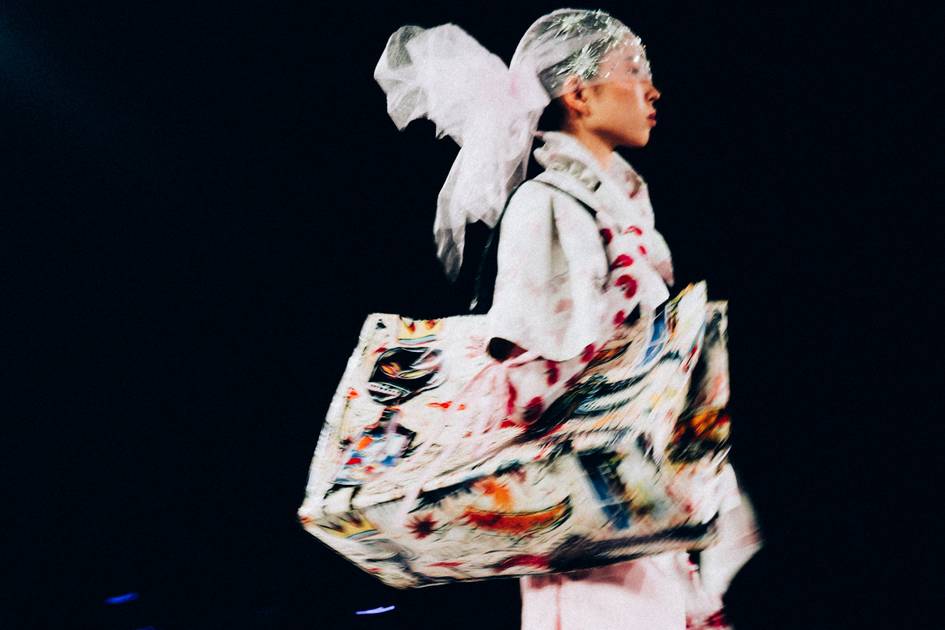
The result is a pop-surrealism in which the contrast between classic femininity codes and sporty accessories forms a consciously hybrid story. Vichy checks, urban-inspired graphics and enlarged volumes are used to stretch the concept of luxury and move it into a more playful, even ironic territory.
The collection is made up of contrasts. Architectural structures are juxtaposed against bursts of red and deep blue, and transparencies meet dense textures. The result is a series of looks that seem to be in constant transformation, as if each look is an autonomous gesture within a larger manifesto on creative freedom.
Mariko (Kazakhstan)
Mari Hayrapetyan transforms migration memories into textiles. “Urmia” creates a precise balance between craft and contemporary design, through the use of crochet, extra-long fringes and fabrics with a strong tactile presence that add depth to sleek silhouettes.
The collection is characterized by an understated refinement. A neutral color base is punctuated by accents of vibrant orange and purple, highlighting a formal investigation focused on materiality. Far from nostalgic, the proposal reconfigures traditional codes from a clearly current logic.
YesYes! (Kazakhstan)
Winner of the sixth edition of the Next Designer Award empowered by Visa, Esmukhan Esbolat – at the helm of YesYes! – presents one of the conceptually strongest proposals of the season with “BITPEYTIN TOY”.
Drawing from the rural and festive iconography of the 2000s, the designer reformulates traditional Kazakh celebrations from a critical perspective. The “brilliant chaos” of the toys is deconstructed and reinterpreted through an aesthetic that incorporates cyberpunk references: neon palettes, exaggerated volumes in materials such as feathers and face-hiding accessories.
The result is a visual story that oscillates between nostalgia and dystopia, projecting a vision of haute couture steeped in contemporary cultural tensions.
Sako (Kazakhstan)
Saltanat Abdildaeva’s debut is an intimate exploration of the process of self-acceptance. Through a visual language based on contrasts, the designer juxtaposes rigid graphic structures with soft volumes and almost exaggerated floral decorations.
The transition from monochrome black to a more expressive palette functions as a metaphor for the development of one’s own identity. The result is a collection that translates a personal experience into a very interesting proposal.
Manuk Aleksanyan (Armenia)
From Armenia, Manuk Aleksanyan proposes a reflection on the suggestive power of faith. “Effect Placebo” is built around a dark maximalism that combines grunge codes with elements from the artistic avant-garde.
Rigid silhouettes, surfaces decorated with large sequins, feathers and graffiti form a proposal with a strong theatrical charge. Aleksanyan thus positions himself in an area that eschews the conventional to explore a raw, theatrical and distinctly provocative visual identity.
This article has been translated into Dutch using an AI tool.
FashionUnited uses AI language tools to speed up the translation of (news) articles and proofread the translations to improve the end result. This saves our human journalists time that they can spend on research and writing their own articles. Articles translated using AI are checked and edited by a human desk editor before going online. If you have any questions or comments about this process, please email info@fashionunited.com.
