


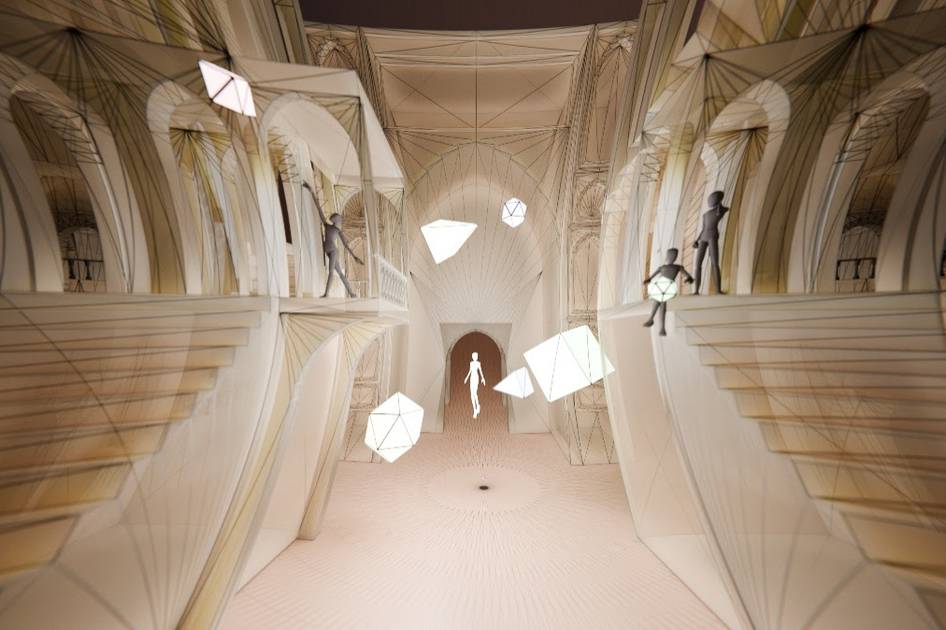
Design Academy Eindhoven (DAE) and its Trans Realities Lab (TRL) will receive 650,000 euros as part of a European Union-funded research initiative. This initiative investigates the cultural and social impact of persistent virtual worlds. The financing is part of the VOPUS project (Virtual World Opera for Participation, Unity, and Social Cohesion) worth 3.5 million euros. This is a 36-month Horizon Europe program with nine partners from six countries, coordinated by Aalto University in Finland.
The project investigates the influence of increasing participation in virtual environments on social cohesion, well-being and cultural identity using opera as a case study. In addition, the aim is to explore how digital and persistent worlds can help cultural institutions reach a wider audience and strengthen the long-term resilience of European cultural heritage.
As the consortium’s main technical partner, DAE leads the design, development and operation of Operaland. This is a persistent virtual world environment built on open Web 4.0 standards, including glTF 2.0, OpenXR, WebXR, and WebGPU. The platform aims to avoid vendor lock-in and provide a reusable infrastructure that can be adopted by cultural institutions across Europe.
The project is the first large-scale application of a new open platform core developed by the Trans Realities Lab. The technology builds on the lab’s previous XR-IT project, which reached Technology Readiness Level 8. This project culminated in Cat Contentthe world’s first live motion-capture animated film. The film was produced simultaneously on locations in Finland, the Netherlands and Germany. The production received the International Production Award at the Next Reality Festival in Hamburg in 2025.
Dr. Ian Biscoe, professor of Transdisciplinary Design Networks at the Design Academy Eindhoven and founder of the Trans Realities Lab, says the project builds on years of research into distributed virtual production and open digital infrastructure. He describes persistent virtual worlds as one of the defining cultural issues of the coming decade. He argues that European institutions must play an active role in shaping their development.
In addition to technological development, VOPUS brings together expertise from research, the performing arts and industry. Partners include Digital Catapult in the UK, Universitat Autònoma de Barcelona, Fundamental Research in Belgium, the Finnish National Opera and Ballet, Staatstheater Augsburg, Staatsopera Stara Zagora and Sunderland Software City.
The project also reflects Design Academy Eindhoven’s broader involvement in European initiatives around virtual worlds and immersive technologies. The Trans Realities Lab participates in the EU VR/AR Coalition, the Virtual Worlds Association and the Metaverse Standards Forum. The VOPUS project is expected to contribute to the future development of standards in the sector.
This article has been translated into Dutch using an AI tool.
FashionUnited uses AI language tools to speed up the translation of (news) articles and proofread the translations to improve the end result. This saves our human journalists time that they can spend on research and writing their own articles. Articles translated using AI are checked and edited by a human desk editor before going online. If you have any questions or comments about this process, please email info@fashionunited.com.
