


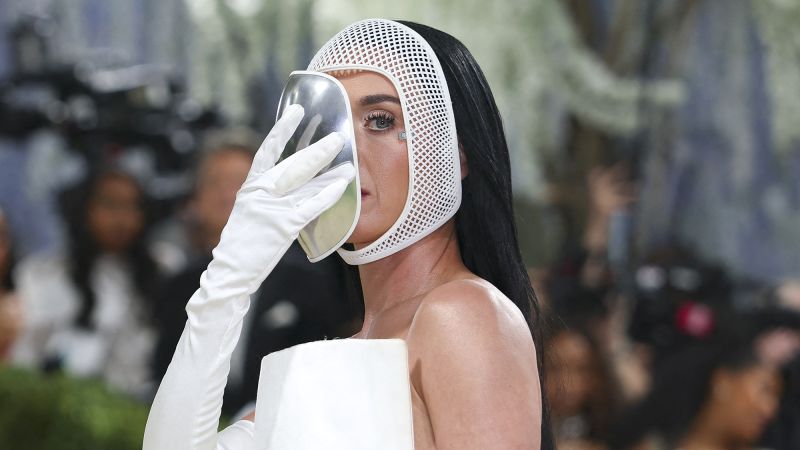
Extreme visibility has historically been the name of the game on the Meta Gala’s celebrity-packed red carpet, but this year some guests hid (or at least obscured) their biggest asset: Their faces.
It started with the eye masks. Rachel Zegler, dressed in Prabal Gurung and referencing Paul Delaroche’s 19th century painting of Lady Jane Grey, wore a gauzy recreation of the young queen of England’s execution blindfold.
Then in a more obvious act of provocation, wearing a frayed tulle ball gown, Sarah Paulson arrived “blinded by money” — her eyes covered with leather dollar bill designed by avant garde Parisian label Matières Fécales. (In what is likely a comment on the Bezos-related controversy surrounding this year’s event, Paulson’s outfit came from a collection titled “The One Percent,” which reflected on greed, corruption and extreme power.)
Big Style: Where culture meets clothing
- CNN senior style reporter and advanced outfit anthropologist Rachel Tashjian excavates the stylish amusements and contextualizes the world of fashion – all in your inbox. Sign up for Big Style here.


Like an 18th century masquerade ball, more and more celebrities kept arriving in varying levels of disguise. Actress Gwendoline Christie made her way up the steps carrying a hand-held mask of her own face created by one of the original Young British Artists (YBAs) and Turner-prize winner, Gillian Wearing. Elsewhere, singer and model Yseult wore a custom Harris Reed face shield with two protruding plumes of black feathers.
But who was the dark-haired woman hiding behind the space-age fencing mask? Half-way up the steps a white gloved hand shakily hinged open the mirrored facade to reveal Katy Perry, a woman who has actually been to space on the recent Blue Origin NS-31 mission, before snapping it shut again. Message received.


Centuries ago in Europe, elaborate masks that concealed guests were part and parcel of events like the Venetian Carnival and May Day celebrations. The role of these face coverings, as well as adding to the spectacle of the party, was to free people from the shackles of their class and status and enable a more liberated, often debauched, send-up.
At the Met Gala, where much of the guest list is kept confidential until the red carpet is over, the mask performs a slightly different role. It not only keeps us guessing: Crucially for a few more precious moments it keeps us waiting — or wanting more. Masks can engineer a slow, sartorial curtain-raising which holds our attention that little bit longer. That’s no small feat in a sea of loud, competing outfits.


But keep a mask on, and it gains even more power. Subversive Belgian designer Martin Margiela understood the inherent democracy in a mask, employing them in his collections since 1989 to re-focus attention on the garment. Today, Margiela’s tradition of masks have become even more relevant as they undercut the cult of celebrity which is so often inextricable from fashion. First time Met Gala attendee Ananya Birla, an Indian businesswoman and daughter of billionaire Kumar Mangalam Birla, seemed to harness the mask’s equalizing potential and made a splashy debut in a skull-shaped facade fashioned out of traditional Indian silverware by sculptor Subodh Gupta.
Then there was the so-called Queen of Halloween, Heidi Klum, who took the mask to its logical conclusion at this year’s Met Gala and disappeared entirely inside the skin of a marble statue. Her look toppled the red carpet game of ‘Guess Who?’ into an investigation, and was as spotlight-stealing as they come.
