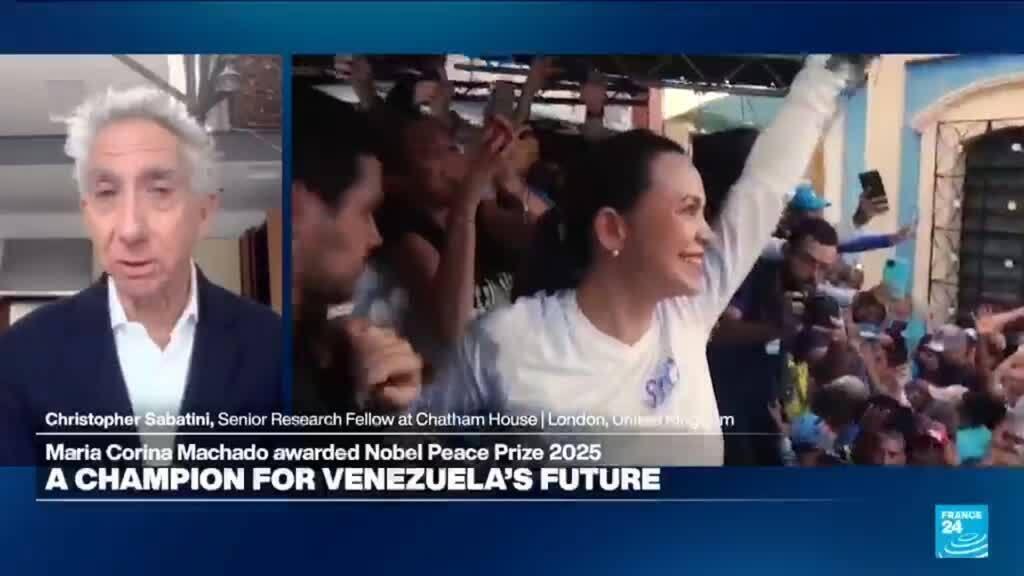
Awarding the Nobel Peace Prize to María Corina Machado might serve as a watershed moment for Venezuela’s long slide toward authoritarianism and force a reckoning within elite circles. Christopher Sabatini, Senior Research Fellow for Latin America at Chatham House, joins us for a sobering analysis: It will merely serve as a symbolic act that could very well galvanise international attention, embolden domestic opposition, and test the limits of Venezuela’s ruthless regime. There has been a gradual hollowing out of democratic institutions under Hugo Chávez and Nicolás Maduro; the sweeping politicisation of judicial and electoral bodies; the weaponisation of security forces and militias; and the long-neglected humanitarian crisis that has displaced millions. A political crisis began last year, when Machado was forcibly sidelined leading up to the disputed July 2024 election. But Mr. Sabatini warns that Venezuela is not an Eastern Bloc nation: external signals: US naval deployments, sanctions, diplomatic rebukes may provoke a hardened response and further entrenchment rather than lead to any democratic reform.
Trending
- The making of ‘Red Berlin’
- Ed Sheeran calls Gaza war catastrophic after dropping Macklemore over pro-Palestinian comments
- Lisa Riley – News, views, pictures, video
- ‘La Bola Negra’ wins TIFF audience award, ‘Angh’ triumphs in Platform | News
- Ben Affleck Nearly Cast Ex Jennifer Garner In ‘Animals’ As His Wife
- ‘La Bola Negra’ Wins Audience Award
- Sylvester Stallone Opens up About His Underdog Story and ‘Rocky’
- Fed's Kashkari says inflation is still too high across US economy, in Fox News interview