


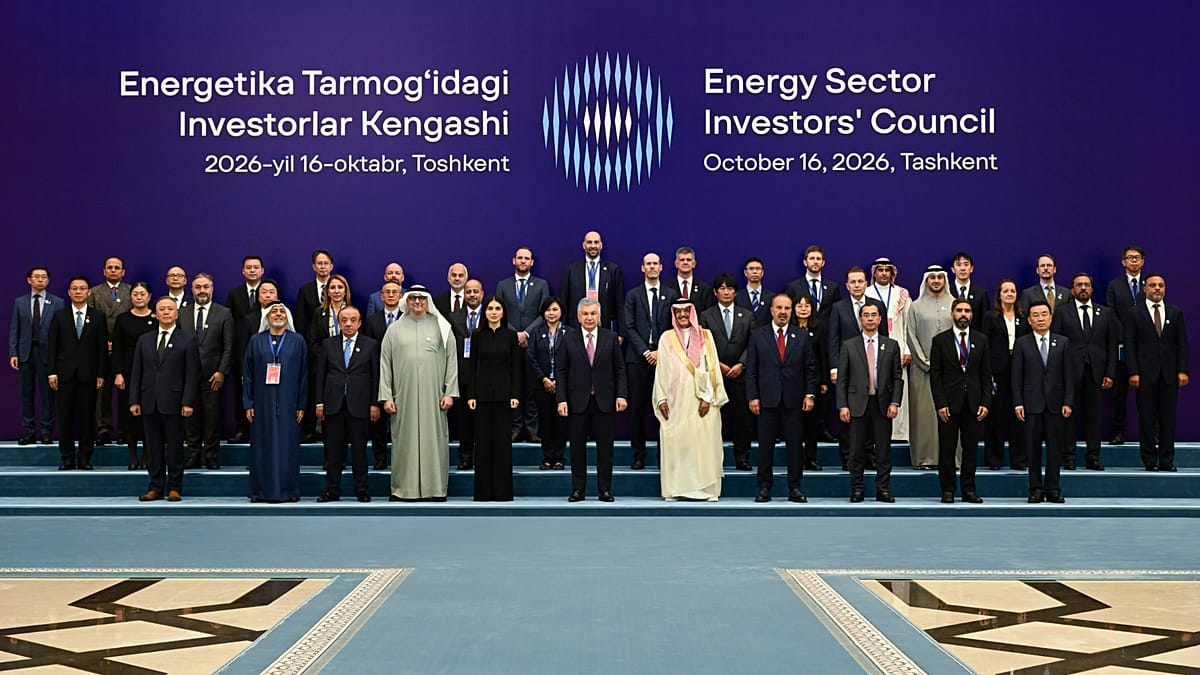
Uzbekistan has signed six energy agreements worth $4.7bn (€4.19bn) and announced plans for two more nuclear power plants, as President Shavkat Mirziyoyev seeks to attract foreign investment and meet rising demand from industry and data centres.

ADVERTISEMENT
ADVERTISEMENT
The agreements, signed during talks in Tashkent on Friday, cover 3,000 megawatts (MW) of new generating capacity and 400 MW of energy storage, according to the presidency.
Companies named in a project list obtained by Euronews include Saudi Arabia’s ACWA Power and Saudi Tabreed, the UAE’s AMEA Power, Japan’s Toyota Tsusho and Sojitz, France’s EDF, Qatar’s Nebras Power, StorEn and CRE International.
A new approach to energy investment
Uzbekistan has attracted $35bn (€31.2bn) in energy investment over the past decade, according to President Mirziyoyev.
But he acknowledged that allowing developers to choose plant locations had concentrated generation in some areas and increased transmission costs elsewhere.
“We need an integrated energy system, not isolated power plants,” he said.
Future projects will undergo competitive tenders with grid connections and electricity purchase terms disclosed in advance. Six solar and wind projects totalling 2,200 MW will be tendered separately from the newly signed agreements.
The country’s first National Energy Master Plan, covering the period to 2050, is due by July 2027, with a map of grid connection opportunities expected in March.
By 2030, the government aims to add 22 GW of generating capacity, build 5,000 kilometres of power lines and 16 substations, and expand storage capacity to 4.5 GW.
Annual electricity output is targeted to exceed 129bn kWh, with renewables, including hydropower, expected to account for 54% of generation, up from 31% today, according to the presidency.
The government has also proposed 12 manufacturing projects worth $850m (€758m), aimed at increasing domestic production of energy equipment.
Najy Benhassine, the World Bank’s division director for Central Asia, said fast growth would require more generation and better networks. “All of this will need energy, will need more generation, but will also need the transmission infrastructure and efficient distribution to power the future growth of the country,” he told Euronews.
Neil McKain, the International Finance Corporation’s country manager for Uzbekistan and Turkmenistan, identified a further weakness. “In the energy sector, I think it’s energy efficiency. This is still a highly energy-intensive economy,” he told Euronews.
McKain said competitive tenders and higher electricity tariffs had also made projects more attractive to investors. He cited a 1.6 GW gas-fired plant in Syrdarya, financed with international partners and expected to start operating this year.
Nuclear expansion
President Mirziyoyev said Uzbekistan planned to build a second and a third nuclear power plant, with talks involving potential investors in the second project scheduled for Saturday.
“We have started the first nuclear power plant, and we have plans for the second and third as well,” he said.
Construction of the first plant, developed with Russia’s Rosatom in Jizzakh, began in June.
Its two large and two smaller reactors would provide 2,110 MW. The project is estimated to cost up to $9.5bn (€8.48bn), with initial technical commissioning scheduled for 2029 and completion planned for 2034–2035.
Partners, costs and timetables for the additional plants have not been announced.
Oil and gas investment
Britain’s BP and Azerbaijan’s SOCAR are involved in exploration across six blocks in the Ustyurt region. Uzbekistan has prepared another 128 blocks for foreign investors.
Preliminary government estimates suggest these additional blocks could contain 5.8 trillion cubic metres of natural gas and 560mn tonnes of liquid hydrocarbons.
The government also wants to expand domestic processing through a methanol-to-olefins project in Bukhara, in south-western Uzbekistan, which would turn methanol into chemicals used to make plastics. It also plans to upgrade two oil refineries and introduce private participation in liquefied petroleum gas distribution.
Energy links to Europe
President Mirziyoyev said plans to export renewable electricity towards Europe through Kazakhstan and Azerbaijan were advancing.
The proposed Caspian Green Energy Corridor, backed by the Asian Development Bank and Asian Infrastructure Investment Bank, envisages a connection across the Caspian Sea and onward links through the South Caucasus and Black Sea.
The corridor remains at the feasibility stage.
International investors call for further reforms
President Mirziyoyev acknowledged persistent barriers to investment. “We have serious problems, shortcomings, bureaucracy and corruption,” he said.
A new Energy Investors’ Council, chaired by Saida Mirziyoyeva, head of the Presidential Administration, will seek to address obstacles including land allocation and grid connections.
At the meeting, Mohammad Abunayyan, founder and chairman of Saudi Arabia’s ACWA Power, called for reforms to Uzbekistan’s financial and capital markets.
“We need reform in the financial sector. We need reform in capital market,” he told the president. He also urged stronger requirements for employing Uzbek workers and using local suppliers in future projects.
Mohamed Jameel Al Ramahi, chief executive officer of UAE-based Masdar, said his company had invested more than $2bn (€1.78bn) since 2019, developed over 2 GW of renewables and committed to another 2 GW.
“In return, we require predictability, certainty and stability in policy, regulation and the agreements underpinning our investments,” he said.
