


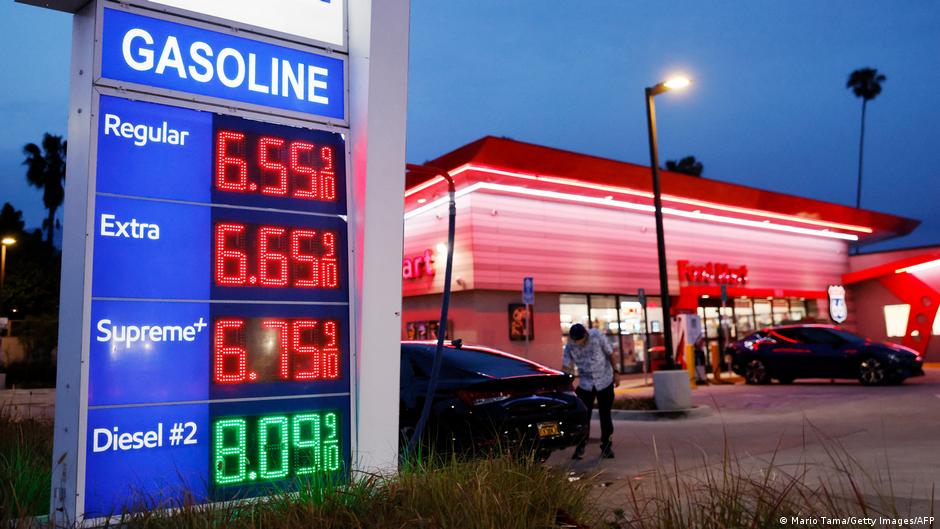
As part of its “Freedom Means More Affordable Cars” initiative, the US Department of Transportation this week rolled back fuel efficiency rules under the guise of lowering vehicle prices.
The Trump administration’s transport agency says US taxpayers will save $138 billion (€122 billion) over the next five years — new vehicles will be $1,300 cheaper on average — since automakers will no longer have to invest in more fuel-efficient fleets.
But this does not account for soaring gas prices as Middle East conflicts choke global supply.
“Any savings on the front end get eaten up and spat out by excess costs of fuel… Fuel economy standards have saved drivers hundreds of billions of dollars,” said Democratic Senator Sheldon Whitehouse from Rhode Island in a social media post.
Under the revised Corporate Average Fuel Economy (CAFE) rules, vehicle fleets only require an average fuel efficiency of about 35 miles per gallon (14.7 kilometers per liter) by 2031, down around one-third from 50 miles per gallon.
Implemented by then-President Joe Biden in 2024, the updated efficiency rules aimed to incentivize the production of low emission electric vehicles and hybrids. The US National Highway Traffic Safety Administration (NHTSA) estimates the standards would have saved 70 billion gallons (265 billion litres) of fuel over 25 years.
Meanwhile, nonprofit advocacy group the Union of Concerned Scientists (UCS) says an earlier version of CAFE regulations has saved US consumers about $321 billion at the gas pump since 2010.
Rollbacks set to increase planet-heating emissions
As the world’s biggest petrol consumer, the US burns through 20 million barrels of oil per day, which is 20% of global consumption, notes Dan Becker, director of the Safe Climate Transport Campaign at the US-based nonprofit environmental group Center for Biological Diversity.
“Transportation is the biggest consumer of that oil, making strong auto standards the most effective way to cut pollution and oil use,” Becker said in a statement.
The rules that have been diluted this week would have prevented more than 710 million metric tons of carbon dioxide emissions by 2050 — the equivalent of running 165 million gas-powered passenger vehicles for a year.
“With transportation representing nearly 28% of US greenhouse emissions, rolling back fuel economy standards is a dangerous setback for near-term climate goals,” said Ben Scott, head of Energy Demand at UK-based climate think tank Carbon Tracker.
“It risks keeping inefficient combustion engines on the road much longer than climate science demands,” he told DW.
But following President Donald Trump’s elimination of greenhouse gas emissions standards for light- and heavy-duty vehicles last year, Dave Cooke, senior vehicles analyst for the UCS Clean Transportation Program, said the rollbacks merely compound “a much more significant step backwards.”
He said the trend sends “a specific signal to automakers,” adding that “the United States is seeking to maximize oil usage to increase oil company profits.”
This will be to the detriment of climate targets, with high-polluting oil contributing one-third of global fossil fuel emissions that continue to rise — along with temperatures.
The world just had the hottest August on record as severe heatwaves in Europe caused more than 16,000 excess deaths in Germany alone.
Can US transport still transition to clean energy?
Sales of low emission EVs are down in the US in 2026, especially after Donald Trump scrapped the $7,500 tax credit for new electric vehicles.
American automakers also continue to push back against regulations that would incentivize a switch to EVs, arguing there is a lack of consumer demand.
“It’s highly unlikely that the United States will suddenly become awash in electric options when neither the auto industry nor regulators seem interested in providing such choices for consumers,” said Cooke.
But Ben Scott believes that while softening US fuel economy standards “will create temporary headwinds”, it won’t stall an inevitable transition to electric vehicles.
“With EVs delivering vastly lower running costs, electrification becomes a clear-cut economic choice,” he said of cars running on “cheaper, domestically secure energy that will drive the transition forward, regardless of short-term politics.”
As less efficient cars and trucks consume more oil that’s more expensive and in shorter supply, “the fragility of oil-dependent transport” is set to be exposed, he said.
Edited by: Tamsin Walker
