


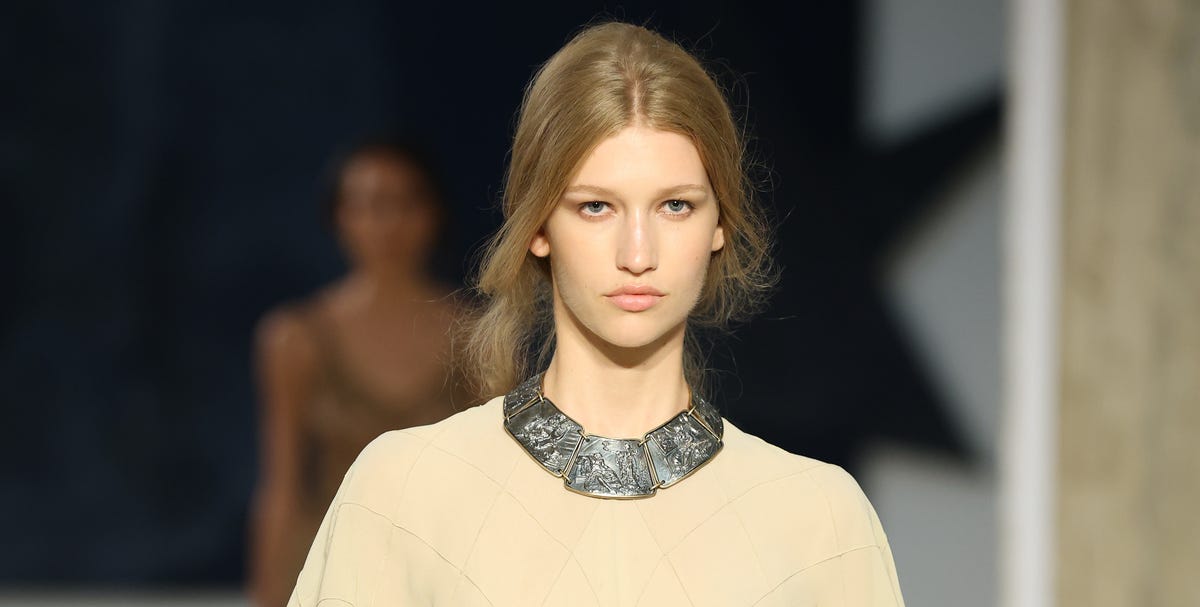
One of the defining themes of Paris Couture Week has always been restrictive: corsets that were impossibly tight and silhouettes designed to deform the body. But this week presented Maria Grazia Chiuri something completely different in Rome her Fendi Couture debut.
The collection, which was shown in the National Gallery of Modern and Contemporary Art – where the exhibition is today Aafter a Percorso di Lavoro. Fendi/Karl Lagerfeld 1985. After Steps Through Work‘ opens to the public – rejected restriction in favor of freedom.
Maria Grazia Chiuri leaves Dior after putting 10 feminist values at the heart of this fashion house >
Maria Grazia Chiuri’s Fendi Couture debut
The opening looks – two geometric caftans, one of which was worn over loose trousers – immediately announced this shift. Instead of being reformed, the body was given space to breathe and simply exist.
Text continues below the images


The first two designs are inspired by the Labyrinth toile, a winding Lagerfeld-era creation – prominently featured in the exhibition – described by Chiuri as a metaphor for the creative process. Geometric shapes accentuated the collection in both a literal and figurative way: from a kimono-like overcoat with winding black and white stripes to a little black dresswhose body was accentuated by opaque inserts.
Text continues below the image

As one of the few women at the head of a major luxury fashion house Chiuri is more interested in accentuating the female body than transforming it. The dropped waist of the silk dresses softened the silhouette, an effect further enhanced by the art deco sequins on the plunging, sheer tops and A-line dresses reminiscent of the 1920s.
Text continues below the images


Flexible and movement
Outerwear was also flexible: suits. With barely visible lapels, flowing, boudoir-style jackets and capes with high collars and feather decorations. Fendi As a fashion house, it has its characteristic elements: leatherwork, rough fabrics, the Baguette, all well represented in the front row by Sarah Jessica Parker, Jessica Alba and Danny Ramirez. But beneath all that splendor lies the humanistic approach to it women’s clothing which Chiuri has captured so aptly here.
Text continues below the image

The modern world of haute couture is often about spectacle, but at its core this art form finds its greatest expression in the intimacy between garment and wearer.
Even in the halls of a museum, Chiuri argued that fashion does not only become art when it hangs on a gallery wall. It becomes art when the clothing itself moves with you.


Matthew Velasco is fashion news editor at ELLE. Based in New York City, he previously worked as a news writer at W magazine and as an assistant editor at V magazine. Besides fashion, he enjoys interior design, tennis (both watching and playing) and a packed antique shop.
