


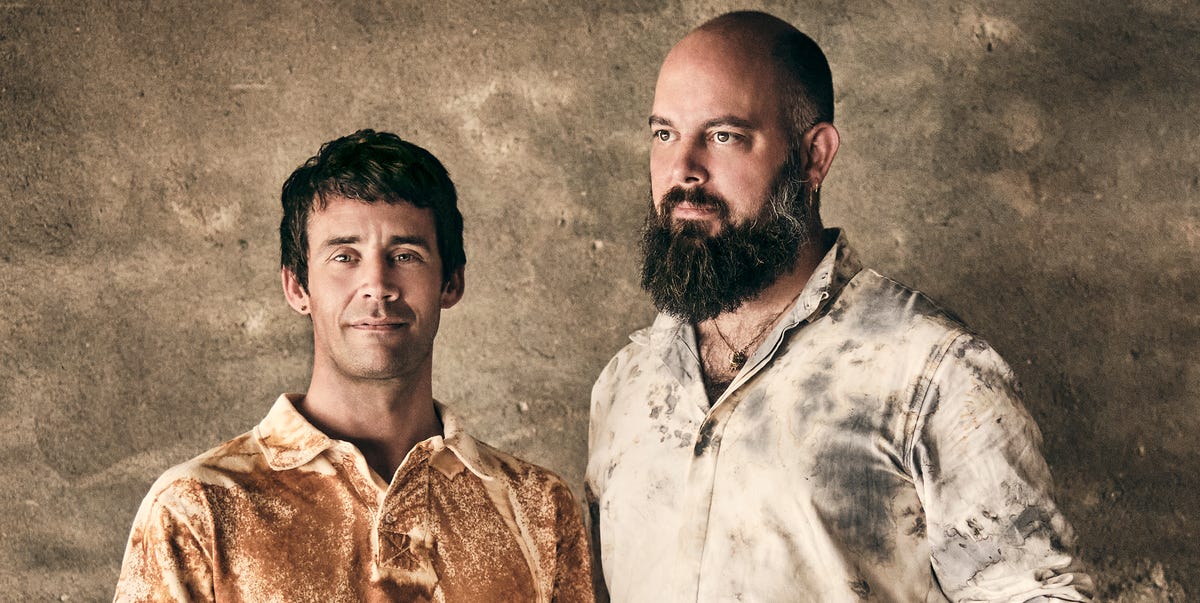
With Hul le Kes, Sjaak Hullekes and Sebastiaan Kramer show that the fashion industry can also look different, both for people and for the planet. From an old sawmill in Arnhem, the label has developed a completely local ecosystem since its start in 2018 post-consumermaterials are processed into high-end fashion, while at the same time space is created for people at a distance from the labor market and participants in recovery programs within the Hul le Kes Recovery Studio. While deadlines, margins and sales figures are central to traditional fashion companies, other values count just as heavily at Hul le Kes. ‘We don’t just count the euros,’ says Sjaak Hullekes. ‘We also count how many articles of clothing we have saved from the incinerator. We count the people we see walking out healthy again.’
Hul le Kes is one of the few fashion brands that produces completely locally. ‘We are one of the last larger studios in the Netherlands,’ says Hullekes. The fact that the clothing is made in the Netherlands is underappreciated by Dutch people. ‘In stores in Japan, the US, even in Belgium, they think it’s fantastic that it is made in the Netherlands. But Dutch stores only look at the price. Because yes, it is extremely expensive to run a brand this way.’ Yet they think it is important to produce locally. Not only to keep the CO2 footprint low, but also to retain professional knowledge. For young people who are following the vocational training course Fashion Designer or Fashion Tailor, there are few places to further learn the trade. ‘Most people end up in a curtain making studio,’ says Hullekes.
Sjaak Hullekes and Sebastiaan Kramer employ nine people permanently and have committed themselves to building a kind of family to maintain balance. Kramer: ‘Diversity is important, then you strengthen each other. That’s why we never put the same type of people on the team.’ Three years ago they hired someone who was 64. He is now retiring. ‘A very expensive force of course, but so incredibly good. She was surprised that we still wanted to hire her for those last three years.’
The text continues below the photo.

The care studio, called the Recovery Studio, currently employs 45 people who, for whatever reason, cannot participate in society – it is actually a poignant success, says Hullekes. In the care workshop they get the chance to pick themselves up again. There is no pressure to do it perfectly, no deadline stress, no focus on what they can no longer do, only on what they can. “The head goes out for a moment,” says Kramer. ‘We’re just talking about making a beautiful product.’ For example, there was someone with severe tinnitus who could barely function. ‘Partly due to the peace and regularity she gained through her work in the Recovery Studio, she is now moving on to a regular job.’
It was quite a process to obtain accreditation as a healthcare studio. It was successful, partly thanks to the background of Sjaak Hullekes, who in addition to his HAVO at the time did an MBO in Social Pedagogical Work. ‘I didn’t dare to go to art academy straight away at the time. So I thought: if I do SPW in addition to my HAVO, then at least I have that. It is actually the basic education that every person should have. As a part-time job, I have always worked with young people in assisted living institutions, young autistic people.’ Two full-time staff now work to guide the participants in the Recovery Studio, because Kramer and Hullekes are not always present and the participants need focus and attention. ‘Funny enough, the people who supervise them full-time all have a fashion background, but then switched to healthcare,’ says Kramer. ‘Every week I have an email in my inbox from someone who says, “I worked for such and such a brand for years and I was so fed up with it that I retrained. Now I really want to work for you.”’
‘Many people who say goodbye to fashion end up in healthcare,’ says Hullekes. He sees a clear connection between mental exhaustion and the fashion industry. ‘The pressure is too high. It’s not healthy to cram three seasons into one. And you also know somewhere that what you are doing is not entirely kosher.’ Kramer and Hullekes have experienced this themselves. Before they started Hul le Kes in 2018, they already had a traditional fashion career. Hullekes: ‘I was sour when we stopped. I haven’t touched anything for two years. I felt cheated by the system. I felt like I hadn’t left anything beautiful behind. You design something with five or six extra frills on it and then you have to take everything off because otherwise it becomes too expensive. Dirty tricks, they really make you sick. It’s not about creativity anymore,” he says.
So they really wanted to do things differently. Giving fashion back the value that you would give to a design object or an antique piece of furniture that you have inherited. They also did not want to be just another sustainable fashion brand that works with certified cotton and that’s it. The circular and social story really had to be right. ‘Also because we want to hold up a mirror to the rest of the field. We don’t point out, but we show that things can be done differently,” says Hullekes. Kramer: ‘Our society is like that sales driven and thus focused on standardization and perfection, which causes us to completely overlook creativity, social involvement and sustainability. What we do is ensure that our creative, social and sustainable vision and our commercial side are continuously in balance. I studied business administration and from that perspective that is the dumbest thing you can do. You should actually have one goal and go all the way for it. But we don’t want that, we want to ensure that all those things are in balance. So we also count the values that are important to us, such as helping people out of their isolation and the number of shirts we have been able to remove from the pyre.’
The clothing they save from the incinerator largely comes from local cycles, the Salvation Army and a collection location. The process works both ways; they make mood boards in advance of what they are looking for, but they also look at what comes in in large numbers, says Hullekes. ‘You see all the trends from the previous year. This year I see an alarming amount of sweat fabric and that crazy pale aubergine color.’ They also work with Yumeko, from the bedding. That brand has a return policy for bed linen that has a problem, and it sends it to Hul le Kes. They have an old sawmill in Arnhem as a workshop. ‘Everything that comes in is first washed and sorted. We have stacks of green checks, antique French fabrics in different thicknesses… Sjaak calls it his shop. We shop around to see if the stacks are big enough and we can put a design into production.”
And what do consumers ultimately gain from this circular and social approach? Kramer: ‘They initially come in because they like something. And that’s fine. But most of all we want to tell the story of a piece of clothing that someone buys. That is why every piece of clothing has its own passport containing information about the fabric, the design and who made it. And we notice that people are telling that story again. When they wear it at a party they talk about the stains in their shirt and why they are there. And that is a very important part for us. Because hopefully we will change the entire system bit by bit.’ You notice that if there is a Hul le Kes item in the closet, the rest of that closet receives the same care, says Hullekes. ‘For example, other items of clothing are also repaired more often. We woke people up for a moment.’
For their inspiring vision, Hul le Kes received the 15th Cultuurfonds Fashion Stipend last Wednesday and they are in the list of illustrious winners such as Duran Lantink (2025), Iris van Herpen (2016) and Mohamed Benchellal (2023). With this cash prize they can expand their creative vision even further. Sebastiaan Kramer: ‘For us, this stipend is not only a prize, but also an opportunity to continue building a new form of design. A form in which imperfection, humanity, craft and imagination come together. It gives us the space to work even more autonomously and artistically, without making concessions to our values.’

As Deputy Editor in Chief, Elles plots stories, monitors planning and is co-responsible for the strategy of the ELLE brand. Her favorite sections of ELLE.nl include De Rekening and Goudsmit goes for it and the sharp thinking pieces that the editors are so strong in. In the past, Elles worked as a Deputy Editor at Glamour. In terms of relaxation, she cannot do without Netflix, yoga and bouldering.
