


With a view to Spring/Summer 2027, four clear directions are emerging in men’s fashion. These directions respond to changing consumer needs and cultural shifts. The overarching themes are cross-category elements, a demand for versatility driven by price consciousness, and a growing desire for authenticity in design.
Ivy League influences and archival styles
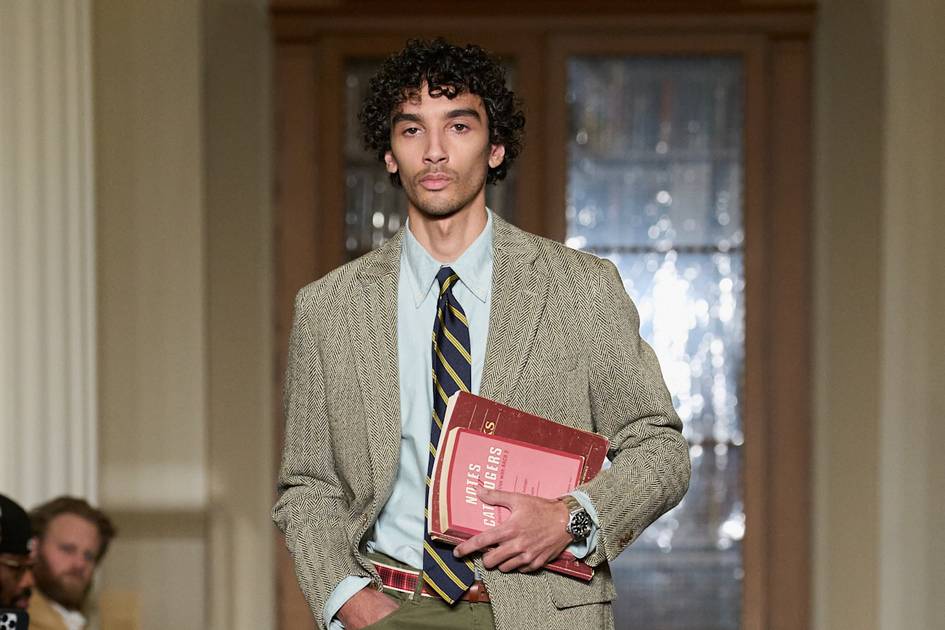
The style profiles of Gen Z and Millennial men are evolving with them. Their fashion interests are shifting from the streetwear of the late 2010s to more sophisticated, sartorial styles as they find their place in society and everyday life. This is leading to a significant revival of both heritage and archival styles. This makes semi-formal and classic custom silhouettes accessible for more wear occasions, beyond campus, the country club and the office.
Brands like Soshiotsuki and Giorgio Armani are reviving the ‘power suit’ silhouettes of the 1980s and 1990s, with draped shirts and flowy trousers. Armani even launched a special archive capsule collection, a reissue full of elegant tailoring of their iconic looks from 1979 to 1994. Ralph Lauren’s return to the catwalk after more than two decades was a celebration of playful primary color blocking, knitted varsity cardigans and classic straight-leg jeans. The Ivy League influences are also visible at J. Press. Their NYFW runway debut was a tribute to “Take Ivy,” a 1965 lookbook showcasing the original American Ivy League style, photographed by Teruyoshi Hayashida. Iconic sports jackets, varsity jackets and polos get an update with more modern fits and layering, contemporary adaptations of heritage patterns and highly saturated colors. This creates a mix of familiar forms and progressive reinterpretations.
Commercial transitions
Due to the growing demand for high-quality design that conveys authenticity, community and the celebration of diverse subcultures or backgrounds, several sectors are in a transition phase. Streetwear, fast fashion and even luxury brands are trying to reconnect with a commercial audience that still shops price-consciously.
Willy Chavarria’s move to the Parisian catwalks brought his ethnic and culturally driven storytelling to a global stage. He reintroduced a mix of contemporary design elements into streetwear classics that feel truly authentic. Baggy, oversized jeans, draped tracksuits and sweaters with dropped shoulder seams feel more like everyday garments than other ready-to-wear collections, which appeals to a wider audience. Chavarria’s recent Vatísimo collaboration with retail giant Zara also signals a significant shift. Fast fashion labels are trying to break through into higher segments with the support of established design talent. The Spanish brand seems to be fully committed to this with the appointment of John Galliano as creative director, a similar step to the appointment of Zac Posen at Gap.
Even established luxury brands like Gucci are experimenting with shifting their image to a more commercial basis. Reactions have been mixed to their runway models and styling, which target younger internet personalities and celebrities in sagging leather pants, cross-body bags and shiny coated denim.
Dramatic romantic silhouettes
Jonathan Anderson’s stint at Dior continues to receive positive attention for bringing back dramatically romantic, historic silhouettes. While functionality, affordability and portability remain key drivers for SS27, there is also room for premium, authentic artistic expressions. These are in line with consumers’ increasing need to gain satisfaction from hobbies, passions and other interests outside of work. This supports brands that unashamedly choose a passionate, expressive approach. Between the revival of Dior Men’s iconic, modernized Bar Jacket silhouette, AMI Paris’ romantic bow-tie shirts and Celine’s sport jackets with royal gold buttons, a middle ground emerges between avant-garde and existing maximalist trends.
Market-level brands are already starting to interpret more romantic and theatrical design elements. This is again visible in Willy Chavarria’s Vatísimo collection for Zara, which features all-white double-breasted suits with peak lapels, voluminous silhouettes and an accompanying short film. In a similar way, GapStudio’s shirts with decorative ribbons and denim blazer with decorative buttons take basics to the next level.
Multifunctional wardrobe
Rising prices and brands that emphasize quality or natural materials are making the average consumer more aware of the basic components and concepts of design. This leads to a superficial discussion online about the negative view of polyester, the lifespan of products and the practicality or versatility of clothing. Wider cultural and lifestyle changes are also taking place. More people are returning to the office, further blurring the already blurred boundaries between work and home. The focus shifts from career to fulfillment from community or leisure activities. Due to a more cautious consumer and a desire to maintain comfortable casual clothing, men are less willing to maintain two separate wardrobes: one for work and one for play. This brings relaxed and effortless holiday style to more wearing moments.
Isabel Marant’s bone-colored, unstructured suits and rounded bomber jackets show how traditional silhouettes can be made holiday-ready. Ziggy Chen goes one step further with comfortable suits, trousers and shirts made of cotton, linen and hemp, promoting the use of natural materials. Kartik Research uses worldly vegetable dyes, embroidered flowers and handloom production methods without electricity. This results in well-cut, easy-to-style heirlooms. More accessible brands like Our Legacy or Banana Republic are following suit. They present effortlessly flowing silhouettes in rich, subdued neutrals or sun-drenched holiday palettes, applied to a wide range of cotton and linen suits, custom drawstring trousers and shirts.
Men’s fashion is entering an era of more nuance. Themes are chosen that challenge current trends to make contact with consumers on a deeper level than just visual contact. Cultural influences from outside the design studio herald a new wave. This wave includes the reintroduction of archives, a return to authentic, experience-based streetwear, premium romantic heritage silhouettes and cross-category versatility, in response to the infeasibility of occasion-specific wardrobes.
This article has been translated into Dutch using an AI tool.
FashionUnited uses AI language tools to speed up the translation of (news) articles and proofread the translations to improve the end result. This saves our human journalists time that they can spend on research and writing their own articles. Articles translated using AI are checked and edited by a human desk editor before going online. If you have any questions or comments about this process, please email info@fashionunited.com.
