


Britain is “firmly on track” to meet its clean power targets for 2030, according to the government following a record offshore wind auction.
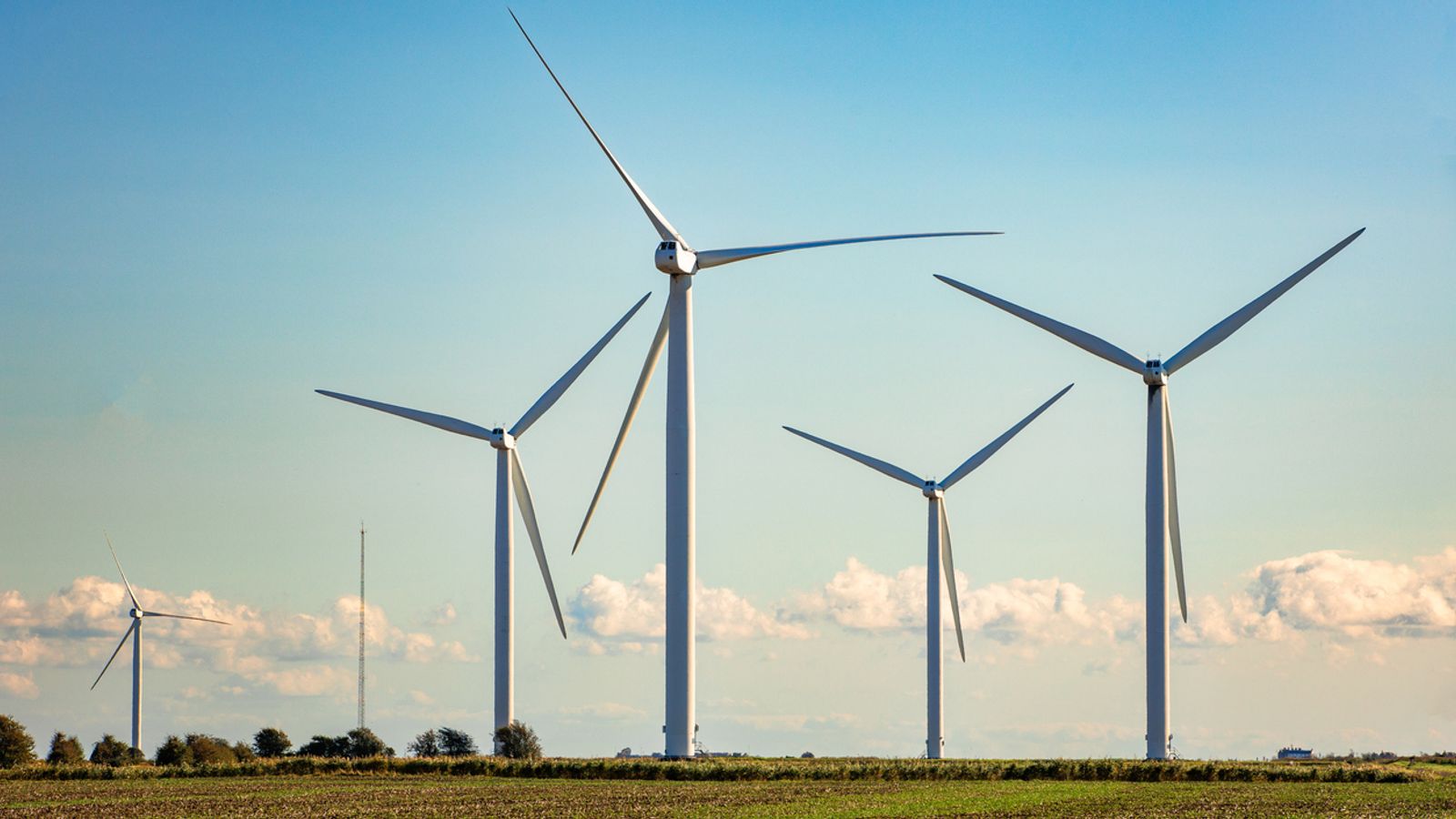
It has awarded contracts to supply 8.4 gigawatts (GW) of new offshore wind power – enough to power 12 million homes.
The auction is part of efforts to ease the country away from volatile and polluting natural gas, but the strike price of £90.91 represents an increase of 11% on contracts agreed last year.
The target of a clean power grid by 2030 requires at least 43GW of operational offshore wind but the price increase will stoke political debate over the rising costs of renewables and the economic impact of high energy prices.
Money latest: The problem with supermarket honey
Energy Secretary Ed Miliband welcomed the results and said they would help reduce the UK’s exposure to volatile fossil fuel prices, specifically gas, which triggered the energy bill shock following Russia’s invasion of Ukraine.
“With these results, Britain is taking back control of our energy sovereignty”, he said.
“This is a historic win for those who want Britain to stand on our own two feet, controlling our own energy rather than depending on markets controlled by petrostates and dictators.
“It is a monumental step towards clean power by 2030 and the price secured in this auction is 40% lower than the alternative cost of building and operating a new gas plant.
“Clean, homegrown, power is the right choice for this country to bring down bills for good and this auction will create thousands of jobs throughout Britain.”
His Conservative opposite number, Claire Coutinho, accused the government of an energy smokescreen.
She responded: “Labour promised to cut people’s energy bills by £300, but Ed Miliband has just locked every family in Britain into higher energy bills for decades.
“These are the highest prices for offshore wind in a decade and higher than the current cost of electricity. If you think your bills are too high, this won’t make them any lower.
“Bills are now almost £200 higher than when Labour came to power and Ed Miliband is cementing our uncompetitive electricity prices for even longer at a time when the world is becoming more unstable and we need cheap, reliable energy to compete.”
The government said that every region of the country would benefit from the £22bn of private investment secured through the so-called Contracts for Difference (CfD) – a mechanism designed to give developers certainty and protect consumers from price fluctuations.
A total of 7,000 jobs were secured from the result, ministers said.
In a CfD auction, generators bid to provide a certain amount of capacity, with the lowest bids awarded contracts at what’s called the strike price, which sets a floor for developers and a ceiling for consumers.
Generators are guaranteed to receive the strike price for every megawatt hour (MWh) of power they produce when they sell it into the electricity market, underwritten by bill payers, but it also acts as a maximum that consumers can pay for the same megawatt hour.
If the market price of electricity falls below the strike price, the government’s Low Carbon Contracts Company pays generators the difference. If the market price is higher than the strike price, the generator pays the difference back.
The government sets a budget for the amount it is willing to pay in CfD “top-ups”, ultimately funded from consumer bills and in this round, the Department for Energy Security and Net Zero initially set aside £900m.
The contract length in this auction round was also extended from 15 years to 20 years in order to make it more attractive to bidders.
Rising prices
Offshore wind is the engine room of Britain’s renewable power but the price the government has had to offer developers has risen steeply in the last three annual auction rounds.
After securing strike prices as low as £51 MWh in 2021, the cost of securing new wind capacity has risen steadily, driven up by inflation, commodity prices and the rising cost of financing huge offshore construction projects.
In 2022, the then Conservative government set the effective reserve price too low and received no viable bids. In the last auction round, strike prices had reached £82.
The UK has 16.6GW of operational offshore wind capacity, with a further 11.7GW under construction, meaning at least another 14.7GW has to come online by 2030 to hit its target.
Many analysts and observers believe the wider goal of delivering 95% of power from low-carbon sources by 2030 is highly ambitious and could drive up costs. The UK currently has the highest industrial energy prices in Europe and the second-highest domestic bills behind Germany.
Politically charged
The issue has become politically charged, with the Conservatives saying the auction will lock consumers into higher energy bills into the 2040s, and Reform UK warning power companies they will not honour the contracts awarded today.
Both are likely to point to the fact that today’s auction sets the price of offshore wind power above the average wholesale price of electricity last year, of £83.
Energy UK, the industry body that represents companies in all forms of power generation, says the figures are not directly comparable because the wholesale price accounts only for existing power capacity, rather than the cost of building new capacity.
They also point to the downward pressure on wholesale prices of renewables as they reduce the UK’s exposure to gas, which sets the market price the majority of the time in the UK system.
Independent analysts Aurora calculate that a strike price of £94MWh for new wind capacity would be neutral for consumers, with the increase in CfD top-up payments offset by the reduction in wholesale prices.
The Energy and Climate Intelligence Unit calculated that wholesale prices were around 30% lower in 2025 because of the dampening impact of wind capacity on the market.
