


When you move house in Germany, you need to register your new address with the authorities. That often means calling city hall, waiting weeks for an appointment, and showing up in person with paper forms.
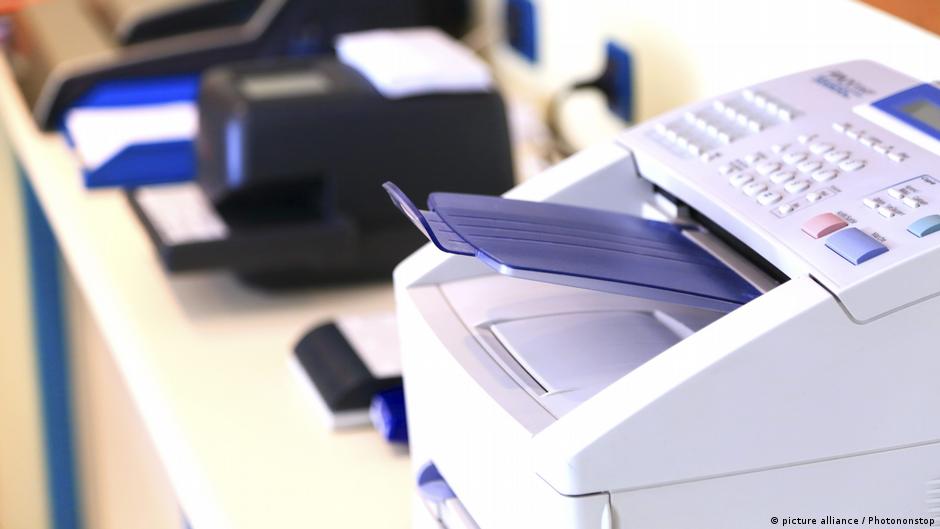
Yes, in 2025! And if you forget your health insurance card at the doctors? Some apps can help — by sending a fax.
“Around three-quarters, 77%, of German companies still use fax machines,” Felix Lesner from Bitkom, Germany’s IT industry association, told DW. “And 25% use it often or very often.”
Why? “Most of the companies state that it’s essential for communication with the public authorities,” Lesner said. “So maybe this is where the problem lies.”
Falling behind
The European Union regularly publishes rankings of digital development among member states, with Germany performing somewhere in the middle of the 27-nation bloc — at best. When it comes to e-government, meaning digital public services, the country lags especially behind.
A study by CapGemini, a consultancy, ranks Germany 24th within the European Union.
German engineers invented the programmable computer, the SIM card and MP3 technology. Yet registering a car or getting a marriage license still means standing in line.
Frank Reinartz, head of the Digital Agency company in Düsseldorf, told DW that Germany doesn’t have an issue with strategy or targets: “We have an issue with getting things done.”
Düsseldorf, a city of about 650.000 people, offers 120 administrative services online out of 580 — just over 20%. And yet, Düsseldorf is considered digitally advanced and ranks in sixth place in the Smart City Index compiled by Bitkom and measuring digital services in German cities. Berlin, the country’s capital, had difficulties makeing it into the Top 40.
‘Institutional inflation’
Germany’s federal government structure, with 16 states, often leaves communities to figure out their own solutions.
“We don’t have much software and processes coming from the federal [state] level,” Reinartz said. “Each city has to find their own solution for a process which is nationwide, for example, car registration.”
Add to this a lack of coordination and what researcher Stefanie Köhl calls “institutional inflation.”
Köhl and her colleagues at SHI Institute in Berlin examined why digital public services didn’t really take off in Germany in the past 25 years.
“Everybody does something, but only in his or her silo,” Köhl told DW. “There’s no connection between solutions, sometimes also no compatibility between technologies.”
Reinartz’s Digital Agency was set up to avoid this. His vision for Düsseldorf’s digital future centers on a website that allows residents access to every public service online.
“You log in and see your building tax, if you are the owner, the kindergarten for your kids, and the parking permit for your car,” Reinartz said.
Denmark: Digital wonderland
While Germany debates, Denmark delivers. Germany’s northern neighbor has turned Reinartz’s vision into reality long ago.
“The website Borger.dk is a one-stop-shop where all citizens have access to more than 2,000 public services on a digital platform,” said Jakob Frier of Digital Hub Denmark in Copenhagen.
Almost everything — from taxes to health care — is online. The key is a mandatory digital ID or eID, Adam Lebech, deputy director-general of Denmark’s Agency for Digital Government, told DW.
“About 97% of the adult population have eID,” Lebech said. “And 83% use it at least once a week.”
The digital foundation of Denmark’s system is a single identification number called Central Person Register (CPR), which the country introduced in 1968.
“Since we use the same identifier for all systems, it makes data sharing easy,” Lebech said. “That means we can create seamless services across several authorities. You have to trust the government, of course.”
Though regular surveys show the majority of Danes trust their government, Germans are far more skeptical about state-run centralized data gathering because of their country’s Nazi and East German Communist past.
Both, Hitler’s Third Reich and East Germany’s Communist party used personal data to spy on people and control their lives.
How India leapfrogs developments
India has shown that it is possible to make big strides in developing digital services, establishing its own electronic ID system, called Aadhaar, within just 15 years. Some 99.9% the Indian population use Aadhaar, official government data says.
Meanwhile, Aadhaar is linked to a digital payment platform called Unified Payment Interface that even street vendors selling coconuts at roadside stalls accept as payment method. Customers simply transfer the money via a QR-code and a mobile-phone app.
Tej Paul Bhatla, of India’s largest IT company, TCS, told DW that Aadhaar and UPI are “foundational systems” that were developed with support from the state but also funding from the private sector.
Right from the beginning, Aadhaar and UPI were planned as open-source systems for private and public usage, he said, similar to public infrastructure.
“When you build railroads or highways or ports, you make them available for everybody,” Bhatla said. He added that this has allowed private-sector initiatives to use these systems to “build larger services for citizens and businesses, and take advantage of these.”
Bhatla said digital infrastructure was India’s chance to speed up progress so that today “almost 80% of the adult population has bank accounts.” Without Aadhaar and UPI, he said, “it would have taken us 48 years to reach the bank account penetration that we have today.”
Better digital infrastructure and an ecosystem of digital services could also spark economic growth in countries such as Germany, Bhatla said.
“If you don’t grow, you will definitely see threats coming in from other economies,” Bhatla said, “and life is going to become harder.”
Edited by: Uwe Hessler
Want the full story? Listen to DW’s new podcast series: Delayland: Germany and the Missing Magic
Also on Apple Podcasts, Spotify, Youtube or wherever else you get your podcasts.
