


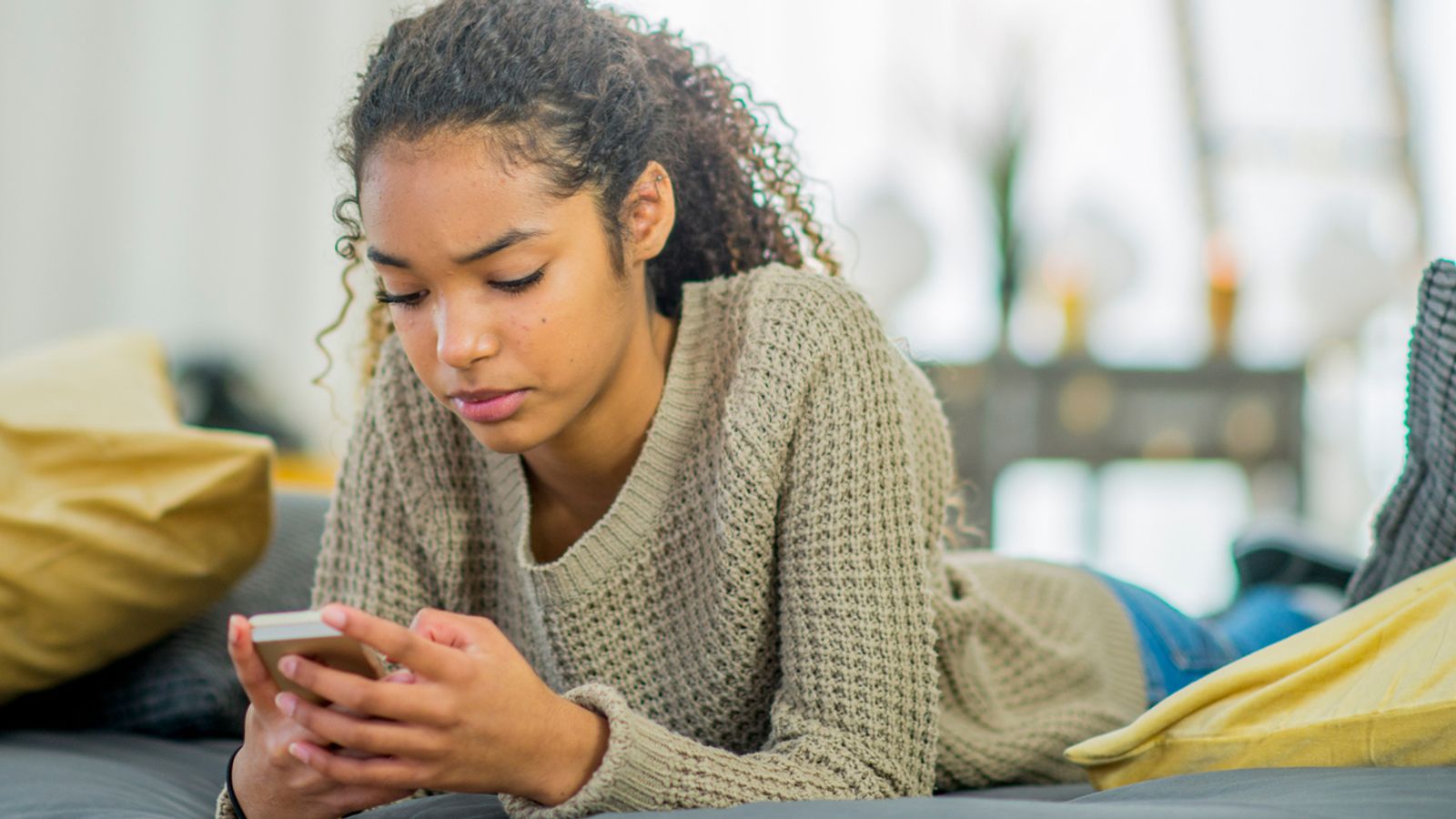
Ministers are consulting on banning social media for under-16s in the UK – just weeks after a ban in Australia came into force.
The government’s consultation will look at various options, including increasing the digital age of consent and restricting potentially addictive app design features such as “streaks” and “infinite scrolling”.
There have been growing calls for Sir Keir Starmer to take action, and the announcement comes ahead of the Lords voting on a Conservative amendment to Labour’s Children’s Wellbeing and Schools Bill, which would force social media platforms to stop under-16s from using their platforms within a year of it passing.
The Department for Science, Innovation and Technology (DSIT) said it will also be taking immediate action on children’s social media use.
This would include directing media regulator Ofsted to examine schools’ mobile phone policies and how effectively they are put into practice during inspections.
The government will also produce screen time guidance for parents of children aged between five and 16. It said guidance for parents of under-fives will be published in April.
The government will seek views from parents and young people and it will respond in the summer.
An Australian inspiration?
Ministers will visit Australia as part of the consultation.
A social media ban for under-16s was implemented there in December. Ten of the biggest social media platforms in Australia were ordered to bring in the ban or face fines of up to AU$49.5m (£25m).
The companies were required to find ways to close existing accounts for under-16s and prevent new ones from being created.
The law is designed to protect children from potential mental health risks, inappropriate content and cyber-bullying.
Which platforms are affected by ban in Australia?
The age-restricted platforms include:
• Facebook
• Instagram
• Snapchat
• Threads
• TikTok
• Twitch
• X
• YouTube
• Kick
More generally, age restrictions apply to social media platforms that meet three specific conditions, unless the Australian government determines they should be excluded.
The conditions are:
• The sole purpose, or a significant purpose, of the service is to enable online social interaction between two or more users
• The service allows users to link to, or interact with, some or all of the other end-users
• The service allows users to post material on the service
Platforms are responsible for determining whether they fit the criteria and doing their own legal assessments.
Which apps are not age-restricted?
Australia’s eSafety Commission has said the following platforms will not be age-restricted:
• Discord
• GitHub
• Google Classroom
• LEGO play
• Messenger
• Pinterest
• Roblox
• Steam and Steam Chat
• WhatsApp
• YouTube Kids
But the Australian government has indicated the list could change as new products are launched, and young users switch to alternatives.
Teenager. File image: iStock
How do social media companies comply with ban?
Australia’s Online Safety Amendment Act 2024 requires companies to take “reasonable steps” to prevent underage users from signing up and using their platform; they could face fines of up to $49.5m (£25m) for failing to comply.
Of the initial 10 banned platforms, all but Elon Musk’s X have said they will comply using age inference. This involves guessing a person’s age from their online activity – or age estimation, which is usually based on a selfie.
They may also check with uploaded identification documents or linked bank account details.
But the Australian government has said requesting ID cannot be the only method to determine someone’s age.
Meta – the owner of Facebook, Instagram, and Threads – said in submissions to the Australian government last year that the legislation was “a missed opportunity and overlooks the practical reality of age assurance technology as well as the views of a majority of mental health and youth safety organisations in the country”.
The company, chaired by Mark Zuckerberg, began to exclude suspected young children from its platforms a week before the ban was implemented, but previously admitted that it expects issues with its technology, which could result in accounts belonging to people who are actually over 16 accidentally being shut down.
TikTok said it will have a “multi-layered approach to age assurance,” while Snapchat will use behavioural signals for age estimations.
Is the move controversial?
Prior to the passing of the ban in Australia’s parliament last year, more than 140 national and international academics with expertise in fields related to technology and child welfare signed an open letter to Prime Minister Anthony Albanese opposing a social media age limit as “too blunt an instrument to address risks effectively”.
In Sydney, two 15-year-olds have sued the Australian government over the ban.
One of the claimants, Noah Jones, who turns 16 in August, has argued the ban will deny 2.6 million young Australians of a right to freedom of political communication implied in Australia’s constitution.
As Meta did in its submissions to the Australian government, several other platforms also hit out at the move.
Google and YouTube Australia’s public policy senior manager, Rachel Lord, said the site will automatically sign out users who are deemed to be under 16.
But, she said, they can still view some YouTube videos while signed out, and parents will “lose their ability to supervise their teen or tween’s account” and use controls such as blocking channels.
In response, Australia’s communications minister Anika Wells said it was “outright weird that YouTube is always at pains to remind us all how unsafe their platform is in a logged out state”.
What have people said about possible UK ban?
Esther Ghey, whose daughter Brianna was murdered at the age of 16 by two other teenagers in 2023, said a ban would be “a vital step in protecting children online”.
In a letter to party leaders Sir Keir Starmer, Kemi Badenoch and Sir Ed Davey, Ms Ghey said her daughter had had a “social media addiction” and “desperately wanted to be TikTok famous”, putting her “in constant fear about who Brianna might be speaking to online”.
Ms Badenoch has already said the Conservative Party would introduce a ban for under-16s if it was in power.
The Tory leader said the consultation was “more dither and delay” from Labour.
Paul Whiteman, general secretary at school leaders’ union the NAHT, said: “It’s important that we learn from other countries and consider the unintended consequences as well as the advantages of such an approach.”
But he added: “The vast majority of schools already have restrictions on the use of mobile phones on school sites.
“The government’s suggestion that Ofsted should be ‘policing’ school policies is deeply unhelpful and misguided. School leaders need support from government, not the threat of heavy-handed inspection.”
Chris Sherwood, chief executive at the NSPCC, also welcomed the government consultation, saying tech companies “have prioritised profit over children’s safety”.
“Taking forward measures to ensure products are safe by design would be a vital step in redressing that balance,” he added.
