


Jeans brand Kuyichi was founded in 2001 by Solidaridad, Triodos Bank, Stichting Stimulans and Oro Blanco, a collective of Peruvian cotton farmers that no longer exists. They had a clear goal: to make organic and fair trade cotton the standard.
The brand grew into a forerunner in sustainable denim, but got stuck in 2015 due to high overhead costs, opening its own stores too early and changing leadership. Bankruptcy followed, but also a restart. Sales director Peter Schuitema took over the brand together with partners Floortje Dessing and Guido Keff. Later, Laurent Safi (Product manager) and Bjorn Baars (Brand Director) also acquired a share in the company.
In the run-up to the anniversary, FashionUnited visited Vleuten for a conversation with Bjorn Baars. To look back and forward. Because after 25 years you are actually no longer a pioneer. What should happen next for the quintessential Dutch denim brand?
Humble restart
Small but nice describes team Kuyichi’s office space well: the location just outside Utrecht, the modest size, the homely furnishings. It is an upgrade, says Baars, pointing to the years after the restart in which work had to be done from Schuitema’s attic. They assessed the first denim prototypes in the backyard. “In the second year we had a mini-building in Amsterdam where it was almost impossible to hold meetings due to the size and acoustics.” That was eight years ago now.
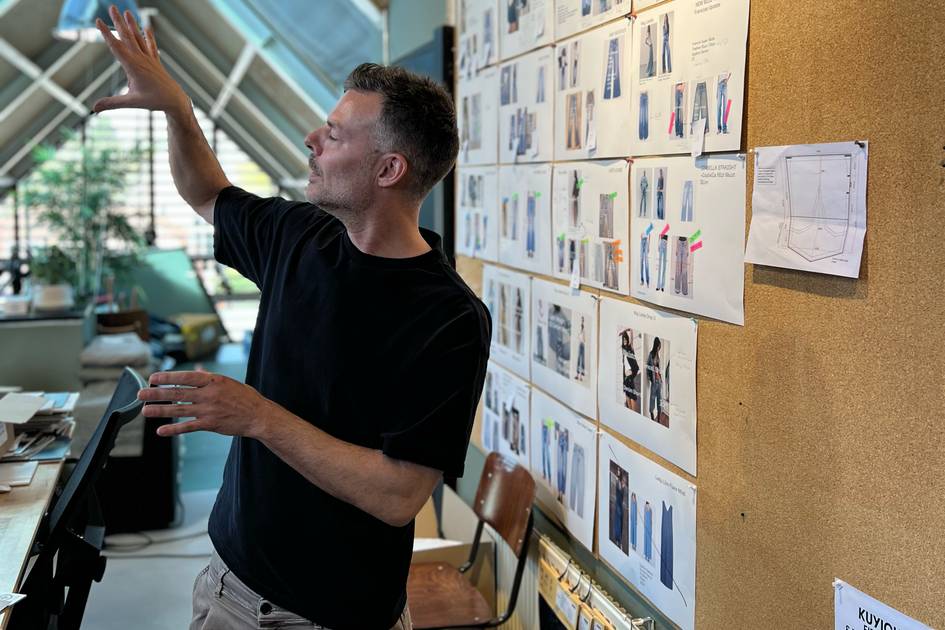
Baars takes us upstairs, where a leather sofa stands among the mood boards, houseplants and archival designs on clothing racks. He is busy reflecting on what exactly has happened in twenty-five years; he was there for almost all those years, first as sales manager, after the takeover as designer and now as brand director. “For our anniversary, I’m digging up the most remarkable designs,” he says, caressing a pair of trouser legs. “How they were made and what they stood for; what innovations we had to make. Much of what hangs here is now too outspoken and also too time-consuming and expensive – that no longer works.”
Organic cotton
Kuyichi’s story starts with the plans of Solidaridad, the foundation behind the Max Havelaar quality mark, to scale up organic cotton from Peru and pay farmers a fair wage for it. “Solidaridad went to Lima in 1998 to see what was going on in the cotton industry. They saw how heavy the use of pesticides was, how unhealthy for the farmers and the soil, how much water was used. The country was literally dying; I later saw shocking videos of that.” The foundation wanted to support those cotton farmers to work pesticide-free, for a fair wage and without intermediaries. “It was not certified fair trade, but they did work according to those principles.”
Only: no brand wanted to purchase organic cotton. “Organic cotton was not yet a trend and it was more expensive,” says Baars. Meanwhile, the better denim brands were blown away by cheap fast fashion chains, which bought cotton from unsustainable growers and had it made into jeans in low-wage countries with a lot of synthetic stretch. That did not do justice to either the makers or the sector, Solidaridad felt. Let’s do it ourselves, they thought. Fortunately, the right people were recruited, including Tony Tonnaer (later founder of Kings of Indigo), Peter Schuitema as sales director and designer Jason Denham.
The first collection consisted of T-shirts made of organic cotton; the first organic cotton jeans followed in 2004. “Since then, we have continued to experiment to make it even more sustainable with spare denims, recycled cotton, hemp cotton. It was pioneering, and sometimes it still is.”
The premium middle ground
In 2007, a Pure Premium line was introduced, a kind of laboratory for sustainable innovation, but it was eventually discontinued. “That was a line with expensive Japanese fabrics, selvedge denim, trousers from 250 to 550 euros. We were at the (former Berlin, ed.) Bread & Butter fair with all those trousers on a jet-black background. Everyone was impressed, we were literally the talk of the town, but they could not be sold.”
“We knew the looks could work, but they had to be more accessible. Now those design elements are in our regular collection.” This year, Kuyichi is also bringing back the premium piece, “but much more limited, and with the lesson of that time in mind: we don’t make a living from this.”
Organic with a huge footprint
Producing trousers that are too beautiful was one of the stumbling blocks that Kuyichi fell over in 2015. “Several things went wrong,” says Baars. “The overhead was far too high. Thirty people in the office, a large marketing budget, brochures, we knew no boundaries. We had shareholders who were not involved in the brand, but appointed three different CEOs in two years, which resulted in completely different collections. When we started opening expensive stores on top of that, things really went wrong.”
Kuyichi had to learn to be more commercial. After the takeover, the brand focused on Never Out of Stock (NOOS) and smaller collections using exclusively GOTS-certified cotton. The production chain was re-established in Turkey: cultivation, production, washings, trimmings, labels and packaging. Every step had to be certified. According to Baars, this has greatly reduced the footprint. Fortunately, because something about the old production chain bothered him: “The cotton came from Peru, it had to go to Turkey for the certified factory, and the laundry was somewhere else. At the bottom of the line you had organic jeans with a gigantic footprint.”
Cotton in conversion
One successful project that has emerged from that course is supporting cotton conversion, together with Bossa, Kuyichi’s largest fabric supplier. “The idea was to guide a cotton farmer in Turkey in the transition to organic cotton. That takes three years, because the soil has to be really clean before you can call it organic. There are no subsidies for this in Turkey, so it is scary for farmers to take that step.”
“Together with Bossa, we helped such a farmer: Cengiz Karadeli. He has now switched completely to organic and his successful harvest is available in several styles from the collection. We would like to expand to the next farmer.”
Circular denim
Another successful innovation is 100 percent post-consumer recycled (PCR) denim. “We finally succeeded in 2023, together with Bossa. We already had a variant with 20 percent PCR denim. The technical problem was in the warp: it has to be strong and for that you need long fibers. Recycled denim almost always produces shorter fibers.
Bossa managed to adapt the spinning technique. The short fibers are twisted in such a way that the yarns can still be strong and heavy.” The result: the Izabella Old Blue for women and Scott Old Fashion Blue for men, which has already sold out and is being replaced by a new model. There is also a baggy variant for women, Lucy Loose Atlantic Ocean. “That is currently our best-selling model.”
Sale
What didn’t work: never participating in the sale again. Much of Kuyichi’s offering consists of basics. “Why would such a product suddenly become less valuable after a season?”, thought Baars. Retailers were also happy with the no-sale policy. “There is nothing more annoying than losing margin because a brand goes on sale on its own website two months after delivery. “You could always reorder our collection for a fair price.” There was only one problem: Kuyichi didn’t have his own outlet channel. What was not sold accumulated. Since 2026, Kuyichi’s denims have also been on sale.
Baars thinks it’s a shame. “In any case, we have succeeded in structuring the collection in such a way that we are reasonably clean at the end of the season: 70 percent is NOOS, and of seasonal items we only produce what has already been pre-sold and what will be in the webshop.”
Blowjob action
During the reconstruction period there was hardly any budget for marketing. Now that the brand has started up again, that has to come back, says Baars – and he mentions a very direct campaign that was very popular at the time: ‘Blowjob 10 euros’, devised by an Amsterdam PR agency. “That was a recycling campaign where people could hand in their old jeans in exchange for a 10 euro deposit. We had a workplace in the Amsterdam Red Light District with people on sewing machines and with scissors. The idea: the legs of a jeans are easier to recycle than the top, because that contains all those trimmings and metal parts. You throw the legs into a shredder and then turn them into new trousers.”
The campaign generated a lot of press attention. “Precisely because it was so direct,” thinks Baars, with some doubt as to whether it would still work that way today. “If you communicate something like this in a good way, no one will notice it.”
Regenerative cotton
For Baars, the way forward for Kuyichi starts with the term ‘regenerative’; that you do not exhaust the soil for cotton cultivation and allow the ecosystem to recover. Then life can emerge again in the soil and the land will become resilient if the weather becomes more extreme. Currently, around 30 percent of Kuyichi’s offering consists of regenerative cotton – it is also certified, which is a requirement for Kuyichi’s German customers.
“The direction I see for Kuyichi is a blend of regenerative cotton and 100 percent PCR denim, with GOTS supplementing where necessary. And we want to close the loop: collect, repair, upcycle. We already work with Mended for our repair service, but ultimately we want to take that into our own hands.”
The dream of having your own shop in Amsterdam is also cautiously alive again. “Small and cozy, not a large flagship store like before, with the intention to tell our story and as a service point for the customer.”
K25
If Baars has to point to one pair of pants that shows where Kuyichi should go, it is the K25. It is a reinterpretation of the very first trousers that Jason Denham designed for the brand: the K100. “Back then, those pants were already very trendy, and now Y2K style is back. Now is the perfect time to bring them back.”
The pants are made of unwashed, 100 percent regenerative cotton and selvedge woven in the Japanese way. Actually it is a fairly simple, solid model. That’s what the market is looking for. “I have the most sustainable pants I can think of here,” says Baars.
Storytelling
Where is there still work to be done? “The storytelling”. But marketing is expensive, says Baars. “Our CSR manager once said: the big difference between fast fashion and slow fashion brands is that the former have huge margins and focus on marketing and storytelling. Sustainable brands put all their money into sustainable entrepreneurship and at the end of the day don’t have much left for storytelling. We have very reasonably priced pants and yet our margin is still not high enough to get our story out.”
“But: we work almost entirely with our own money, we hardly have any loans. As a company, Kuyichi is finally healthy. In fact, our core jeans should also cost 150 euros. They are all premium products when you consider where they come from and how they are made. That is the whole truth of honest production.”
