


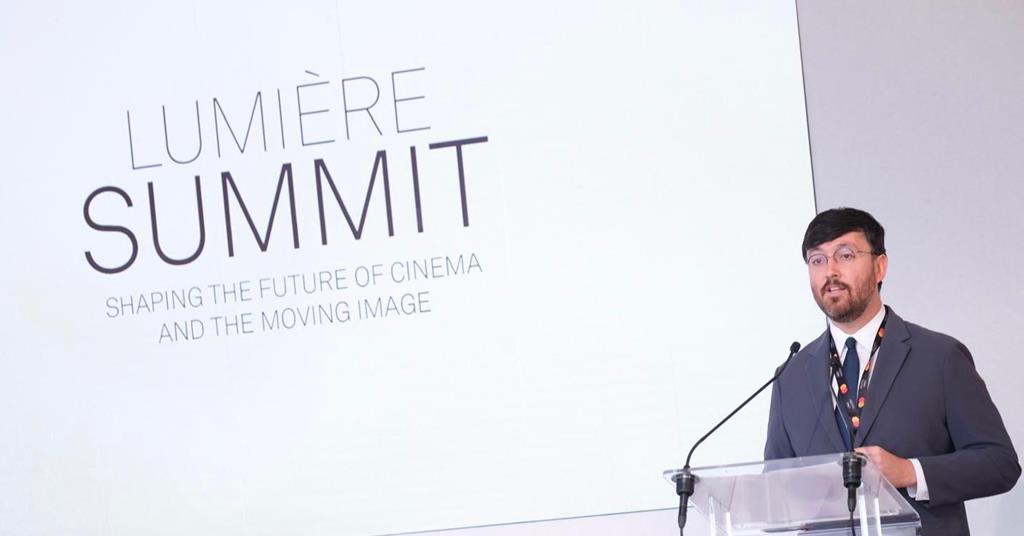
EXCLUSIVE: Warsaw is being “seriously considered” as the location of a second edition of the Lumière Summit, possibly to be held in late summer 2027, France’s CNC and the Polish Film Institute have confirmed.
A second edition in the Polish capital would continue the conversations that began at the first Lumière Summit in the south of France in September, co-chaired by French president Emmanuel Macron and South Korean president Lee Jae-myung. The event saw around 200 key figures from the film, audiovisual and video game sectors come together with political decision-makers and creative talents to discuss the challenges and opportunities for the future of cinema and the moving image.
The Polish Film Institute would drive this second edition for which no further details have yet been decided.
A follow-up conference, In The Light of the Lumière Summit, was held during last week’s Warsaw International Film Festival to discuss new opportunities for Polish-French and European co-productions. The CNC’s deputy general Olivier Henrard and the fund’s head of international affairs Jérémie Kessler were in attendance, along with the French ambassador to Poland Étuenne de Poncins and Poland’s minister of culture and national heritage Marta Cienkowska.
“We already have a long tradition of cooperation between France and Poland with 20 co-productions in the last 10 years,” Henrard said during a discussion with Polish producer Dariusz Jablonski, the president of the Polish Film Academy
These have recently included films such as Agnieszka Holland’s Green Border, Michal Marczak’s documentary Closure, Anne Fontaine’s Les Innocentes and Pierre Le Gall’s queer romance Flesh And Fuel.
Closer links
The conversations around the second Summit illustrate the desire to forge closer links between Polish and French filmmakers. Henrard suggested the Summit programme might provide the setting for a discussion on whether the joint German-French Minitraité co-production fund could be used as the model for a similar arrangement to be created between France and Poland.
It could also include pitching sessions of new projects by French, German and Polish producers looking for co-production partners.
Meanwhile, culture minister Cienkowska underlined how further cooperation between the French and Polish film industries is set to benefit from the staging of the ’Poland-France 2027 Season’ which will run simultaneously in both countries, promoting collaboration between cultural communities, institutions, organisations and creators.
“I want 2027 to be remembered for the beginning of new partnerships,” she said. “The best co-productions are not simply about financial agreements, but about taking creative risks and creating something that wouldn’t have existed otherwise. This is the kind of cooperation I want to encourage.”
Furthermore, an association agreement to see greater cooperation between Poland and France was signed by ARTE president Heike Hempel and Polish broadcaster TVP’s director-general Tomasz Sygut at the end of the Warsaw conference. It will come into effect at the beginning of 2027.
The agreement will cover three strands: co-production with a particular interest in documentaries and support of younger and smaller production companies; the exchange of programmes such as TVP’s long- running Television Theatre; and the expansion of its role as a media partner of film festivals.
“This agreement opens up new opportunities for co-productions and closer cooperation between filmmakers, producers and creative teams in Poland, France, Germany and beyond,” Hempel explained.
“Europe is culturally rich and diverse but we still also surprisingly know little about the lives and experiences of people in our neighbouring countries. Films and documentaries can help us to change this. They allow us to see the world with someone else’s eyes.”
Sygut described the signing as far more than a formality. “It is another step on the long road to restoring TVP’s standing and credibility”.
It is the 15th association agreement ARTE has signed following similar partnerships concluded in the past with such European public broadcasters as Sweden’s SVT, Italy’s Rai Com, Finland’s YLE, Austria’s ORF and Spain’s RTVE.
