


Tokyo Fashion Week also brings an end to the international catwalk shows for women’s fashion autumn/winter 2026. In the Japanese capital, designers look back to the past for inspiration from bygone eras and mythical creatures. At the same time they show their craftsmanship in creating fashionable sculptures.
Fashion history
This season, several designers – not just in Tokyo – seem to have studied fashion history for inspiration from the past. There are several silhouettes that are reminiscent of creations from the eighteenth and nineteenth centuries. Most looks are high-necked, hardly show any skin and focus on layers and subdued colors, such as black, various shades of white and navy blue. There is often a playful detail, such as a special headgear, as a finishing touch. Ruffles, especially at the collar, add sophistication to some combinations.
Designer Moe Ishida of the Tokyo label Houga draws inspiration for her collection ‘Our Playground’ from the experimental Off-Off-Broadway theater plays of New York and, it seems, also from their costume archives. She shows, among other things, a blue dress with suspenders and a layered, flared skirt, styled over a simple white blouse.
The French Agnès Troublé, founder of the Agnès B. brand, presents as part of the ‘by R’ project of Fashion Week sponsor Rakuten. She shows 35 items that are exclusively available through the Japanese conglomerate’s fashion platform. A striking piece is a fitted, beige long coat, combined with a three-cornered hat and leather shoes with a large strap. Connoisseurs of the brand know that this is not the first time that the designer has brought this look to the catwalk. It was already part of the SS26 collection, shown during fashion week in Paris.
The Japanese label Mukcyen from designer Yuka Kimura also incorporates various historical references into the collection, which are always combined with contemporary fabrics and cuts. A knee-length coat stands out, with a silhouette that is fitted by a corset and widened by a transparent underskirt. A long, white blouse with ruffles is worn underneath, which stands out because of the voluminous cuffs and the high-necked, standing collar.
Fairytale
Inspired less by historical pieces and more by the stories of the Brothers Grimm, the enchanting looks of the Pays des Fées and Marika Suzuki brands.
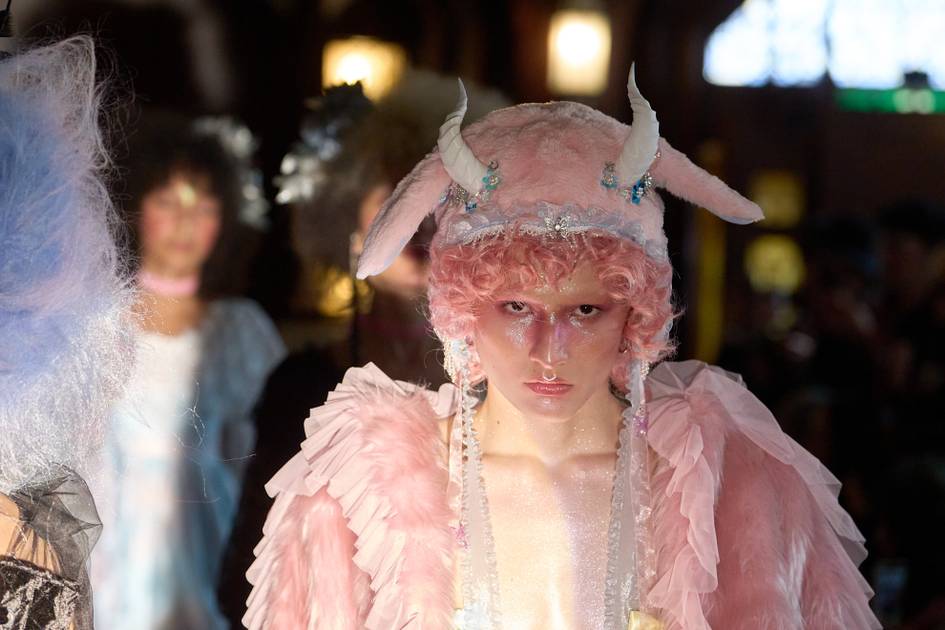
The Japanese label Pays des Fées (French for ‘fairyland’) has fairies floating across the catwalk for its twentieth anniversary. The looks are partly inspired by our own archive of the past two decades. According to the show notes, this includes influences from the animistic and pantheistic worldview, which can be found in religious paintings from the sixth to eleventh centuries. The entire collection is imbued with an interplay between mythical creatures in harmony with flora and fauna. Butterfly wings alternate with horn hats, while almost the entire collection is wrapped in glitter and tulle. Colors such as soft pink, various shades of green and sky blue dominate the looks.
Marika Suzuki, meanwhile, delves into the submerged world of mermaids. The fashion research specialist – behind the Japanese label of the same name – uses discarded plastic bottles and damaged kimonos and textiles as the basis for her collection. Plastic appears in various headgear and as details in voluminous dresses. The curled shape and colors such as green and red make them reminiscent of coral and algae that envelop the carriers. Transparent fabrics, tulle and shiny materials, with a color palette of red, blue and turquoise that resembles the rainbow fish, enhance the feeling of being somewhere in the depths of the ocean.
CreepyCute
For the first time, the fashion federation Taiwan Textile Federation is also presenting the Taiwan Select project during fashion week, in which the three labels PCES Studio, Yentity and Chia are participating. With their collection ‘There is no Party without you’, the designer trio behind PCES want to put the wearer in the center and make them a ‘star’. Under this motto they bring the fairytale atmosphere with tulle and ruffles to the present, to a generation that mainly moves online. These components are combined with streetwear items, such as hoodies decorated with stars.
Designer Yueqi Qi, who founded her eponymous label in 2019 after graduating from renowned London fashion academy Central Saint Martins (CSM) and incorporates embroidery and glass beads into her vibrantly printed fabrics, seems to embrace a similar aesthetic. However, she is more driven by nostalgia, as she draws inspiration for FW26 from a former underground shopping arcade in Niigata, Japan. Details inspired by lingerie are combined with looks that are a cross between a school uniform and ski wear, and that, apart from the thick winter coats with fur collars, show a lot of skin. Pixel motifs such as kittens and flowers can be seen alongside a drawing pad print and bunny embroidery. The interplay of these different elements revives the early 2000s, without following the well-known key pieces of the Y2K trend of recent seasons.
Yusho Kobayashi, who also graduated from CSM, transforms his entire catwalk into a sea of artificial flowers in pink and purple. The very young, almost childish-looking models walk to mystical, electronic pop music. They present a playful collection based on patchwork, layers and crocheted elements. The focus is on voluminous dresses decorated with large bows, the material of which is reminiscent of crumpled paper and decorated with childish drawings. The chaotic-looking mix harmonizes with the Japanese ‘Kawaii’ aesthetic – pastel colours, soft textures, simple graphics and cuteness – which also includes the slightly darker Gurokawa subgenre – ‘Creepy Cute’. Dark and cute at the same time also seem to be the key words for this collection.
Sculptures
The following brands seem to have taken a very different path, with a special focus on the silhouette itself.
The Japanese brand Enföld, known for its sculptural designs, presents this season’s ‘Living Sculpture’ collection, a collection characterized by shapes and layers. Items with soft edges and curves are contrasted with asymmetrical cuts and shortened tops.
Ryunosuke Okazaki, who was already a finalist for the LVMH Prize for Young Talent in 2022, also builds sculptural works with his garments made of thread and stretchy fabric. These elements sometimes wind around the body like the visualization of movements in cartoons and almost resemble a futuristic suit of armor from a video game. Although the Japanese designer has so far focused less on ready-to-wear items, he is trying to integrate some pieces such as polo shirts into the collection. But even these don’t come without a thread in the shoulder areas.
Japanese sneaker specialist Grounds, which showed its FW26 collection in Paris a few weeks earlier, also shows a similar sculptural shape in the final look. A voluminous, long dress stands out because of the strongly flared shoulders, which almost resemble angel wings.
Other trends in brief
In addition to the conceptual similarities, there are also some design elements in Tokyo this season that are found in the collections of several designers, including a quilted diamond pattern and photo prints.
Check pattern
The quilted diamond pattern is especially popular in equestrian outerwear, but also finds its way into experimental pieces again and again. In Tokyo it is mainly used for white, knee-length coats reminiscent of bedspreads. However, Pays des Fées also uses the fabric in a short, almost cape-like jacket with puffed sleeves.
Photo prints
The use of photos of everyday objects or situations is also a popular design element. The variants vary from a simple large print that covers the entire top, to a tile collage with different motifs and an all-over print.
This article has been translated into Dutch using an AI tool.
FashionUnited uses AI language tools to speed up the translation of (news) articles and proofread the translations to improve the end result. This saves our human journalists time that they can spend on research and writing their own articles. Articles translated using AI are checked and edited by a human desk editor before going online. If you have any questions or comments about this process, please email info@fashionunited.com.
