


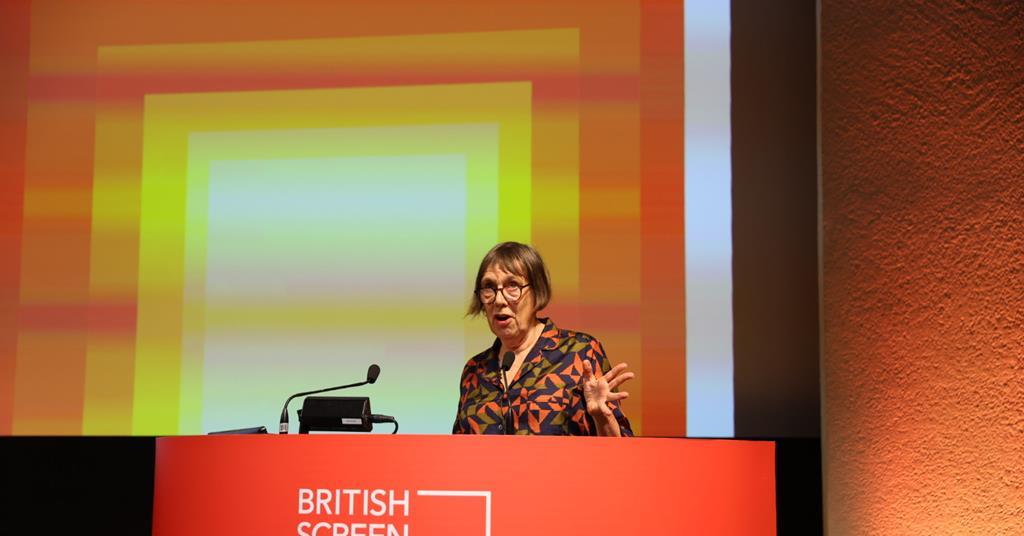
Palme d’Or and Bafta-winning UK producer Rebecca O’Brien has described the UK independent film business as “gasping for breath”, and has called for a series of “radical changes” to revitalise the sector, in particular for films budgeted at £5m and under.
Delivering the Lord Richard Attenborough Memorial Address at the British Screen Forum Conference yesterday (November 19), O’Brien’s proposals included: quotas for local films on streaming and pay-TV services; a cheaper way for indies to cash-flow the tax credit; a simpler process for finalising film finance contracts; funders being more discerning about the films they back and interfering less in projects; and funders widening casting pools beyond marquee talent.
O’Brien set the scene by explaining how funding for independent films has become tougher in recent years, with financiers becoming more risk averse in the wake of Covid, the 2008 crash and industry consolidation.
She argued the UK’s film tax credit system has worked well but has benefitted inward investors to a far greater extent than indigenous creators, and described the new Independent Film Tax Credit (IFTC) as “too little, too late as other parts of the funding model have caved in”.
Wider casting pool
O’Brien, a long-time collaborator of director Ken Loach and screenwriter Paul Laverty through their Sixteen Films with credits including The Wind That Shakes The Barley and I Daniel Blake, began by saying funders should be more open to casting from a wider pool, not just expensive talent.
“Casting super-famous actors is great but it’s a myth that the marquee value is everything… It homogenises and unbalances these lower budget films. If this is where we’re developing new talent, then new talent it should be.”
She also argued that funders should interfere less when a project is happening, describing micro-management as a waste of money for lower budget films. “Once you’ve chosen the project and the team around it, let them do the job, let them learn and use their imaginations, don’t nanny them… If you’re really worried, impose a completion bond.”
Too many films
She also called on funders to say ‘No’ more often, arguing that too many projects that aren’t good enough get made. “The brutal truth in our diminishing market is that a film must have genuine theatrical potential for distributors to be interested.”
She noted that many distributors have halved the number of films they acquire because of the collapse of the home entertainment market, preferring to concentrate resources on projects they believe will work theatrically and on pay-TV. “Hence, we need to make less, but better films. We need a reality check,” said O’Brien.
“Buyers must feel the film has strong theatrical potential so that it can attract the lucrative pay-1 window. This appeal can be the script, the team, the ambition, the originality – not always who is starring.”
O’Brien also called for a “cast-iron” way for indies to cashflow the tax credit, saying the cost of borrowing, even for “solid proposition” films backed by public funding, is prohibitive and eats into production budgets. “This is easy money for lenders to invest but they charge too much for the privilege. How about a couple of supportive banks, like the French have?,” she said, a reference to specialised film financing institutions such as Cofiloisirs and Coficiné.
Film financing contracts
O’Brien also said the contractual minutiae of film financing contracts for small films have become “over the top” and too closely mirrors the complex US legal system.
“A producer finds themselves closing the financing just at the point when the actual production badly needs their decision-making support. I want to be helping the director make decisions at this stage, not being on a Zoom with 20 lawyers bickering over the recoupment schedule.”
She said the extra burden involved in film contracts almost always requires more than one producer to make a lower budget film. “This dilutes the payment available to the individual producer and inevitably they find themselves deferring their fees to close the gap. Very few of us, even the more experienced ones, find it possible to make a reliable living.”
Streaming and pay-TV quotas
O’Brien also called on the industry to think about quotas purely for local films on streaming and pay-TV services, while acknowledging that many would disagree on the point. Unlike the European market, the UK does not impose financial obligations on streamers or pay-TV firms to invest in local productions.
“The fact that independent films don’t have privileged access to this evolved revenue source is at the heart of the market failure for this sector. A guaranteed pay-1 window for films which have had public support would enable those funders to make more savvy equity investments and help the distributors get more original, local product out into the streaming world,” she said.
Elsewhere in her speech, O’Brien called out the trend for actors wanting to be producers to increase their own power and influence.
“Yes, it’s great to develop your own projects but when it comes to actually getting them made, most actors don’t always know how to do the job of making a film. Why should they? They’re good at something else!”
She said actors often get stuck at the complex financing stage and need to call in an experienced production company to finish the job. The result, she said, is that the production fee is more thinly spread and the “real” producer doesn’t get enough to support their own business.
She also said that, with less funding, the independent sector has ended up as the research-and-development wing of the film industry in the UK. “New filmmakers and craftspeople cut their teeth in our low-budget playground and then are often siphoned off into the studio system.
“In many ways that’s fine and there needs to be nursery slopes, but not at the expense of encouraging true, original creativity. Too often the talents we’ve nurtured become rapidly industrialised and often lose the moviemaking passion they started with.”
