


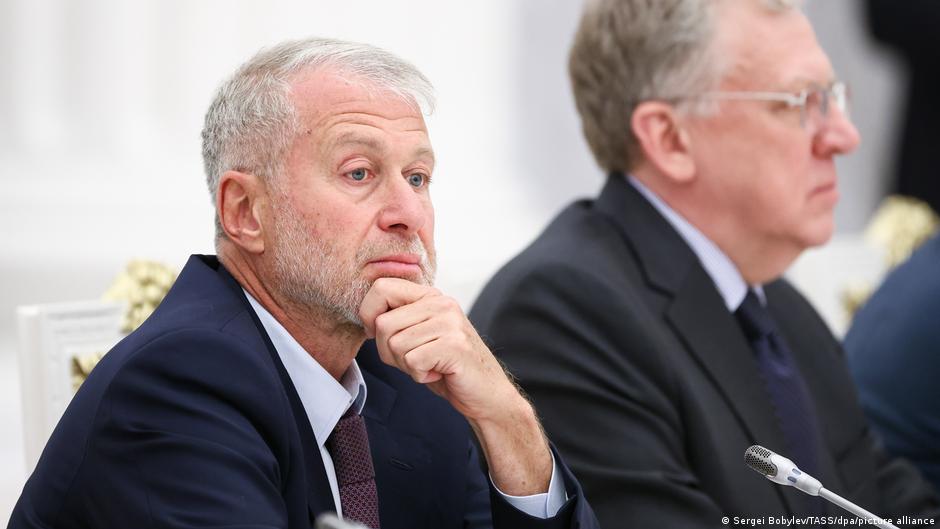
The British government on Wednesday said it was giving Russian oligarch Roman Abramovich a “final chance” to donate 2.5 billion pounds (roughly $3.4 billion or €2.85 billion) to Ukraine from the 2022 sale of Chelsea Football Club, or face legal action.
The funds have been frozen since Abramovich hastily sold the club in the aftermath of Russia’s full-scale invasion of Ukraine.
Two successive British governments and Abramovich have been locked in a dispute over how to use the football funds for years.
The UK is calling for them to be donated to humanitarian causes inside Ukraine, while Abramovich argues it should go to “all victims” of the war, including those in Russia.
Government threatens legal action
The government alluded to past commitments from Abramovich, made amid intense scrutiny of the sale so soon after Russia’s invasion, to donate the proceeds to charitable causes.
“It’s unacceptable that more than £2.5 billion of money owed to the Ukrainian people can be allowed to remain frozen in a UK bank account. It’s time for Roman Abramovich to pay up,” Chancellor of the Exchequer (the equivalent to a finance minister) Rachel Reeves said on Wednesday.
She and Prime Minister Keir Starmer both threatened legal action in the case of non-compliance.
“This government is prepared to enforce it through the courts so that every penny reaches those whose lives have been torn apart by Putin’s illegal war,” Starmer said.
Freezing assets easier than seizing them
However, the government made no mention in its statement of what legal basis it would use for a lawsuit to seek to seize the funds, amid doubts over the feasiblity of doing so.
Europe and the US have been struggling more generally ever since Russia’s full-scale invasion of Ukraine with the reality of it being relatively easy for governments to freeze assets legally, but much more difficult to appropriate them.
EU member states are currently in the process of trying to unlock frozen Russian assets to give to Ukraine, having so far only donated the interest earned by this money, not the money itself.
European Union leaders are expected to review proposals aimed at using these frozen Russian assets to support Ukraine’s budgetary and defense needs at their monthly Brussels summit starting on Thursday.
License issued to release funds, ‘any proposal’ would be considered
Prime Minister Keir Starmer said Britain would issue a licence to release the funds. This would allow the transfer of the money to a new charitable foundation.
“We will consider any proposal from Mr Abramovich to make use of this clear legal route to establish the foundation and transfer the funds under the terms of the licence,” Reeves said in a separate statement issued to parliament.
Meanwhile, Foreign Secretary Yvette Cooper said that the British government had been trying to agree a way forward with Abramovich and his company Fordstam Ltd ever since the 2022 sale.
She also appeared to hint at a compromise proposal on Abramovich’s past calls for some of the funds to go to people inside Russia impacted by the war.
“Under the terms of the licence, proceeds must go to humanitarian causes in the country,” Cooper said. “Any future gains earned by the foundation can be spent more broadly on victims of conflict worldwide. In neither case can the funds benefit Abramovich or other sanctioned individuals.”
Abramovich transformed Chelsea
Abramovich bought Chelsea for just 140 million pounds in 2003 at a time when Manchester United and Arsenal were the dominant forces in the Premier League.
The Russian oligarch, who also has Portuguese and Israeli citizenship, is credited with transforming the club’s fortunes. He routinely helped to bankroll blockbuster transfers as the club spent more than $1 billion on playing personnel.
He was rewarded with a staggering 19 major trophies in his 19-year reign, including five Premier League titles, five FA Cups and two Champions League triumphs, and ultimately sold the club for 4.25 billion pounds.
He did not immediately respond to the British government’s comments on Wednesday.
Edited by: Dmytro Hubenko
