


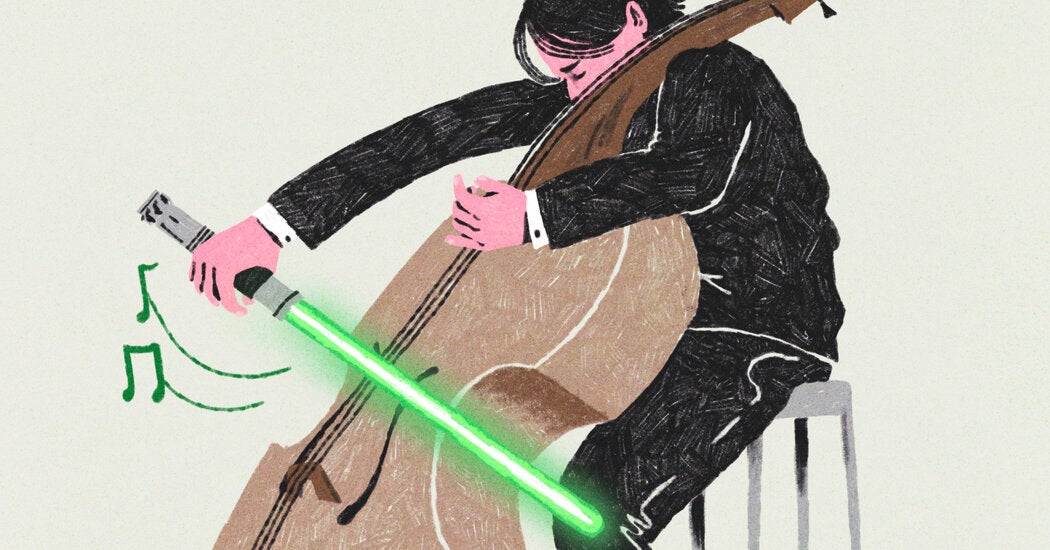
The main theme from “Jaws” is instantly recognizable, but it’s not terribly hard for musicians to play.
For double basses, the true test of mettle in this John Williams soundtrack is a cue called “The Shark Cage Fugue,” which comes during the climax of the film. They lead off with a light-stepping, rhythmically intricate melody: no easy feat with such a rumbly instrument.
Last year Michael Banks, a double bassist who is now 25, played a 30-second snippet of the “groove-based” fugue during his audition for the Pittsburgh Symphony Orchestra, in addition to standard classical fare like Mahler and Mozart. He ended up winning the job of assistant principal bass, a position that comes with a six-figure salary and fireproof tenure once he completes a probationary period.
The Pittsburgh Symphony might play more Beethoven than it does Williams, but a serious mistake in “Jaws” still could have cost Banks the job. It was a critical part of the process.
Orchestra auditions, like coding assignments for software engineers or simulator tests for airline pilots, are meant to be meritocratic performance assessments. Unlike in those other fields, though, the audition is not part of a larger interview process; it’s the whole enchilada. Hiring is based pretty much exclusively on it.
At professional orchestras, there are typically multiple rounds of auditions. They include solo repertoire, like concertos and sonatas, and a dozen or more short excerpts. Members of the orchestra, and sometimes the music director, select the excerpts to test technical skills, for example rhythmic precision or control in the high register. They are specific to each instrument.
Some excerpts are common. For trombones, Wagner’s blazing “Ride of the Valkyries” appears regularly; for harpists, one mainstay is the glittering solo in Tchaikovsky’s “Waltz of the Flowers” from “The Nutcracker.”
Orchestras have increased their programming of both popular film music and living classical composers, and auditions are evolving to match. More and more of those selections are appearing on excerpt lists. These days, 30 seconds of music from “Star Wars” or “Harry Potter” can make or break a player’s chances of winning a job.
BANKS CUT CLASS at the prestigious Colburn School in Los Angeles to fly to Pennsylvania for his audition, which took place at the orchestra’s home, Heinz Hall. He and 53 other candidates drew numbers from a hat, and when it was his turn he walked out onstage, on a carpet to muffle the sound of his shoes and behind a screen to obscure his identity. Most orchestral auditions are “blind” to reduce bias.
The first round lasted about six minutes. Banks performed five excerpts, ending with “The Shark Cage Fugue,” part of what is now a frequently programmed orchestral suite from “Jaws.” That excerpt is nerve-racking because of an “awkward string crossing” between the first and second notes, he said.
He advanced to the semifinals and then to the final round, scheduled six weeks later with the orchestra’s music director, Manfred Honeck, present. For that last stage, Banks played music by Haydn and Mahler. He repeated the Mahler a few times to incorporate feedback from the panel. He also played an excerpt from Jessie Montgomery’s contemporary work “Coincident Dances,” which calls for tricky, large interval leaps and has “a really free quality about it,” he said.
Soon after, Banks was escorted to the Maestro Suite, where Honeck congratulated him. Banks remembers the moment as a “fuzzy kind of fever dream.” He joined the orchestra in May 2025 and has since performed a variety of classical music, works by living composers and film music, including some of the exact music that he prepared for his audition.
MUSICIANS START TRAINING for an audition the moment its repertoire list is announced, but their preparation really begins years before. Serious players often learn some of the standard excerpts in high school. Then they spend their college years woodshedding them obsessively, learning to play them in different styles depending on the particular orchestra they are auditioning for, because each orchestra plays the standards with a slightly different sound and approach.
It’s a little like adapting a cover letter to a specific company; a little legwork, like studying and imitating an orchestra’s recordings, can help impress an audition panel.
The violinist Laura Colgate said she knew her excerpts “backwards and forwards with my eyes closed” by her sophomore year at the New England Conservatory in Boston. She won the job of concertmaster of the National Philharmonic, and she co-founded the Boulanger Initiative (named after the French sisters Nadia and Lili Boulanger), an advocacy organization for women and gender-marginalized composers.
One of the Boulanger Initiative’s projects is called Redefining the Canon. It works with orchestras to add excerpts from music by underrepresented composers to audition lists, with volunteers serving as “excerpt foragers” to ferret out potential passages. Among the composers is the Pulitzer Prize-winner Jennifer Higdon, who said she noticed a sharp uptick in requests about five or six years ago.
“It didn’t occur to me that this would happen because all the excerpts were older standard repertoire when I was learning them,” said Higdon, who trained as a flutist. She and Montgomery said that they see having their music used in auditions as a compliment. Both typically allow orchestras permission to use their music in auditions free of charge. Others sometimes charge a nominal fee. (One perk of using older music is that it isn’t copyrighted.)
Because there’s less tradition around the newer excerpts, they require “a lot of listening” to get to know a composer’s style of writing, said Alex Carroll, a bass player and fellow at the Cleveland Institute of Music. (He shared Banks’s trepidation about Montgomery’s “Coincident Dances.”) The challenge, Carroll said, is how to “make this sound exactly as the composer intended” in a way that “makes sense in the audition room.”
That can be difficult, especially if composers change their minds. Montgomery edited the bass solo in “Coincident Dances” after hearing it “the first few times in performance,” she said. Both the original and edited excerpts are now circulating in auditions; Carroll learned the original version for an audition in Milwaukee, while Banks played the edited version in Pittsburgh.
“In an audition setting, stick to one version and play it with conviction,” Montgomery said. “The composer, in this case, gives that license.”
Learning film music excerpts has its challenges, too. Caitlin Mehrtens, the principal harpist at Houston Grand Opera, began preparing “Fluffy’s Harp,” a soft lullaby from Williams’s soundtrack for “Harry Potter and the Sorcerer’s Stone,” months before an audition for the Detroit Symphony Orchestra. Harpists change the pitch of a string with foot pedals; as with an organ, there’s intricate footwork involved that must be planned carefully in advance.
“John Williams is just hard,” Mehrtens said. “‘Fluffy’ isn’t fast, but there are some weird, repeated notes that are really tough, and it was very pedaly.”
Even though her primary role is with an opera company, Mehrtens regularly substitutes with the Houston Symphony, including on some of their sold-out film music performances, which are “how orchestras make their money,” she said.
“We need to make sure,” she added, “that this kind of stuff is important to the people auditioning, in addition to the standard rep.”
THE CHANGE IN AUDITION EXCERPTS is also symbolic. Orchestras have made a significant push to play music outside the canon, broadening to include works by living and underrepresented composers — partly as a moral imperative, partly with the hope of building new audiences. Placing the newer excerpts alongside standards “gives the idea that these pieces are worthy of being test pieces,” Mehrtens said.
Colleges and conservatories are following along. They have added newer music to their curriculums, and many schools now ask prospective students to include a piece by an underrepresented composer in their applications.
This is not to say that all orchestras are updating their lists. Many aren’t. Banks said that he still encounters the “old-school” attitude that if “a musician can play the great masters, if you can play Strauss and Mahler and Beethoven, you can probably play ‘Star Wars.’”
Nor does everyone agree that playing excerpts provides an accurate representation of the necessary skills. Colgate, the National Philharmonic concertmaster, sees audition excerpts as “pretty archaic and irrelevant to what you actually end up doing in the job,” because the skills needed to play an excerpt aren’t the same as those needed for playing with other musicians. (This is why some orchestras include a trial period playing in the orchestra after the audition before formally offering the winner a job.)
But no one has a better solution than playing orchestral excerpts, which are broadening to reflect the range of music that American orchestras are embracing. After a year on the job, Banks said his take is that if film music and new music “is part of the job description, then it should be evaluated in the hiring process.”
