


Gasoline and diesel have never been as expensive in Germany as they were this April. According to the website Clever Tanken, diesel prices rose above €2.43 (about $2.80) per liter on average across Germany’s 100 largest cities, while Super E10 (unleaded gasoline with up to 10% ethanol) cost more than €2.18. Even during the oil crisis of the 1970s, fuel prices in Germany — adjusted for purchasing power — remained well below €2.
In the context of the US-Israeli war on Iran, this is hardly a surprise. According to the International Energy Agency, the current war in the Middle East has triggered a far greater supply shock to the global fuel supply than the oil embargo imposed by Arab OPEC members in the 1970s. Back then, supply disruptions only affected countries that had aided Israel in the 1973 Yom Kippur War.
Today, rising global market prices for oil and liquefied natural gas affect virtually all countries, but to varying degrees. To try to take the edge off soaring prices, many countries have released some of their national oil reserves, with limited effect. Around the globe, governments have reacted with different tactics.
Europe
In Germany, the government has agreed to reduce the fuel tax by €0.17 and predicts a tax shortfall of €1.6 billion (about $1.8 billion) as a result. In addition, German employers are encouraged to pay employees a one-time, tax- and duty-free relief bonus of €1,000 this year.
Following large protests against rising energy costs in Ireland, the government in Dublin has approved a wide-ranging package of measures worth half a billion euros. As part of this package, approximately 500,000 low-income households will receive a heating subsidy. At the gas station, taxes of €0.22 per liter of diesel and €0.17 per liter of gasoline will be waived until the end of May.
In Turkey, a sliding-scale fuel tax has been in effect since 2018 which decreases as soon as prices rise. This allows the government to automatically offset fluctuations — at the expense of tax revenue. Recently, Finance Minister Mehmet Simsek warned that the system is only financially sustainable on a temporary basis, but not if market prices remain high for an extended period.
Asia
Many Asian countries are directly affected by the blockade of the Strait of Hormuz because they source a large portion of their oil from the Gulf region.
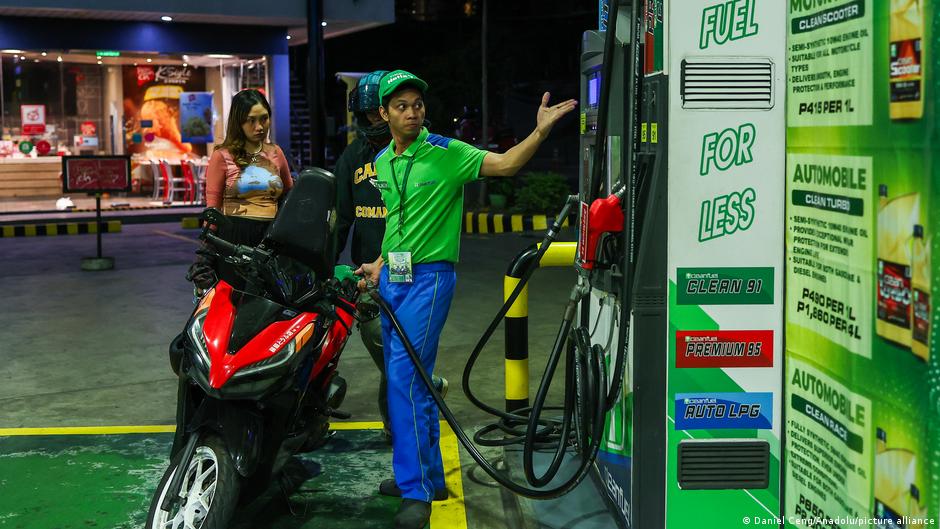
In the case of the Philippines, this figure is well over 90%. Diesel and gasoline prices have doubled since February. So far, however, the government has limited itself to suspending the tax on liquefied petroleum gas, which most Filipino households need for cooking. A standard 11-kilogram cylinder, which costs around €14, will only become about €0.50 cheaper.
Japan and South Korea have responded by capping fuel prices. The government in Tokyo is allocating more than €4 billion to keep the average gasoline price at the equivalent of about €0.91 per liter. According to preliminary calculations, the allocated budget will last just under three months.
Seoul set a price cap equivalent to about €1.19 per liter of fuel in March, but raised it by €0.14 shortly after. The government estimates that it will cost around €3 billion to compensate refineries and wholesalers for their losses. The South Korean government plans to allocate the same amount again to support middle- and low-income households to the tune of up to €350 per person.
China is far less dependent on oil and natural gas than its two eastern neighbors. Coal plays a much larger role, as does renewable energy. As a result, energy costs have risen only moderately. But this makes little difference at the pump. While the state regulates prices, it can only cushion the impact of global market trends to a limited extent. Consequently, fuel prices in China are also about 30% higher today than they were two months ago.
India has lowered its fuel tax by €0.09 per liter, which accounts for about 10% of the price. It has also raised export taxes on diesel and jet fuel to keep more of it in the country.
Pakistan has taken a completely different approach: Among a range of other measures, the government has instructed employers to have 50% of office workers work from home. Civil servants now work only four days a week, and government agencies must cut fuel use by 50% for two months.
Africa
Many countries in Africa also regulate fuel prices. In Kenya, for example, the relevant authority sets a maximum price. For a long time, it kept this price constant despite rising global market prices. It was not until April 14 that higher price caps were introduced, alongside a three-percentage-point reduction in the value-added tax. The bottom line is that gasoline now costs about 16% more, and diesel as much as 24% more. Both now stand at around €1.36 per liter.
In South Africa, the relevant authority sets fuel prices once a month according to a strict pricing formula that includes, among other factors, world market prices and exchange rates. Since February, prices for various types of gasoline have risen by about 20%, while diesel prices have risen by 40%. For the month of April, the government lowered the fuel tax by about €0.16 per liter, so that gasoline currently costs €1.27 per liter and diesel about €1.35.
In Ghana, the National Petroleum Authority (NPA) sets a minimum price that gas stations use as a guide in the otherwise free market. Since the end of February, the NPA has raised the recommended price for gasoline by 27% to €1.02 per liter and that of diesel by nearly 50% to €1.32. So far, the government has announced plans to reduce the tax burden, but has yet to follow through.
Americas
In Mexico, the government has reached an informal agreement with most gas station operators on a price cap of around €1.18 per liter for gasoline and €1.37 for diesel. In return, approximately €250 million per week flows to the oil sector via the energy tax. Without these measures, prices would be up to 25% higher, according to President Claudia Sheinbaum.
In Argentina, the strictly market-oriented government has set strict limits on subsidies. Instead, it has agreed with the state-owned oil company YPF to keep fuel prices stable for 45 days after they had already risen by about 15%. In return, more ethanol may now be blended into gasoline, and a planned increase in the oil tax is to be postponed. YPF had previously benefited from the current government’s market liberalization.
In the US, the government hoped in vain that the price of gasoline would remain below the magic mark of four dollars per gallon (about €0.97 per liter) — a 35% increase since late February. So far, the federal government in Washington has not moved to artificially lower prices. However, some states have suspended the gas tax. In Indiana, for example, drivers are currently paying €0.04 less per liter.
This article was originally written in German.
