


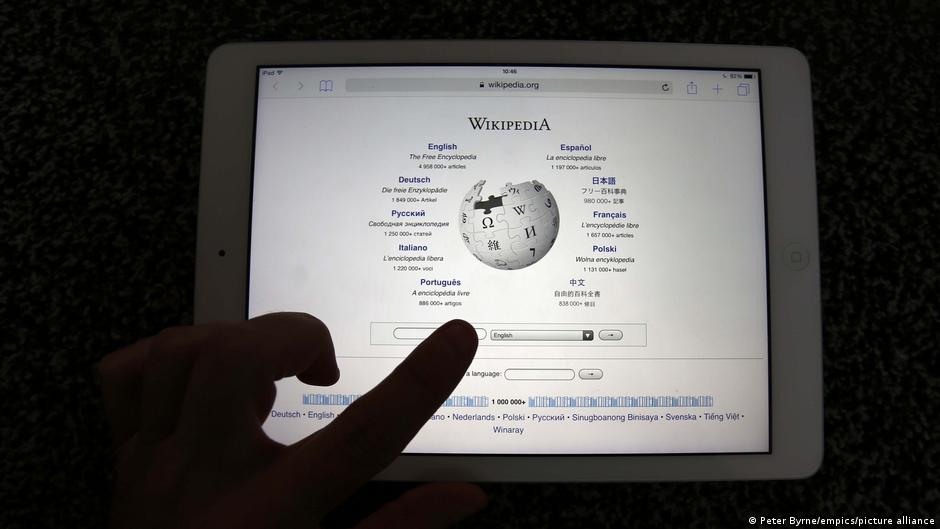
Just as human history is often divided into the eras B.C. and A.D., it’s not unreasonable to imagine the Internet’s story split between B.W. and A.W. — the “W” denoting Wikipedia.
When Wikipedia went online on 15 January 2001, it was the brainchild of two men: Jimmy Wales, an internet entrepreneur with a libertarian streak, and Larry Sanger, a philosopher who became its first editor-in-chief. Their collaboration lasted only a little over a year — but the tension between their visions still shapes the project today.
From the outset, Wales imagined Wikipedia as a radically open project: a place where “every single person on the planet” could contribute and have free access to “the sum of all human knowledge.”
Sanger, however, was skeptical that such openness could ever guarantee neutrality — a divergence that would color Wikipedia’s story.
From tomes to clicks
Previously, accessing knowledge meant navigating physical libraries and curated reference works, with experts and institutions acting as the gatekeepers of “official” information. Wikipedia inverted that hierarchy.
It created a vast, collaboratively edited platform where anyone with an internet connection could write or revise an article — shifting from centralized expert authority to a more decentralized, community‑driven model that still cites expert‑produced sources.
The growth that followed is now internet lore. By 2002, the English Wikipedia had around 25,000 entries; by 2006, it had passed one million. Today it exceeds seven million.
Powered by people, divided by philosophy
As of January 2026, there are more than 300 active language editions of Wikipedia with contributions from thousands of volunteer editors.
No one “owns” an article, and all contributions must follow the core principles of neutrality, verifiability and reliance on reputable sources. Editors debate changes on “talk pages” and reach consensus. In serious cases, conflicts are brought to the community‑run Arbitration Committee.
This model reflects Wales’ belief that a global commons of knowledge can be built collectively. “Wikipedia is not a very comfortable place for extremists,” he told The Guardian in 2025. “If you want to rant and be super biased, then go on, write your own blog.”
For Wales, neutrality comes from grounding articles in facts: “The Hitler entry doesn’t have to be a rant against Hitler. You just write down what he did, and it’s a damning indictment right there.”
Sanger, who drafted Wikipedia’s early neutrality guidelines, has long argued that openness by itself cannot prevent bias; those who write articles should ideally be subject-matter experts.
“Neutrality is entirely possible” he told DW, adding that the gold standard is when “you cannot tell what the person thinks on any issues of controversy,”
“And I don’t see how it would be ultimately possible for a project like Wikipedia to even approximate neutrality without the involvement of experts that are themselves committed to neutrality.”
He has also argued that only those “who think a certain way” are permitted to edit Wikipedia, describing them as “global, academic, secular, progressive.”
Of gender gaps and doom spirals
The estimated number of female Wikipedians is between 10–20%, as acknowledged by the Wikimedia Foundation. Entire categories of notable women and their works remain missing, which spurred the 2015 “Women in Red” initiative to close this gender gap.
Each Wikipedia language edition is created separately, with its own community of editors. That means an article that exists in Hindi might never be written in English, and vice versa. Tools like Wikidelta help show these gaps by mapping which topics appear in only one language.
This matters because Wikipedia now feeds many of the digital tools people use every day. Large language models (LLMs) are trained heavily on its content, and AI‑generated text and translations are flowing back into smaller Wikipedias.
The Greenlandic edition shows how fragile this loop can be: In 2025, after it was flooded with error‑ridden AI content — which some commenters termed a “doom spiral” — its sole editor requested the site’s closure due to, among others, “the risk of harm to the Greenlandic language.”
Used ‘more often than we pee’
Wikipedia’s quirks, though, have also long spilled beyond the site itself. Its “citation needed” tag — once a simple call for verification — has become shorthand for dubious claims.
Online games like Wikiracing turn the encyclopedia into a competitive sport: Players start on one article and race, using only hyperlinks, to reach a completely unrelated target page in as few clicks and as quickly as possible.
Besides long being the go-to for research, it peppers everyday routines — settling dinner‑table disputes, guiding sports commentary or sending readers down late‑night rabbit holes.
Perhaps fashion designer Diane von Fürstenberg best captured its ubiquity when she once joked to Jimmy Wales, “We all use Wikipedia more often than we pee.”
Grokipedia: A new challenger?
But even a platform woven into daily life is not immune to disruption. In 2025, Elon Musk’s company xAI launched Grokipedia, an AI‑generated encyclopedia built on the Grok large language model.
It debuted with nearly 885,000 articles and presented itself as a “truthful and independent alternative” to Wikipedia — or, as Musk calls it, “Wokipedia” for being “extremely left-biased.” Some entries are generated entirely by Grok; others are lifted from Wikipedia, sometimes lightly edited, sometimes copied almost verbatim.
Sanger sees the shift as significant. “For the first time in history, you can actually talk to an LLM and it will turn around and make an edit to an encyclopedia article,” he told DW. “You’re not submitting the edit to a human being. You’re submitting it to a machine controlled by a corporation,” which means getting answers faster.
He believes Grokipedia could eventually surpass the project he once helped create: “There’s a very good chance Grokipedia will be a better encyclopedia than Wikipedia after some amount of time.”
Speaking to news agency Reuters in late 2025, Jimmy Wales expressed skepticism at large language models being able to produce encyclopedic content. “Whether it’s an important or meaningful competitor, remains to be seen.”
Edited by: Tanya Ott
