


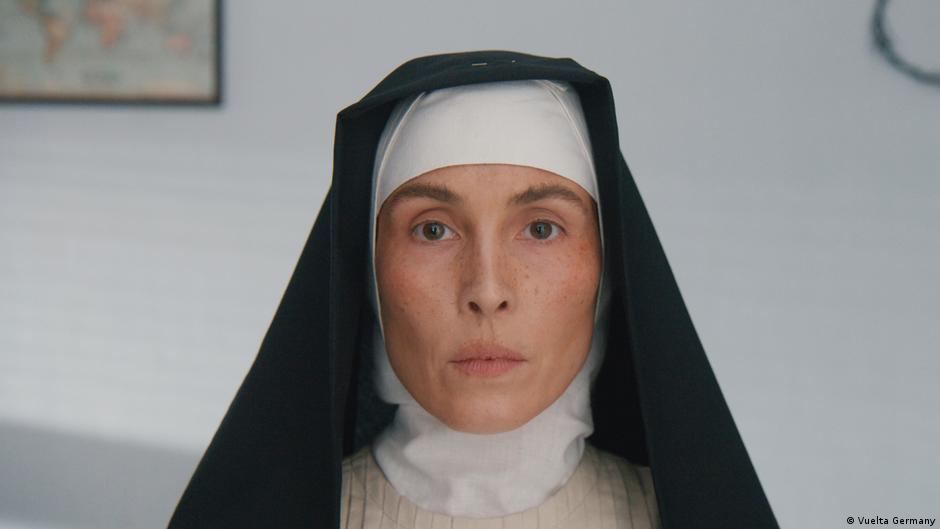
Teresa was 19 years old when she moved to India. There, the novice was confronted with misery, hunger and disease. She lived as a nun and teacher in Calcutta (now Kolkata) as a member of the Catholic Loreto Order, which was dedicated to educational and missionary work in India.
Calcutta was overcrowded, the state welfare system was overwhelmed and the health care system was virtually nonexistent. After around 200 years of colonial rule, India faced enormous challenges shortly after gaining independence from Great Britain. The country was in turmoil, and thousands of people died in violent crises.
The film “Mother” depicts the extent of this chaos. Instead of shiny aesthetics, it shows a cityscape of noise, cramped conditions and throngs of people.
Born in 1910 as Anjeze Gonxhe Bojaxhiu in Skopje (then part of the Ottoman Empire, now the capital of North Macedonia), Teresa appears in the film as a woman searching for her calling amid ruins and hardship.
During a train journey, she is said to have experienced her “calling within a calling”: to not live only for God, but for and among the poorest of the poor.
A woman rebelling against her church
The film shows Teresa (played superbly by Noomi Rapace) not as a supernatural figure of light, but as a woman rebelling against the Catholic Church.
After all, her plan was revolutionary: to leave the convent, found her own order, move into the slums and care for the sick and dying — as a nun living outside of the order.
The Catholic Church put the brakes on her ideas, because Teresa’s wishes meant breaking with old traditions and obedience. But she remained stubborn.
It was not until 1948 that the Vatican relented, and in 1950, she finally founded the worldwide order of the Missionaries of Charity.
Visually dense, light on dialogue and set to the sound of distorted electric guitars, the film shows people living in the slums of Calcutta struggling with poverty and disease, the idealized world of the girls’ school in their pink dresses and the nuns’ spartan chambers within the convent walls — where Teresa, as Mother Superior, ruled with an iron fist.
Vanity or charity?
The film critically but respectfully portrays Teresa, with some controversies only being hinted at. For example, in a solemn scene, Teresa wonders to herself whether her commitment really stems from pure charity or rather from vanity — a moment that briefly sets aside the myth and shows Teresa examining herself.
Later, she discusses abortion with the priest who heads the convent. He reminds her not to condemn the women, but to consider the reasons that drove them to take this step. And suddenly, the film raises the question as to whether compassion also permits dissent — against the institution of the Church, which condemns abortion.
Dark side of the myth
Despite her veneration, the image of the real Teresa — who was canonized by Pope Francis in 2016 — has long since been tarnished. She was a controversial figure even during her lifetime.
Human rights organizations accused her of providing inadequate pain relief and hygiene in her shelters, which they said were more like hospices than hospitals. She received hundreds of millions of dollars in donations from sometimes dubious sources, while the medical standards in her facilities were abysmal.
British journalist Christopher Hitchens summed it up this way: “She was a friend of poverty, not the friend of the poor.” She deemed suffering “a gift from God” and did nothing to end it. She equated the misery of the poor with the suffering of Christ, and she is credited with saying, “It is a beautiful thing to see the poor accepting their fate and suffering it like Christ.”
How feminist was Teresa?
Teresa was particularly vocal on the issue of abortion. In her speech accepting the Nobel Peace Prize in 1979, she described abortion as “murder” and “the greatest destroyer of peace.” This made her a moral leader of conservative movements.
At the same time, it turned Teresa into the target of feminist criticism, which accused her of subordinating women’s rights to the idea of self-sacrifice.
Nevertheless, the film’s director, Teona Strugar Mitevska, says Teresa had feminist traits. “She took the liberty of being who she was in order to achieve her goal. In my eyes, that makes her an extremely feminist figure,” said Mitevska in an interview with the film magazine filmdienst.
As a woman who gained authority in a patriarchal church, founded her own order and created a global audience, Teresa can certainly be seen as a strong female figure. She defied conventions, left the convent and led thousands of sisters — a form of agency that was not commonplace.
At the same time, she represented an image of women that focused on motherhood, renunciation and obedience. Her work was dedicated to the suffering, not to changing structures. She was hardly feminist in the emancipatory sense — but she certainly was in terms of female presence and leadership.
Teresa suffered from severe doubts in her final decades. Her letters and diary entries, which were published in 2007, reveal a great deal of loneliness and repeated questions about whether God even exists. The woman who symbolized hope worldwide wrote that inside she felt “ice cold” and that heaven no longer meant anything to her: “To me, it looks like an empty space.” Perhaps that is what makes her character so human.
Why the film comes at the right time
Abortion debates, poverty, religious conflicts, female authority in the church — many of these issues are still frighteningly relevant. The film confronts us with the question: Can a woman be a saint — and politically problematic at the same time? It shows Teresa as a character with limitations.
Perhaps that is where her significance lies today: not as a saintly figure of light, but as a character who raises issues. This film, which explains nothing but merely observes, may be a good opportunity to talk about Teresa in a new way.
This article was originally written in German.
