


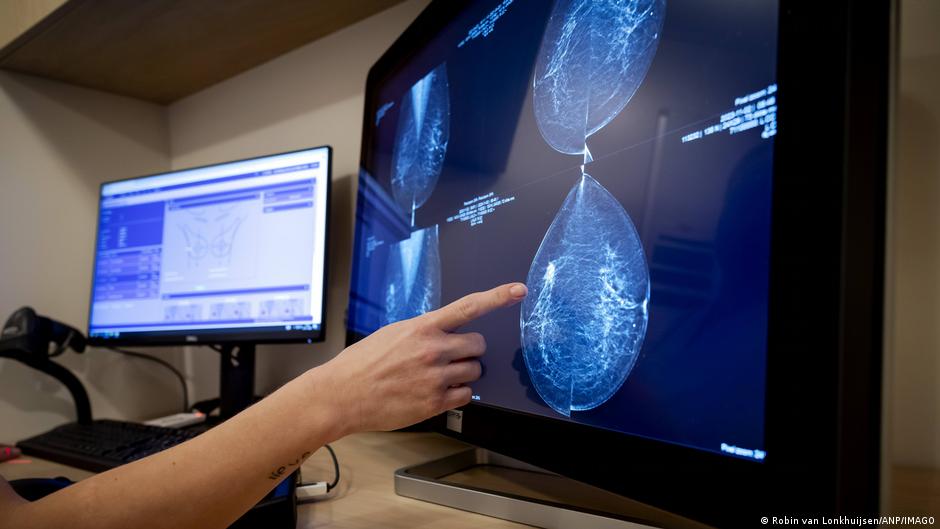
Every year, around 2.3 million new cases of breast cancer are diagnosed worldwide. The disease “caused an estimated 670,000 deaths globally in 2022,” according to the World Health Organization (WHO). “Breast cancer is the most common cause of cancer death in women — despite mammography screening,” said Christiane Kuhl, the director of the Department of Diagnostic and Interventional Radiology at RWTH Aachen University Hospital.
“The explanation is that mammography still fails to detect many cases of breast cancer, or is not detecting them early enough,” she said, explaining that fast-growing aggressive tumors in particular were often not picked up and these were precisely those that killed many women.
Now there is a new algorithm that could revolutionize breast cancer screening. The AI (artificial intelligence) model can very accurately classify a person’s risk of developing the disease within the next five years solely by analyzing mammogram images.
In one study, women whom the algorithm identified as having a high risk of developing the disease were significantly more likely to develop breast cancer than those identified as having a “normal risk,” Kuhl said. “To be specific, these women were four times more likely to develop breast cancer than those whose AI score was low,” she explained.
“With this newly-developed AI model, we can predict with much greater precision that a woman will develop breast cancer in the next five years — on the basis of mammograms that are normal and show no signs of breast cancer.”
Mammograms every two years after 50
Currently, all women in Germany aged 50 to 75 are offered breast cancer screening mammograms every two years. But the risk of developing the disease and thus the need for effective early detection varies considerably from one woman to another.
Kuhl believes that the “one-size-fits-all” principle is outdated and advocates for tailor-made breast cancer screening, considering the variations in mammography accuracy. The denser the breast tissue, the higher the risk of disease — and the less accurate mammography’s prediction of this risk. But many women are unaware of this, said Kuhl.
In the US it has long been a requirement that women be informed of glandular tissue density in their breasts and the “masking risk” that means breast cancer might not be detected by mammography.
MRI technology is more reliable than mammography
For several years now, it has been recommended that women with very dense breast tissue have an MRI (magnetic resonance imaging) which is better at detecting breast cancer at an early stage.
MRI technology is a medical imaging technique that uses strong magnetic fields and radio waves, but not X-rays, to produce very detailed cross-sectional images of the body. Although it is very reliable, it is much more expensive than mammography or ultrasound technology, which are both less dependable.
In order to identify women who need an MRI for early detection, the Clairity Consortium — an international association of 46 research institutions in North and South America and Germany — has developed an AI model called “Clairity Breast.”
The algorithm was trained on more than 420,000 mammograms from Europe, South and North America.
Unlike traditional risk models for breast cancer, the AI model does not need any data about family history, genetics, or lifestyle. It calculates the probability of developing breast cancer on the basis of mammograms and classifies women into risk categories using established thresholds.
The AI model cannot only detect how much glandular tissue there is but also its texture and how it is arranged, which is another breast cancer risk factor.
“Only about 10% of women have such extremely dense glandular tissue,” said Kuhl. “The vast majority of women who develop breast cancer and receive a late diagnosis have less dense tissue.” What is important about the new technology, in her view, is that the “AI model can decide within seconds whether a woman needs an MRI for early detection or not.”
Should comprehensive breast cancer screening start earlier?
Comprehensive breast cancer screening starts at the age of 50 in most countries because the risk of developing the disease increases significantly with age and the benefits of doing this are proven. But Kuhl said that provided the AI model worked, “younger women would benefit from early detection” as though they are less likely to develop breast cancer than older women, if they do they are more likely to develop aggressive tumors.
Moreover, mammography is particularly problematic for younger women, she said. “Young women are more likely to have dense glandular tissue, which makes early detection using mammography particularly difficult.”
But generally Kuhl did not think it would make sense to lower the general screening age. “If we simply lower the age at which women are invited for a screening, we will not alter the fundamental problem.” She was in favor of a two-step approach: ” First, mammography for early detection; then an AI analysis to determine the risk of disease over the next five years.”
If the algorithm detected a particularly high risk, then an MRI would have to be offered. “A mammogram is no longer necessary for these women,” Kuhl said.
This article was translated from German.
