


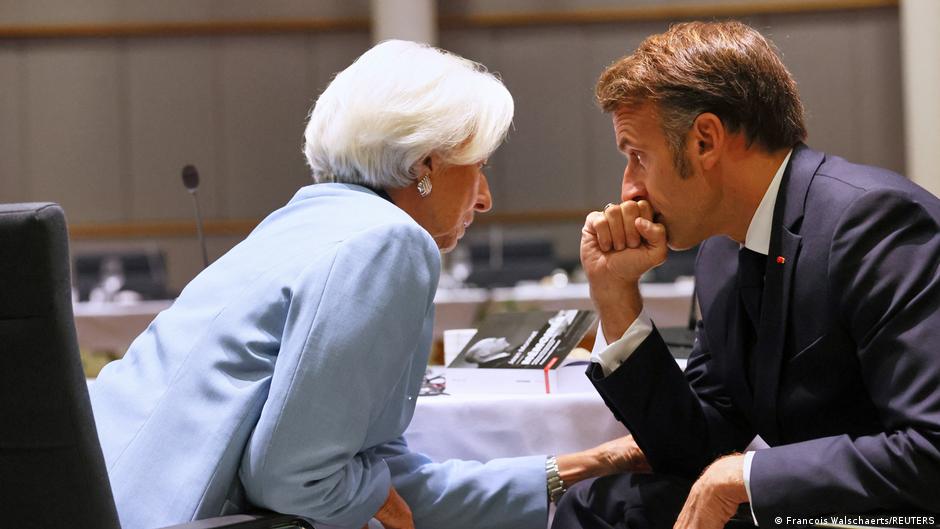
Is Christine Lagarde leaving the ECB early?
Officially, European Central Bank President Christine Lagarde is not quitting her job early as head of the 21-member eurozone’s central bank.
However, the Financial Times reported on Wednesday that Lagarde has told people close to her that she is considering stepping down before her eight-year term ends in 2027.
According to the FT, Lagarde has been weighing the move for several months and has discussed it with senior European officials.
The 70-year-old’s thinking, the report said, is to leave before France’s presidential election in April 2027.
That timing would let French President Emmanuel Macron, who can’t seek a third term, help choose her successor, along with Germany’s Chancellor Friedrich Merz.
The goal appears to be to ensure a mainstream, pro-European candidate takes over as chief of the eurozone’s central bank, rather than risking influence from a possible newly elected far-right president in France next year.
Lagarde, who was formerly the first female president of the International Monetary Fund, has not set an exact departure date, according to the report.
The London-based business daily said she has not made a final decision and has not communicated any plan to the ECB’s Governing Council.
Lagarde is “totally focused on her mission and has not taken any decision regarding the end of her term,” an ECB spokesperson told DW in a written statement.
Why would an early departure be significant?
Current polls indicate that France’s far-right National Rally (RN) could win or secure substantial power in next year’s presidential election.
A Euroskeptic French president might advocate for a more unconventional ECB leader, potentially steering the bank away from its present centrist, pro-European stance.
By leaving early, possibly in late 2026 or early 2027, Lagarde could help secure a mainstream successor. This approach aims to future-proof the ECB against rising populist pressures all over Europe.
Analysts do expect near-term monetary policy to remain constant, with the ECB expected to keep interest rates at around 2%.
This is due to the central bank’s consensus-driven process and the similar views of likely candidates for the president’s job.
Even so, the speculation introduces uncertainty around succession and could affect perceptions of the central bank’s long-term credibility.
“In itself, this move will not be very damaging,” Andrew Kenningham, chief Europe economist at the UK-based Capital Economics, told DW. “But it sets a precedent which could be followed by future governments that may wish to pressure the ECB to take particular decisions. This undermines the ECB’s image as one of the world’s most independent central banks.“
Would her early departure undermine the ECB’s independence?
Even if Lagarde’s departure is voluntary, it does raise concerns about the ECB’s independence.
The central bank is designed to operate free from political interference, with its mandate focused on price stability protected by European Union treaties.
However, reports suggest the timing is driven by a desire to let EU leaders shape the successor choice before a major national election, where a far-right win is possible.
Critics say an early departure would reveal a somewhat opaque bending of the rules for preferred outcomes, potentially eroding the bank’s reputation as an apolitical institution.
In practice, however, ECB independence safeguards remain strong. The bank’s president is nominated by the EU’s European Council and approved by the European Parliament, with input from multiple EU leaders.
A successor would still need a broad consensus among eurozone governments and interference would be limited by the continuity of a seven-year term.
“It is not an accident that, like other central bank bosses, the ECB president is appointed for a long and fixed term,” Kenningham told DW. “That is one of several features of ECB governance that is intended to guarantee independence.”
Financial markets have reacted calmly to the FT report, suggesting the perceived threat is so far limited.
However, the move has reignited concerns about central bank autonomy on both sides of the Atlantic, after US President Donald Trump publicly pressured Federal Reserve Chair Jerome Powell over interest-rate decisions. Powell is under criminal investigation over accusations that he misled Congress over renovations to the Fed’s headquarters.
Who could replace Lagarde?
Several names have emerged as potential successors, including Klaas Knot, the respected former governor of the Dutch central bank.
Knot is known for his hawkish stance on inflation and strong pro-EU credentials.
Pablo Hernandez de Cos, former governor of the Bank of Spain and now at the Bank for International Settlements, is another leading candidate.
He brings experience in crisis management and a balanced, data-driven approach.
Joachim Nagel, president of Germany’s Bundesbank, is also frequently mentioned as a possible successor.
As head of the central bank for Europe’s largest economy, he represents fiscal discipline and has expressed interest in broader roles.
“The next ECB president should have a very strong understanding of monetary policy, probably gained from working within the European System of Central Banks, as well as economics and financial markets. And he or she must command the respect of the leaders of the main eurozone governments,” said Kenningham.
How could a far-right government impact Eurozone monetary policy?
A far-right government in France would likely face significant hurdles in directly steering eurozone monetary policy.
The ECB’s primary mandate is to achieve price stability, with a 2% inflation target over the medium term. This is decided via consensus by a 26-member Governing Council.
A single country’s leader cannot dictate rates or policy. Even if France elected a Euroskeptic president, they could not force through radical changes, like scrapping inflation targets or loose policy for growth.
No far-right leader in Europe has, so far, successfully influenced core ECB decision-making. However, Italy’s populist Prime Minister Giorgia Meloni has occasionally criticized interest rate decisions.
Indirect pressures from a far-right French government could come from high spending plans or excessive debt, which could push government bond yields higher, as investors weigh the higher risks of default.
This could further threaten financial stability in France, potentially spreading to other high-debt EU nations, forcing the ECB to intervene.
The leaders of France’s far-right RN have said that if elected, they would push the ECB to relaunch quantitative easing (QE) to help ease France’s debt problems.
QE is a tool utilized in the years following the 2008/9 Global Financial Crisis, when the ECB bought large amounts of government bonds to inject money into the system and support the eurozone economy.
Edited by: Ashutosh Pandey
