


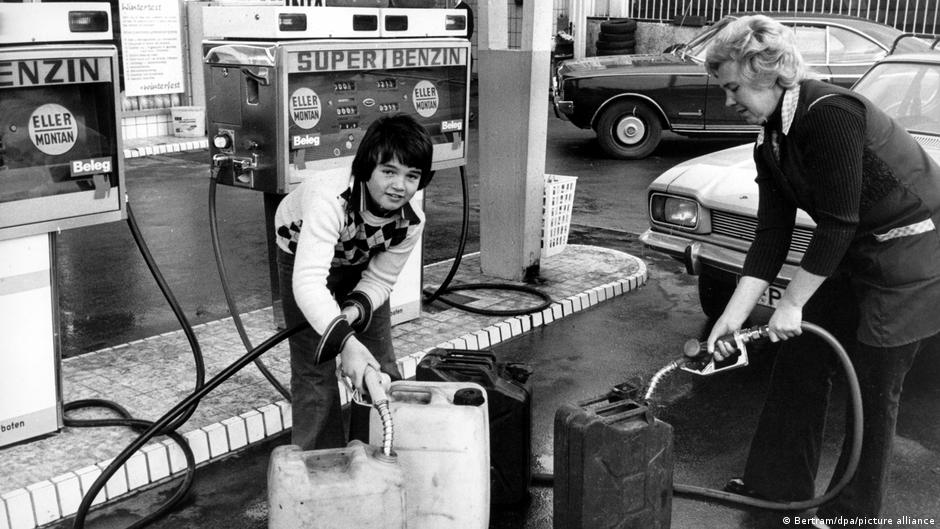
Since the Iran war began, the surge in oil prices has stirred memories of the dramatic oil shocks of 1973 and 1979.
In 1973, oil-producing Arab countries imposed an embargo against Western nations to punish them for supporting Israel during the Yom Kippur War. Oil prices skyrocketed, forcing many Western governments to implement energy-saving measures such as gasoline rationing.
Germany, for instance, declared several car-free days, banning private vehicles from the streets on four consecutive Sundays. Is the world once again on the brink of a similar crisis?
Fatih Birol, the head of the International Energy Agency (IEA), gave a stark warning on Monday, describing the Iran war as “already the biggest threat to energy security in history.”
He views the current crisis as worse than the oil shocks of the 1970s as well as the fallout from Russia’s full-scale invasion of Ukraine.
Back then, we were talking about “a shortfall of about five million barrels of oil per day,” Birol said. “Today, it’s 11 million barrels per day — more than during the two major oil shocks combined.”
He paints a similarly bleak picture of the gas market.
Compared to the situation following Russia’s Ukraine invasion in 2022, Birol said, the global gas supply shortfall has doubled.
In the 1970s, the reduced supply of crude set off a sharp rise in oil prices, which in turn propelled the prices of other goods upward, causing an inflation shock. At the same time, industrial production and economic growth slumped.
The double whammy of soaring inflation and economic downturn plunged many industrialized nations, including Germany, into stagflation.
Decrease in oil supply sharper now than in 1970s
The ongoing Iran conflict and the near total closure of the Strait of Hormuz — a critical chokepoint in the Persian Gulf through which a fifth of global oil and gas shipments pass — has slashed global oil supply by about 8%.
“Back then [1970s], the global oil supply fell by only about 5%. In this respect, the shock is actually more pronounced now than in 1973 and 1974,” says Klaus-Jürgen Gern, economist at the Kiel Institute for the World Economy.
Still, the oil prices rose much more sharply in the 1970s than now, he pointed out.
“From 1973 to 1974, oil prices quadrupled. In 1979, they tripled again,” Gern told DW.
One reason the price increase was more pronounced in the 1970s than it is today is that markets expect the current conflict to end within weeks, which could stabilize the supply again.
Back then it was different. No one knew how long oil prices would remain high, Gern said. Although Arab countries lifted their embargo in early 1974 and oil supplies increased, they kept prices elevated for the rest of the decade — acting as a persistent drag on the global economy.
Also, in the 1970s, “oil-importing countries faced prices they had never seen before,” Gern said.
Today, a spike in oil prices isn’t quite as rare anymore.
“We’ve seen oil prices exceed $100 on occasion, most recently after Russia’s invasion of Ukraine,” Gern noted, adding that oil prices also reached such heights in 2007, 2008 and 2011.
This time around, the high prices are a result of a drop in global supply due to the blockade of the Strait of Hormuz and the subsequent shutdown of fuel production facilities across the Gulf, rather than long-lasting damage to energy infrastructure in the region, Gern explained.
He believes both supply and prices will stabilize and return to pre‑war levels once the conflict ends. A report by Deutsche Bank Research has also concluded that the markets still do not anticipate a prolonged oil shock.
Energy infrastructure damaged or shut down
The conflict, however, has caused a degree of damage to over 40 energy installations in nine Middle Eastern nations, said Biral, adding: Even if the war were to end immediately, it would take a “long time” to bring the damaged facilities back online.
“It will be six months for some (sites) to be operational, others much longer,” he told the Financial Times.
Qatar, for instance, said Iranian attacks on the Ras Laffan complex — the world’s largest liquefied natural gas (LNG) production facility — could result in a 17% reduction in supplies for three to five years.
But Christoph Rühl of Columbia University in New York believes a real energy crisis would erupt only if the Strait of Hormuz stays shut for long and additional fuel installations are damaged.
Qatar supplies about 20% of the world’s natural gas, he pointed out, adding that even with production outages at the Ras Laffan plant, only about 4% of the world’s natural gas supply would be affected.
Emergency measures to curb oil demand
The oil market is also more diversified today than it was during the previous price shocks.
While member states of the Organization of the Petroleum Exporting Countries (OPEC) — an intergovernmental cartel founded in 1960 to coordinate petroleum policies — supplied more than half of the world’s crude in 1973, their share has since fallen to just over 36%.
The US was already the largest oil-producing country back then and remains so today. Over the past decade, it has seen a further sharp increase in production, supplying as much as 90% of the amount oil that’s been added to the global market over the past few decades.
Despite the oil crises of the 1970s, which made the West painfully aware of its dependence on Middle East oil, demand for the fossil fuel has continued to rise.
While global supply stood at less than 60 million barrels per day in 1973, it had already reached nearly 94 million barrels per day by 2022.
To avoid supply disruptions, many countries have built up significant oil reserves. According to the IEA, these reserves reached 8.2 billion barrels at the beginning of this year, their highest level since February 2021.
They help mitigate the current supply shortfalls, with the IEA announcing earlier this month that its member states had agreed to release 400 million barrels of oil from their emergency reserves to address the challenges stemming from the Middle East conflict.
It is estimated that the release of reserves has reduced the global crude shortfall from 11 million barrels a day to 8 million barrels. To alleviate the supply shortage, the US has also temporarily suspended sanctions on Russian and Iranian oil that is already at sea.
These reserves have so far also prevented oil prices from rising more sharply, according to Commerzbank Research.
Over the past decade, IEA member countries have also built up large gas reserves to mitigate supply shortages.
It comes down to how long the Iran war lasts
“The current OECD reserves — both commercial and strategic — could compensate for the loss of oil shipments through the Strait of Hormuz for about nine months,” Carsten Fritsch, a commodities analyst at Commerzbank, told DW.
China, too, has built up strategic and commercial reserves that could cover its import needs from the Middle East for about seven months, he added.
It is uncertain how long the military conflict will last. President Donald Trump recently said the US and Iran were in “productive” talks to end the war, but Tehran denied the claim, making it unclear how the supply of oil and gas from the Middle East will be affected in the coming months.
The world economy, meanwhile, is already feeling the impact of the war.
“We will see two things happen: inflation will rise in the short term, and industrial production will slow down because oil consumption will be cut back wherever possible,” said Gern.
Although Western nations like Germany have yet to introduce measures to cut back on energy consumption, some in other parts of the world have already initiated steps to conserve fuel.
Pakistan, for instance, has ordered fans of its top cricket tournament to stay home and watch matches on television, shifting the Pakistan Super League to a watch-from-home model.
This article was originally written in German.
