


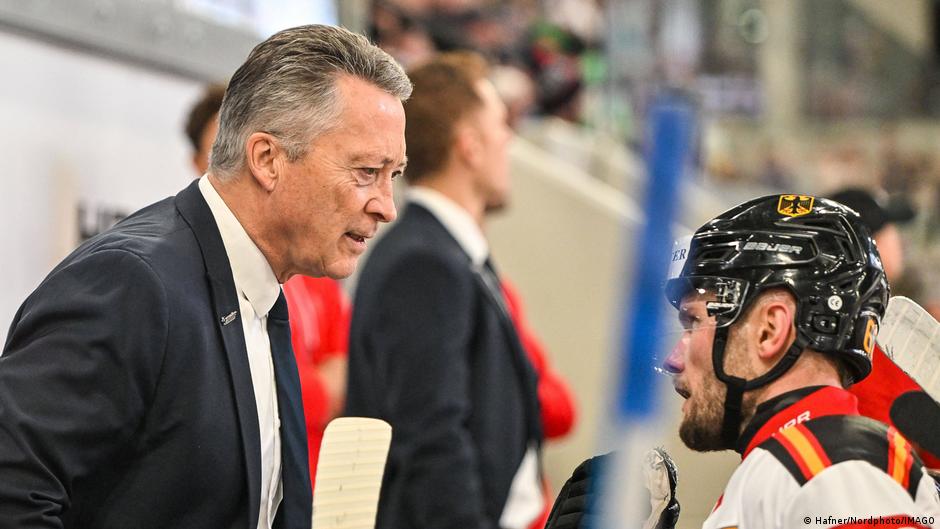
When the German Ice Hockey Association (DEB) named Harold Kreis as the men’s national team head coach three years ago, many observers saw his appointment as something of a no-brainer. By then, he’d simply seen and done it all in German hockey.
But the Winnipeg native’s arrival in the Ice Hockey Bundesliga, the predecessor to Germany’s topflight DEL, was not without controversy. Kreis came at the age of 19 as part of an influx of several Canadian players in 1978, recruited by Mannheim’s general manager to help make his side, newly promoted from division 2, competitive in the top league. The fact that he and four of the others who came over were eligible for West German passports meant little to their detractors.
Heckled during warmup
“In Mannheim we were welcomed with open arms, but when we played in other rinks, not so much — even though other teams had their own Canadians,” Kreis told DW.
“One night in Rosenheim a fan was really giving it to me in the warmup. I went over and asked him if he also swore at Karl Friesen [Rosenheim’s Canadian-born goalie] like that. He didn’t say another word.”
“I think it was something that people simply weren’t used to, this big influx of ‘Ausländer’ [foreigners] — even though we were all of German heritage.”
Olympic debut delayed by four years
Like Friesen, Kreis, a defenseman, quickly became a mainstay of the West German national team, and he was on the initial roster to make his Olympic debut at the 1980 Games in Lake Placid — but was dropped at the last minute due to a technicality regarding his West German passport. It’s something that he laughs off these days, but he still finds the whole thing a bit “strange.”
Kreis would not be deterred, playing his entire 18 seasons with Mannheim while making 180 appearances for the national team — including at the 1984 and 1988 Winter Olympics.
Transition to coaching
After he hung up his skates in 1997, having won a second title with Mannheim, Kreis turned his hand to coaching, where he has also found success, including winning two Swiss championships and leading Germany to a silver medal at the 2023 world championship — his first major tournament after taking the job.
Almost 50 years since he arrived in West Germany, the question of how many foreigners are “too many” still comes up from time to time. Germany captain Moritz Müller caused a stir a few years ago, when he accused DEL rivals Iserlohn on live television of icing a “Canada 1c [third rate] national team” — the DEL now allows nine imports, as opposed to just two in 1978.
Foreign players a positive in Germany
So, has the influx of foreigners helped the game’s development in Germany? Or has it hurt it by denying ice time to German-born youngsters?
“I’d say that overall it has helped. I believe the influx of players from North America or Czechoslovakia back then helped raise the level of play, although it probably hindered the development of individual German-born players,” Kreis said.
“For a high-caliber league, which the DEL is, you simply need foreign players to improve or maintain its current level of play.”
At the same time, though, he pointed to a rule introduced a few years ago, requiring DEL teams to carry two spots on their squads for U23 German players to give prospects more opportunity to play at a high level.
Strongest Germany team aren’t favorites
Having recently turned 67, Kreis is set to head back to the Olympics — for the first time as head coach. He does so with what is generally seen as the strongest German team ever, as the world’s top league, the NHL, is allowing its players to participate for the first time since Sochi in 2014.
Germany has six NHLers in the squad for Milano Cortina, including Edmonton’s superstar Leon Draisaitl and fellow star forwards Tim Stützle of Ottawa and Utah’s JJ Peterka, as well as Calder Trophy-winning defenseman Moritz Seider of Detroit. In goal, Seattle’s Philipp Grubauer has returned to form at just the right time, after a couple of sub-par seasons.
But their strength doesn’t make them favorites — not by a long shot — as the traditional powerhouses of the game, like Canada, the USA, or Sweden are packed with NHL stars. And like Draitsaitl, who has had to wait until the age of 30 to get his first shot at an Olympic medal, their stars have also been chomping at the bit for years to play in a truly best-on-best tournament.
A lasting change in mindset
Still, Kreis says Germany has become a different team since former coach Marco Sturm led them to Olympic silver at Pyeongchang in 2018.
“Sturm brought a completely different mindset to the dressing room — to the entire German Ice Hockey Association,” he explained.
“No longer was Germany happy with a 3-1 loss to Canada, for example. His attitude was that this is not acceptable. We can do better, we intend to do better. And the team brought this mindset to the ice in 2018, and ever since, the players have brought a high competetive level when they play for Germany.”
Coach Kreis declined to name a specific goal for this tournament, but he did accept that getting out of a group with the United States, Denmark and Latvia was doable.
“Denmark and Latvia are two teams that we have always performed well against. They have similar numbers of NHL players as we do, so these will be two very interesting and very important games for us,” he said.
“Our goal is to achieve the best possible result for us. To play our very best ice hockey in each game. And then we’ll see where we stand at the end.”
Germany’s men’s ice hockey team start their campaign against Denmark on February 12.
Edited by: Matt Pearson
