


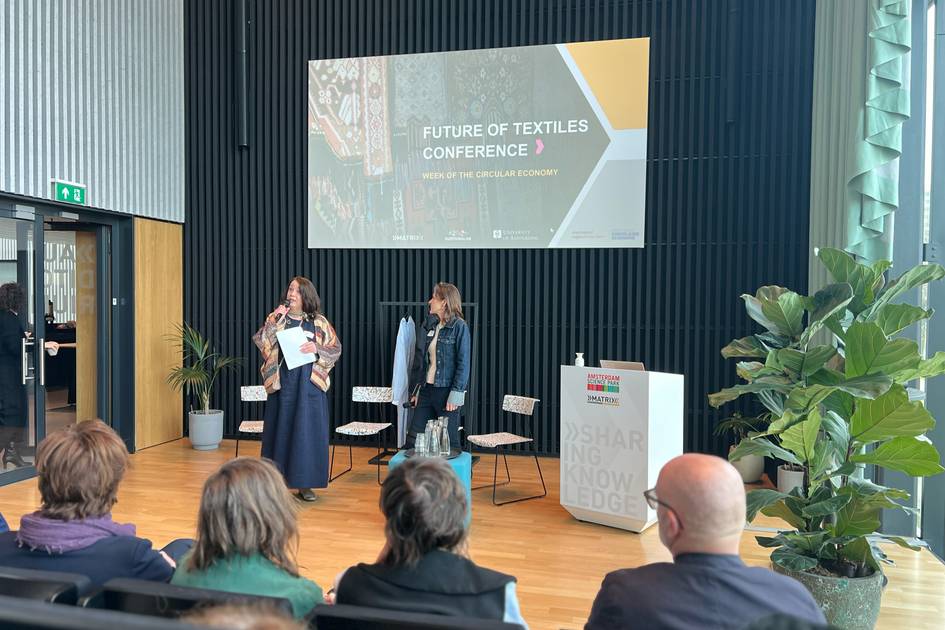
At the second edition of the Circular Textiles Conference, organized by Sustainalab and Clean & Unique, consultant Marten Boels presented the new course of Circular Textiles Amsterdam (CTA), a public-private partnership between government, business and education to boost circular textiles in the Amsterdam Metropolitan Area (MRA). CTA officially started at the beginning of this year.
The reason for the new plan was that the existing roadmap was outdated. Boels’ introduction shows that collaborations around circularity in the region are still inadequate and that there is a need for action. Above all, the plans must be implemented. Sustainability experts call it walking the talk.
Two pillars
While the previous plan was based on ten goals, this has now been reduced to two. The first focuses on a ‘circular culture’: behavioral change and market transformation in the city. The second aims for a vibrant Amsterdam Circular Textile District, a network that connects circular entrepreneurs, designers and institutions in the region. A first step was already taken last year with the launch of Textielhub, a workspace of over 4,600 square meters in Amsterdam West with offices, studios, workshops, studios and storage.
There are action points under both pillars, which will be further developed in the coming phase.
Role for fashion students
New in the roadmap is the explicit role for the Amsterdam Fashion Institute (Amfi). Bregje Lampe, who was the spokesperson at the conference on behalf of Amfi, brought along a clear principle: less is more. The more small collaborations CTA organizes between policymakers, researchers, students, local makers and companies, the greater the chance that the transition will move.
That translates into two plans. Firstly, CTA wants to support Amfi in data-driven research into circular textiles and hands-on product development when it moves to the Theo Thijssenhuis in mid-2027. Lampe is also cautiously announcing a new maker space, in which sustainability can be experimented with. Secondly, a new practice-oriented associate degree is planned for more sustainable and circular design.
What Amfi also contributes is its own knowledge pool and the time investment of researchers and students. “We are not going to set up a new company,” Lampe told FashionUnited, “our students will do that later, but as an institution we can ensure that new projects can start.” The school wants to operate in the background as an education and research partner. Companies and organizations that are dealing with a concrete circularity issue will soon be able to offer this to a student as a graduation or research assignment.
As an institution that is much closer to fashion, Amfi can also help the municipality establish ties with the creative industry. “We especially want to ensure that people know where to find each other. Not by organizing panel talks again, but through concrete projects and by picking up research questions.”
Amsterdam as a textile cluster
Why is Amsterdam the ideal place to roll out the government’s sustainability plans for 2030? Boels points to the number of professionals involved in circular textiles: with 20,000 people, the MRA is the largest textile cluster in the Netherlands. In addition, Amsterdam traditionally has a strong creative industry, and activity in the field of tech and analyzing large mountains of information (big data). In short: Amsterdam has the potential to contribute to the textile transition on a global scale.
The roadmap was drawn up under the leadership of the Amsterdam Metropolitan Area, with contributions from Marten Boels (Amsterdam Metropolitan Area), Bregje Lampe (Amsterdam Fashion Institute) and Laura Vicaria (Rethink Fashion).
Organizations active in circular textiles in the region are invited to contact us and help build the initiative.
