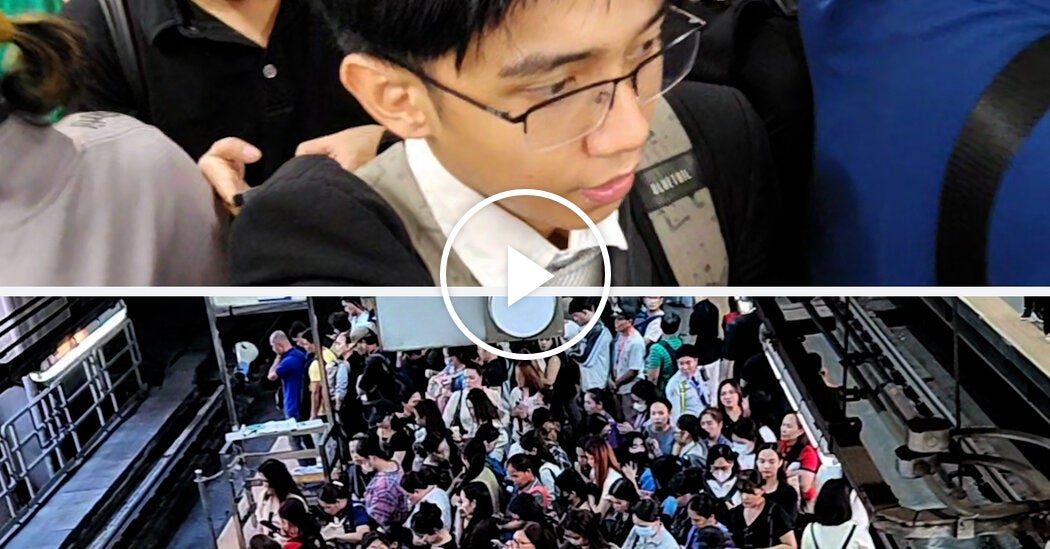
Commuting in the Philippines has become extremely chaotic. “When you get on the train, you have to protect yourself so that you don’t get squeezed.” “We call it a sardine situation. It’s becoming unimaginable.” The war in Iran has created a global energy crisis, more than doubling the price at the pump in the Philippines. This has forced people to ditch their cars for public transportation, like trains and popular vehicles called jeepneys, that could typically hold about 20 people. Many are trying to figure out how to navigate massive crowds during rush hour, while saving money. “Excuse me.” These commuters filmed and posted on social media about their new challenging journeys. “I stopped driving. I take the public transportation as a commute.” Stella Kim works for a multinational company in Manila as a project coordinator. Her drive to work was typically about an hour and a half. But then gas prices started to climb. “It just wasn’t worth it. It’s very expensive.” So Kim now hails a motorcycle, and takes a train and jeepney during her commute. “I used to ride jeepney maybe like once a month, but now it’s like the cheapest option.” Kim said this new commute cost half the price of driving, but it adds an hour and a half to her trip. “When I arrived home, it was 9:30 p.m., so I just go home and the days end.” The crush of new passengers is making travel harder for commuters like Stephen Emperado. “So lines are much longer, waiting times are less predictable, and you’re competing for space.” He already had a complicated commute to his college in Manila. “First, I will ride jeepney to go to MRT train station, and I will transfer to another train.” Emperado said the large crowds at rush hour have become stressful. “It really takes a toll physically, and of course, mentally.” He said his commute used to be the only free time he had to read and study. “All I can do in commuting is just bring my book and I can’t even open it.” Because of the crush of bodies in the summer heat, he also packs an extra shirt. So Emperado has found ways to avoid rush hour. “I sometimes stay at my friend’s condo near school or go home late, around 9 to 10 p.m. since I really want to avoid the people.” Kim started looking for condos closer to her office so she can have her life back. “If I’m living near this city, then I get to do other things. I’d be closer to my coworkers. We can hang out more often.” Both Kim and Emperado are eager for things to get back to normal. “I just wish this energy, fuel crisis would settle down.” “Filipinos are very resilient people. Despite the fuel crisis, we are really trying our best.”
Trending
- No further action against government adviser’s wife over Palestine Action post, police say
- Trump was appalling for sharing horrific tiger attack footage – but we’re just as guilty for watching it
- Anneke laat zien hoe vrouwelijke soldaten in het veld plassen: ‘Moeten nadenken over hoe man en vrouw verschillen’
- Urgent plan needed to end ‘corridor care’ for children, health secretary says
- Why is China buying up gold? | Explainer News
- Ligue 1: Paris Saint-Germain aim to build on recent progress at Strasbourg
- Germany goalkeper Ena Mahmutovic takes her chance
- Pope Leo returns to Vatican four days after lung cancer surgery