


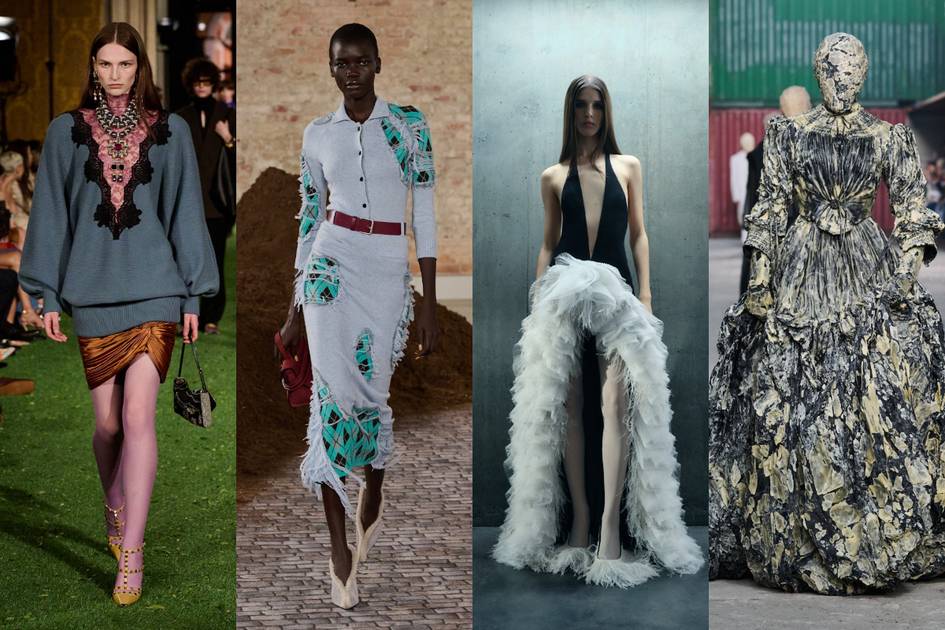
The spirit of the times is ugly and cloudy. Creative sectors are responding with escape routes and solutions, fashion in particular. This is how Christine Boland opens her trend seminar about next year’s winter fashion. She predicts lavish designs with a constructive purpose: encouraging people.
Grounding, earthing
Boland encapsulates her trend predictions in a social desire to learn to live more groundedly. For the expert, the first trend, which she calls ‘regrounding’, is about being present in the room, stretching your attention span and working with your hands — in short, everything that AI cannot do.
But taking root is difficult, says Boland, with the excess of information that forces itself on us via the web: images without context, opinions that polarize. “We become alienated from ourselves and others, miss a shared truth and contact with nature.” The question is not how to escape that complex reality, but how to live with it. Designers have their ideas and make clothes, bags and shoes that express them. “That’s their job.” Boland translates them into three trends in her trends seminar.
Individual Familiarity
Familiar items with something innovative will become bestsellers, Boland predicts with her first direction, Individual Familiarity. For example, folklore is reappearing in collections, but Boland and her team could not trace many of those designs back to one culture: Eastern European? Afghan? Liberty? They are mixtures of heritage. Boland calls this ‘bohemian beyond borders’. The trick is to bring references together without naming them. There is therefore no question of cultural hijacking.
Layering is a method of alienating known items. Boland points to the Prada show in February. Miuccia, who has been involved with the fashion house for almost half a century, spoke beforehand about the simplification of complexity. She took not sixty but fifteen models and had them walk several times, each time wearing a layer less. It resulted in huge commercial fashion: a long-sleeved shirt under a jacket, lace peeking out from underneath everything. For the complete look you want it all. “No matter how classic your customer is, inspire them to create these types of combinations,” Boland advises.
Materials and craftsmanship can also evoke recognition: beautiful wickerwork in a bag, hand knitting, suede in 70s brown. With surface design, designers make fabrics more interesting. The rich jacquards in Gucci’s winter collection and the metallic finishes at No 21 are good examples. You can also stack these techniques, and then the following applies: more is more.
You also get freshness by playing with proportions. After a constant widening of the trousers along the entire gender spectrum, the upper body is now becoming wider: 80s shoulders, a broad chest. The pants or skirt underneath narrows for contrast.
The designer is free to exaggerate even more, by combining wearable fashion with thigh-high leather patent boots (For All Mankind), or accentuating the body with leather belts in places where they do not necessarily adorn it, such as just below the hips, seen at Chanel.
In terms of color, Boland expects a lot of celadon blue with aubergine, green-brown from the seventies and ‘mean yellow’. Bright and neon, we saw that before. The autumnal gradations from the Etro and Missoni spectrum also appear, but in unexpected combinations. The trick is to choose one shade and make it stand out. Otherwise it remains just nostalgia, and nostalgia does not help time move forward.
Dramatic Antidote
The second trend on which Boland attributes the turning of the tide is Dramatic Antidote. She mentions Valentino’s winter collection, where Alessandro Michele presented theatrical sequins and deep V-neck blouses filled with lace, topped with a statement necklace. All-over lace, where the entire body is drowned in it, we saw at Saint Laurent. At Margiela, the skirts seemed to come from the French court, grandiose as they were in their design, the fabric looked as if it had been 3D printed. It’s not gray mouse fashion. “We don’t wait for a party for these types of outfits,” says Boland. That attitude is part of it.
For grandeur, the material must be solid: sturdy velvet (not fake silk), bronze buttons (not plastic), and embroidery with gold thread. LCD Textiles, a Milanese fabric manufacturer, set the tone during the design week with a fully decorated dining table, including the plates in fine silver silk. It really shouldn’t be less. In that sense, the trend is not for every customer.
By ‘dramatic antidote’, Boland also refers to the political charge of fashion, in response to the conservative movement that wants to put women back behind the counter. Ambitious women should take a step back, they believe. Not if it’s up to fashion designers. Adrian Appiolaza (Moschino) portrays the working woman in suits with revealing lace panels and broad-shouldered jackets with ruffles — they flow in all directions. Nothing neat about it. David Koma’s models are even grunge in plunging black tops and tulle skirts. They don’t hide and reveal their bodies with confidence.
In this trend story, the more conservative colors are gaining ground: beige, white, black, and historic pastels are often used by designers, just like very old pink and petrol blue. Decorations are made of gold, bronze and old silver, preferably in matte versions rather than high-gloss.
Unapologetic Presence
The third tendency, Unapologetic Presence, requires space: the physical space you take up with your body, and the mental space you claim by standing out. Boland invites you to look at fashion like Jeff Koons. ‘Here I am’ and ‘see me.’ Examples from the catwalk: the teddy bear coat including ears from Loewe, the patent leather dresses from Christian Siriano and the chick-yellow fur coats from Max Mara.
The technical translation ranges from sculptural pleats in sturdy fabrics to architectural collars (funnel necks) and raised shoulders above slimmer trousers. See the stylized coats with a perfectly rounded waist at Jil Sander, puffy shoulder tops at Carven, and fur coats to drown in at Saint Laurent. More modest is the scarf with purchase details from Sacai; You can style it ‘down’, above an ironed shirt.
Colors within the trend, the most striking of the three, move from primary to frog green, Yves Klein blue, fuchsia. They can be fierce and go against each other. Color blocking returns. Not everyone likes it, and that is exactly the intention. Shameless presence is a command, a liberating view that consumers still need to be convinced of. Boland: “You can’t be present without excuses without occasionally bold to be.”
The inflatables that are popping up everywhere also fit into this fashion trend. Moschino led the way three years ago with its pool party collection; Since then they have appeared as art objects in shops and on the catwalk. Moncler installed a huge inflatable red octopus in 10 Corso Como during Milan Design Week in April — eight legs peeking out from between windows and walls. The message of such an object is the same as with the inflated clothes: take up space.
