


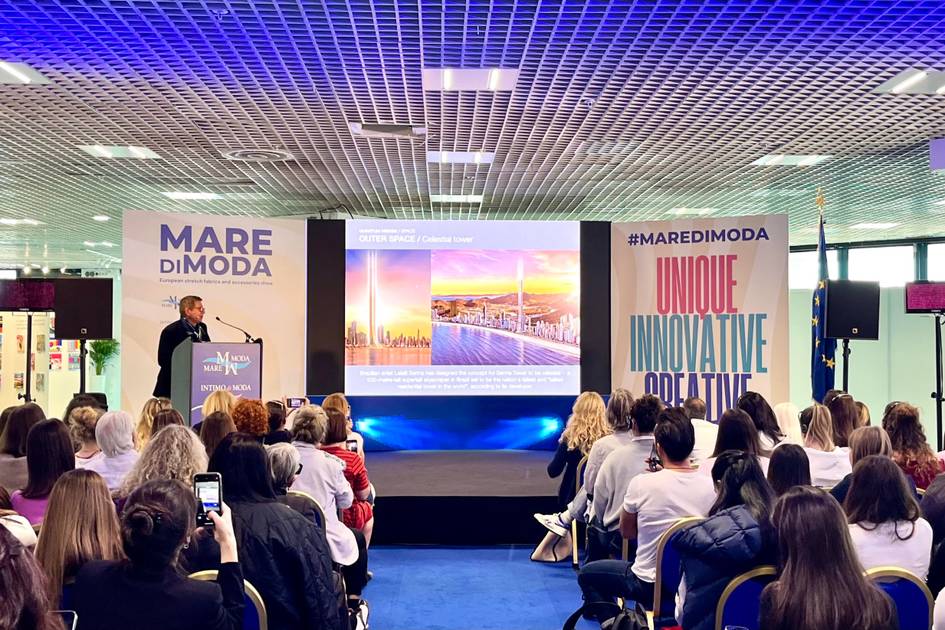
From October 22 to 24, 2025, Mare di Moda, the leading European fair for swimwear, lingerie and athleisure fabrics, will take place at the Palais des Festivals in Cannes. This event annually attracts the continent’s most innovative designers, manufacturers and design studios. But behind the swimsuits and innovative fibers, Mare di Moda is also a place where the future of the global market is taking shape, two years in advance.
As chief guest of this 2025 edition, David Shah – publisher at Metropolitan Publishing BV and professor at the ArtEZ Academy – captivated the audience with a lecture that was as profound as it was future-oriented. In one hour, he dissected the soft signals and deep changes that will shape the fashion and textile industry by 2027.
Between experience and inflation: the new consumption paradox
“People travel, but don’t buy anything anymore,” notes David Shah. This paradox, visible in both ready-to-wear and swimwear, reflects a profound change. The global middle class is now willing to pay top dollar for experiences such as long weekends or wellness retreats, but is hesitant to invest in clothing. Premium brands, from beachwear to lingerie, must therefore find a balance between high quality and price justification.
Recent scandals in the luxury sector, particularly around Loro Piana, have increased distrust. Consumers now expect tangible, measurable value, supported by coherent storytelling. In this context, clothing primarily becomes an object of use rather than a status symbol.
Still, some segments are holding strong. Sportswear continues to grow at almost seven percent annually, driven by a unique blend of lifestyle, health and mobility. Since the coronavirus pandemic, Shah points out, “sport has become a way to get out of the house, a ritual for social escape.”
This dynamic is amplified by the growing importance of wellness, especially among Generation Z, who, according to Shah, “value wellness over wealth.”
Sportswear and hybridization: the new creative matrix
According to David Shah, 2027 will be the year of ‘hybrid fun’ – a mix of technical aesthetics and sensory emotion. Textiles become performant, breathable, protective (anti-UV, anti-salt, quick-drying) and durable, while retaining a soft and light touch.
These are the main directions:
- Layering – functional layers, inspired by Skims and The North Face;
- Sculpt – shaping fabrics, a dynamic silhouette;
- Glow & Shine – satin or iridescent materials, discreet elegance;
- Sober luxury – plain tones, precious minimalism.
Women’s sports continues to transform the market. “Women are no longer just participating in sports, they are redefining its codes – from sneaker design to brand communication,” Shah explains. They bring a desire for beauty, story and emotion to the segment, where men previously valued performance.
But behind the sector’s vitality, a question arises: is the sportswear market saturated? Nike is going through a difficult period, Asian, and especially Chinese, competition is getting stronger, and new outdoor brands are emerging with a more lifestyle-oriented than athletic approach.
‘Desired’: the return of emotion and romance
While the 2020s were all about functionality and minimalism, Shah now sees a return of emotion, color and romance. No more restrictive and standardized styles: 2027 promises to be the year of reclaiming visual pleasure. Lines become softer, colors become more vibrant and stripes get an ombré effect. The key word? Desired.
Consumers, tired of the crises and the gloomy atmosphere, are looking for a happy ending, tenderness, flowers and sensual textures. The color palettes become softer – powder pink, water blue, light coral – and floral motifs make a comeback, modernized by digital techniques.
There is also a strong trend: ‘kidulting’, the fascination with cuteness – cats, toys, naive worlds (think Labubu) – that reflects a search for innocence in a world full of uncertainties.
Between modesty and excess: the two faces of desire
While fashion is rediscovering emotion and fantasy, another trend is emerging: that of conscious modesty. “Saint-Tropez (fashion’s summer showroom) is no longer the temple of nudity and freedom; today it is about traditional marriages, austerity and religion,” Shah notes.
This more covert aesthetic – protective materials, anti-UV fabrics, sober lines – indicates less a step back in time than a need for support and stability. But at the other end of the spectrum, a desire for extravagance is reviving: the return of glitter, saturated colours, ‘ombré’ stripes and multi-coloured effects.
Since Anna Wintour’s departure from the front stage, discreet luxury has given way to an aesthetic of chaos, according to the expert. “The rich are starting to show that they are rich again,” Shah summarizes. This dualism, between protection and provocation, between restraint and exuberance, illustrates the spirit of the times: a fragmented but deeply expressive fashion, in which each extreme reflects the same search for meaning and visibility.
Textile innovation: the key role of technical players
On the industrial front, Shah highlights the role of smart fibers and premium recycling, driven by players such as Lycra, “one of the few still convinced that sustainability and performance can coexist.” Substances that tan the skin or contain protective micro-treatments are gaining ground.
In addition to the material effects, there is a whole Euro-Mediterranean ecosystem reorganizing around innovation: short chains, partnerships between spinners, designers and manufacturers, supported by European programs.
2027: coveted, hybrid, romantic and conscious
At the end of this 2025 edition, David Shah paints a picture of a fashion that is coveted and liberated, but now firmly anchored in reality. Reading between the speaker’s lines it becomes clear that 2027 will be a year of accepted contradictions: protection and sensuality, romance and achievement, introspection and expression. Fashion is no longer just trying to fix the world; she wants to feel it again, to restore the bond with material, emotion and the pleasure of existence.
The five fashion & textile trends for 2027
- Hybridization – sport, luxury and functionality merge into new stylistic domains.
- Emotion – the return of color, romance and stories in the creative process.
- Protection – the emergence of smart, light and breathable fabrics with anti-UV and anti-heat properties.
- Kidulting – nostalgia and the sweetness of childhood are embraced as comforting values.
- Exuberance – the end of minimalism: the return of ‘show-off’, vibrant materials and visual joy.
This article has been translated into Dutch using an AI tool.
FashionUnited uses AI language tools to speed up the translation of (news) articles and proofread the translations to improve the end result. This saves our human journalists time that they can spend on research and writing their own articles. Articles translated using AI are checked and edited by a human desk editor before going online. If you have any questions or comments about this process, please email info@fashionunited.com.
