


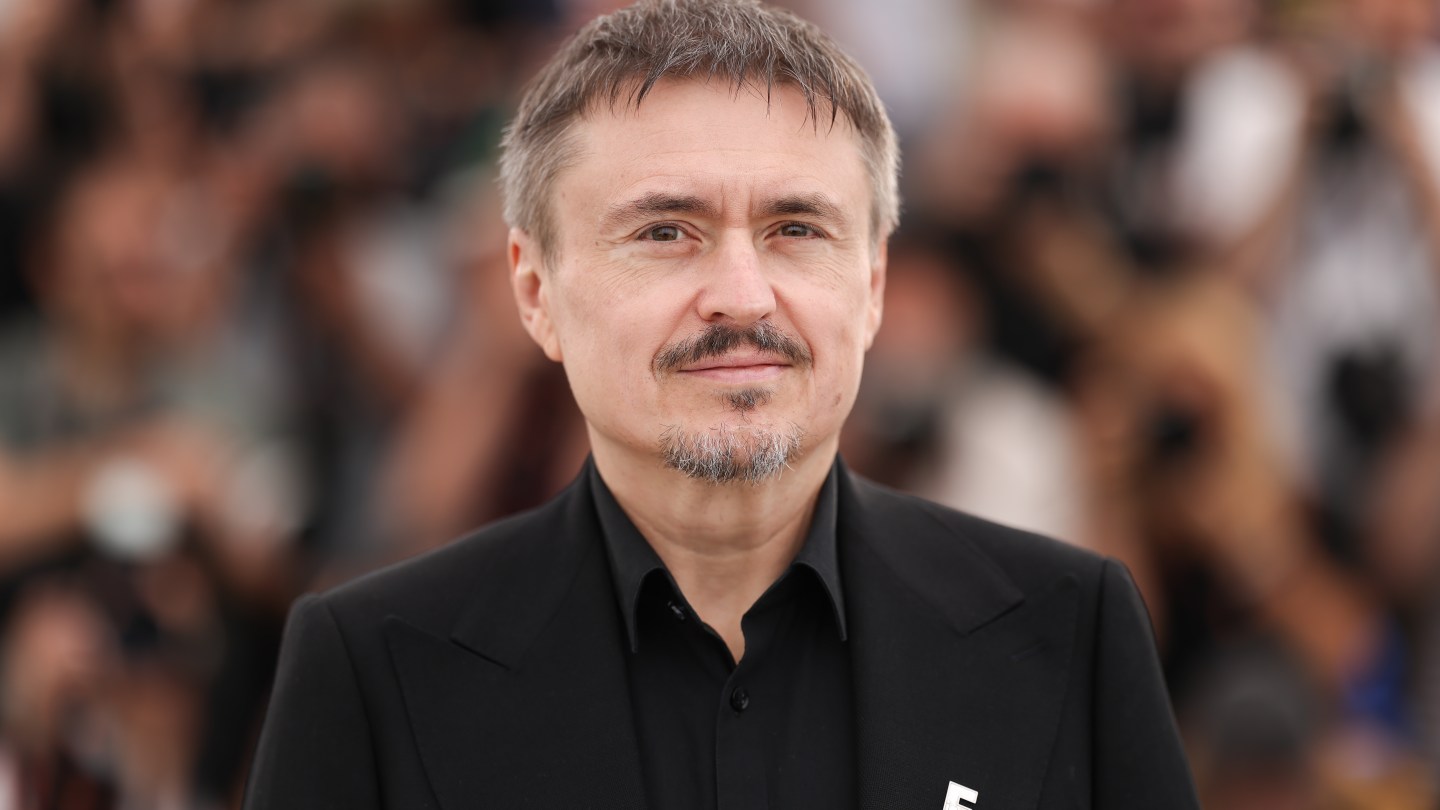
Nearly two decades after winning the Palme d’Or with 4 Months, 3 Weeks and 2 Days (2007), an abortion thriller set in Communist-era Romania, Cristian Mungiu is back in Cannes with another challenging, potentially hotly divisive film about the clash between progressive and conservative values and what it means to live in a free society.
In Fjord, a Romanian Evangelical family, headed by father Mihai (Sebastian Stan) and mother Lisbet (Renate Reinsve), moves to Norway, only to be confronted by local welfare authorities, who view their traditional child-rearing methods — including occasional corporal punishment — as child abuse. The legal trial that follows becomes as much about their beliefs as about the alleged crimes committed.
Fjord is Mungiu’s first film made outside Romania, and his first shot (at least partially) in English, but the film echoes themes — of globalization, cultural conflict and the divide between rich and poor, East and West, traditional and progressive — that define his work.
The Hollywood Reporter spoke with Mungiu in Cannes about the real-life inspiration behind the film, working with Stan, and why he believes cinema should provoke debate rather than confirm ideological certainty.
What sparked the story for this film? Was there an inciting incident?
Absolutely, yeah. Actually, I started from several articles in the press, but particularly one which is very close to what you see in the film, and I started noticing a kind of a pattern of such incidents. Some 10 years ago it was conflict between a Polish family and the Danish authorities, and then a conflict between an Indian family and the Swedish authorities, and then this case of a Romanian family and the Norwegian authorities. Little by little, I saw this pattern of conflict between conservative values and progressive values, and it’s more obvious to see happening in the Nordic countries, because they are the most progressive in Europe.
I followed the Romanian case in detail. I ended up contacting the families and talking to them. I went to Norway, to talk to the prosecutors and the judges, to the press and journalists. Finally, I decided to fictionalize the story, not do a reenactment. So this isn’t how it really happened, but the story is not far away from what I discovered.
What drew you to this particular conflict between a progressive society and a conservative family?
Well, I think that it is the main conflict I see around us in our societies today, from the U.S. and France and Italy and descending down from Norway to Romania. I think we live in a very polarized society in which you have these two groups of people who believe that they are right, that they have the one truth, and this has led to a kind of social violence which makes it impossible to live together in the same society. We are divided into groups that became so radicalized that we can’t find common ground.
We see this very often when the results of elections surprise us, because we haven’t talked to these people and we haven’t asked what they think about the society in which we live.
I think that it’s important to use cinema to speak about the concerns that we have about the direction in which our societies are going. That’s always the most important topic for me in my films — to understand the issue of the day.
I think that this conflict, which doesn’t have a clear solution, is something that we need to tackle, and we need to look for some answers, because if not, we will just end up killing the others that don’t think the same way that we do.

Renate Reinsve and Sebastian Stan with cast in ‘Fjord.’
Cannes Film Festival
This is your first film made outside Romanian. How different did you find Norwegian society, and Norwegian bureaucracy, which is central to the film’s plot, compared to Romania?
First of all, it’s important for me to underline that this film is not about the conflict between Romania and Norway. It’s way more than this. It’s the conflict between a layer of society which had access to privilege, education and wealth, access that allows people to be more empathic, and the level of society of people with fewer opportunities which have these conservative views.
But of course Norway is a very different society that Romania, you go there and see they don’t view the world in the same way. When we arrived, we ere locking our doors and taking our wallets with us, and they kept asking us why, saying “We don’t do that here.” We’d say: “But there might be bad people around, thieves.” They said “No, there’s aren’t.” Then we joked, “Well, we’ve brought this big Romanian crew with us, so don’t be so sure.”
A big difference working in Norway was they only work eight hours a day. Even film crews! It was a shock for us. I mean cinema was born in California, you need the sun, and you work all day. But little by little, we managed to overcome these differences and focus on things that we have in common. We ended up as a single crew working on the same film.
There’s was a funny incident that shows you the difference between the societies. We found this lovely location with two neighboring houses [to play the homes for the conservative family and their progressive neighbors], and easily convinced one family to let us shoot there, but we couldn’t contact the other owner. We kept asking our Norwegian partners to contact these people, to call this guy, and they kept telling us “Well, we left him a note.” We said, “Why don’t you go and knock on the door and talk to him?” They said “That’s not how we do things.”
Finally, two weeks before shooting, they found him. They told us, “He seems like a difficult person. He hasn’t talked to his neighbors for some 10 years.”
Actually, he was a very nice person, very reasonable and gave us permission to shoot. It turns out he hadn’t talked to his neighbor in 10 years because he never wanted to disturb him. Nobody had started the conversation.
Eventually, after we shot there, they became very good friends. They needed somebody from outside with a different set of values to come over and show them they had a lot in common. But there was a little too much respect for privacy in the culture.
How hopeful are you that liberal humanism and dialogue are still possible in today’s society, especially in the age of social media, which plays a big role in the film?
I’m not this kind of optimistic person saying, “Hey, don’t worry.” I don’t think that things go naturally in the right direction. We need to make some effort to keep them in the right direction, always.
If you watch what happens today, we see that people are a little bit tired of democracy, because democracy is not something natural — it requires effort. Empathy requires effort. We are not born empathic when we’re children. We’re very selfish. This comes with education.
We need to make an effort of generosity, to share our wealth with poorer areas and societies, if we wish the world to advance in the right direction. We can’t just advocate for social liberal causes to people who don’t have clean water. We need to get more involved. We need to understand that people with more resources acquire more empathy. We can’t just vote for inclusion and empathy, we need to practice it. And this requires effort.
It’s not enough to believe our values are good. We need to convince people that they are good, not just enforce these values on them. Because if we do that, they are just going to surprise us every four years when they vote, by being seduced through social media by all these irrational arguments of the populist parties that don’t care at all about ethics.
How do you balance tolerance in a liberal democracy with people who fundamentally reject democratic values?
This is why I made the film in Norway, not in Belarus. There is no debate in Belarus. I come from a communist country. There was no debate about your right to doubt what was imposed as truth in society.
But I hope there is still room in a democratic society to talk about the values that you are having and the most appropriate way of spreading them around. I have a great respect for Norway and for the Nordic countries. It’s a very civilized society. They need to be less rigid in understanding that not everybody was so fortunate to reach this level of empathy.
You need to be patient a little bit, and you need to find ways of engaging in dialogue. It’s not helpful to say, “Trust me, this is going to be good for you.” You still need to convince people and invest in educating people, not enforcing your set of values, even if you are certain that it’s for their own benefit.
I think this film is a lot about fundamentalism. If you have a mindset of fundamentalism, it’s not such a big difference between right-wing and left-wing fundamentalism. I think that we should meet somewhere in the middle and start by accepting that some people won’t have the same opinions and values as we have.
Were you concerned about making this critique in Norway rather than in your own country?
I think they are smart enough to accept criticism, while a conservative society wouldn’t be smart enough to accept criticism. I was very happy to see that their reaction was accepting that maybe they still have things to improve, and this is what I was hoping from such a civilized society.
The danger is more when you’re trying to bring this kind of subtle balance into a conservative society, because there, things are simpler. You don’t have the right to doubt things.
I hope that I stir things and create a polemic. The film is just the trigger for a conversation that I think we need to have in society, and I hope that many people will start from the film to feed this conversation and this need of trying to speak openly about things that were not spoken openly about for too long.
I think cinema has a part in this as well. I think that films became too political in the last 10 or 15 years, always confirming the “right values.” We need to balance this with films that allow us to express doubts about the values of the day. This is part of democracy and freedom that we need to keep alive as well.
How did Sebastian Stan become involved in the film?
I met Sebastian some 10 years ago. He came to see me after a screening in New York of Graduation. I think that’s a very funny moment, because his mother drove him 400 kilometers from upstate New York so that we could meet.
Because he speaks Romanian — he was born in Romania — we communicated very easily, and we decided that one day we would look for something we could do together, but something that would fit my kind of cinema and his kind of cinema.
For this film, I told him, “I’m sure you can play the dramatic role, I’ve seen that in your other films, but you look too much like a Hollywood star. But this guy’s not [Stan’s MCU character] Bucky.”
We needed some sort of physical change to make him into this humble person raised in a society where he didn’t have any rights. I said: ‘What if we make you bald?” He wasn’t sure. So we put an ad on Instagram in Norway: “Looking for Sebastian Stan fan that wishes to be shaved to be a stand-in.” We got one, shaved him, did the test and [Stan] liked how it looked.
The bald bit helped him a lot, because he’s a method actor. He needs to be close to the character, and this humbleness and this idea not being proud of how he looks brought him closer to Mihai.
It also helped a lot that he and Renate had worked together before [on A Different Man (2024)]. We had very little time to prepare. When they arrived on set we needed to shoot right away. It helped a lot that they knew each other beforehand. They already had the chemistry.
Do you worry that the film could be embraced by right-wing groups claiming victimhood?
Absolutely. I think this is going to happen, but it’s a risk that I thought was worth taking in order to defend this right that we’re still having to doubt the values in which we believe, and also to speak about manipulation.
All the films that I did before were manipulated for one cause or another. 4 Months, 3 Weeks and 2 Days was considered either a film defending or going against the right to abortion, and Beyond the Hills was considered both a fierce criticism of religion and an Orthodox movie.
So I’m used to it, and I think that we need to use our critical filters when we look at these topics. Expressing doubts about our liberal society doesn’t mean for a second that I’m a defender of a conservative society. It means that I trust progressive society more in its capacity for admitting self-criticism.
