


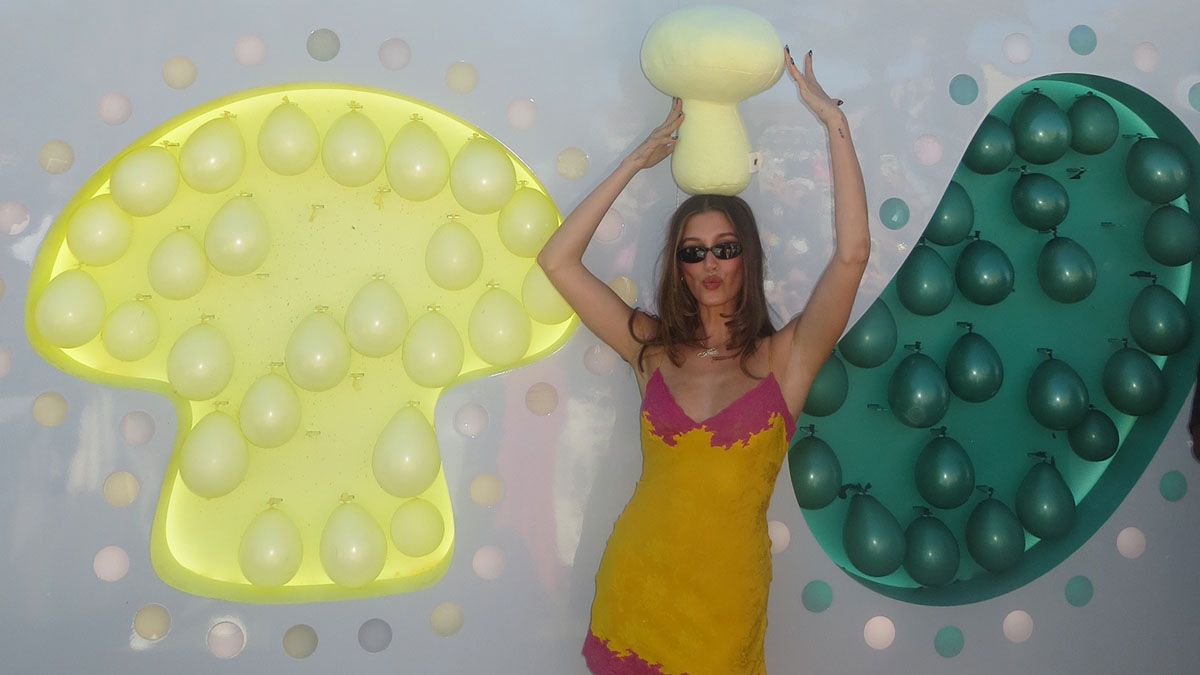
At Coachella weekend one, brands were out in force. Justin Bieber’s Skylrk hosted a ‘Skylrk Oasis’ on the festival grounds, which will continue into weekend two (it’s Bieberchella, after all). Gap, Coachella’s exclusive clothing apparel sponsor and official merch partner, sold hoodies at its ‘Hoodie House’, also on the festival grounds. Off-site, Rhode hosted Rhode World, its first Coachella compound, alongside desert regulars including Revolve, Poosh, Guess, 818, and more.
A mix of CPG brands also got in on the action, from desert veteran (and influencer-friendly) Poppi, to companies like Starbucks and cleaning product brand Method. It’s a reflection of Coachella’s ascent from fashion and beauty influencer Olympics to pure brand play. “Now, ‘Brandchella’ is less about exclusivity and more about visibility,” says Vesper Ireland, founder of creative agency Vescorp. “In turn, the festival has traded some of its underground creative energy for mass cultural reach, which, for brands, is ultimately more valuable.”
As Coachella has strayed further into corporate, commercial territory, onlookers had wondered whether the festival had reached a tipping point. Instead, things seem to be pointing in the opposite direction. “Coachella is unquestionably a different festival from its indie origins — and in recent years, its subsequent success as a commercial juggernaut has shown signs of waning. However, we’ve witnessed a resurgence this year,” says Rebecca Hobbs, senior trends editor for retail and brand communications at trends intelligence agency Stylus. “In comparison to its 2025 edition, tickets sold out and brand activity has ramped up significantly.”
It’s no wonder brands want in on the action, experts agree. Coachella is one of the most influencer-dense moments of the year, with creators on-site and clamoring to post videos in exchange for access — to the festival, to exclusive events, or to products. A well-run activation during Coachella generates more organic reach in 72 hours than a paid media budget of the same size could buy in a month, Ireland says. “Everything at Coachella is commercial,” says Eve Lee, founder of The Digital Fairy, who dubs Coachella the “brand mecca” of festivals.

But not all brands manage to break through the noise. Social media management tool Metricool generally puts a ‘good’ engagement rate in the 1% to 3% range; an engagement rate above this would typically signal a highly engaged following — not just strong visibility, according to the company’s influencer marketing specialist Alexandra Caceres. At Coachella, though, this isn’t the case. “Looking at the data, [many] well-established brands are actually landing below that [range], while newer or more culturally relevant brands are seeing significantly higher engagement,” Caceres says. Brands including Guess, Revolve, and Poosh all had engagement rates under 1%, according to Metricool. Meanwhile, celebrity and influencer-founded brands have a clear advantage. Alix Earle’s new Reale Actives generated 8.12% engagement with its Reale Actives casa, followed by Rhode at 3.68%.
