


When the world seems to be falling apart, people look for something to hold on to. “Now, more than ever, with the world plagued by crises and at risk of being engulfed by war, there is a growing desire for unity,” says Evelyn Meining, artistic director of the Mozartfest Würzburg.
Throughout history, the genius and beauty of Wolfgang Amadeus Mozart’s music has frequently provided comfort during times of crisis — and it continues to do so today. “As a composer, he is a figurehead, especially when there is a sense of hyper-stimulation and polarization,” Meining tells DW. That is why the motto of Germany’s largest Mozart festival this year is “Evoked Beauty: Mozart the Idol.”
Mozart as an idol of modernity
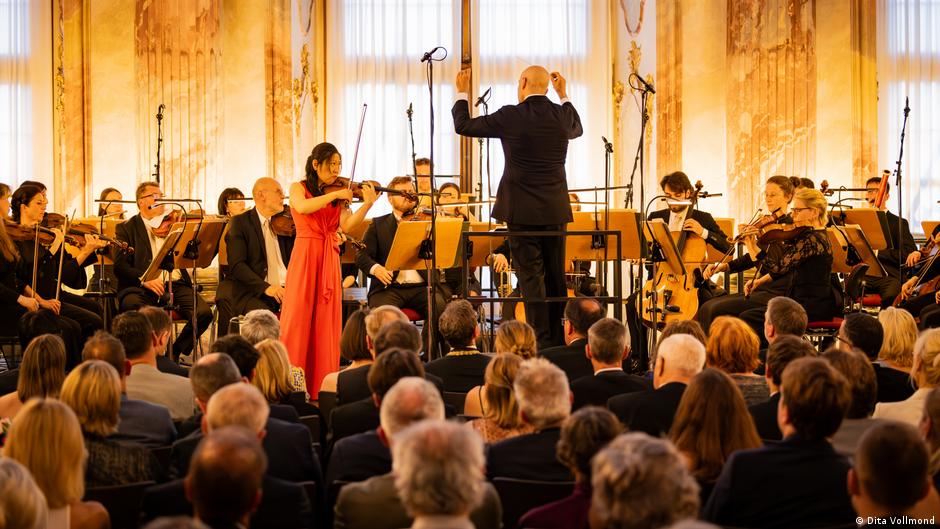
The opening concert of the festival, featuring the Mozarteum Orchestra Salzburg, demonstrated just how powerful and moving Mozart’s music can be. The Salzburg orchestra performed Mozart’s penultimate symphony in G minor.
The program also included modern works by Maurice Ravel and Sergei Prokofiev, both of whom admired Mozart.
Ravel admired Mozart as the “idol of a bygone era.” According to Evelyn Meining, “He shared Mozart’s view that music must enchant.”
Ravel’s work “Le Tombeau de Couperin” pays homage to the Baroque composer François Couperin. “It is a musical work of beauty characterized by clarity, elegance and melodic linearity, just like Mozart,” explains Meining.
Ravel composed the work between 1914 and 1917 during World War I and dedicated it to friends who had fallen in the war.
Sergei Prokofiev, too, admired Mozart’s classical symphonies for their elegance. He wrote his Second Violin Concerto in the mid-1930s. Upon returning from exile, he arrived in Russia under Stalin’s regime, in which mass arrests and atrocities were being committed against the people. A successful testament to this is his Violin Concerto, which Chinese violinist Tianwa Yang performed as a soloist, captivating the audience from its delicate opening to its stormy finale with the beauty and expressive power of her performance. She was celebrated with frenetic applause.
Mozart as a hero of the crisis
While Mozart’s music is often perceived today as beautiful and light, it is meticulously calculated and often difficult to play. “In his day, Mozart’s music repeatedly confounded, even provoked and overwhelmed people,” says Evelyn Meining, citing, for example, its increasingly dissonant sounds and musical complexity.
After Mozart’s death (1791), his wife Constanze elevated him to the status of a genius. “He was hailed as a national spiritual figure, someone on whom people could agree amid a time of national division.”
At the beginning of the 19th century, Europe was marked by the collapse of the old feudal system following the Napoleonic Wars. The citizens wanted freedom and national unity, while the princes sought to restore absolutist rule.
In the 20th century, following the collapse of old Europe due to the world wars, Mozart became an object of longing. “Many artists and intellectuals were searching for something that embodied moderation, order and humanity that would give them stability in times of collapse and terror.” Mozart brought light into those dark times, says Meining.
Connecting with Mozart
Solo violinist Tianwa Yang still sees Mozart and his music as an idol today: “For us musicians, he is someone who is not of this world. Someone from another universe.” Even so, she says, one should not be paralyzed by awe in the presence of this idol. “When you listen to the music and like it, you feel close to the composer and think you understand him, which may not be true. But there is a certain connection with him when playing the music, and that’s what counts.”
This year, Tianwa Yang is the featured artist, or “Artiste Etoile,” of Mozartfest. Not only does she perform the classics, but she also focuses on contemporary music. It was for Yang that renowned composer and clarinetist Jörg Widmann specifically wrote Etude No. 7 for solo violin, also known as the Jupiter Etude. He, too, frequently returns to the classics, this time with Mozart’s Jupiter Symphony. Like the G minor Symphony, it ranks among Mozart’s best-known works. The piece will be performed for the first time on June 26 in Würzburg.
Using humor to knock Mozart off his pedestal?
As an idol, Mozart is not beyond reproach, and his music can also be made accessible to young people.
In his humorous lecture-performance “Nothing Is Sacred,” the German-Turkish-Armenian composer and writer Marc Sinan exposes the mechanisms of power, culture and history that lie behind the untouchable “saints on pedestals” of music history: Mozart, Bach and Beethoven. He chips away a little at their pedestals.
Thanks to his German father, Sinan was exposed to the classics from childhood. Together with the Eliot Quartet, he interrogates these musical giants. “And through his non-European background, he connects his questions to the present-day reality of a society of migration,” says artistic director Meining. “He is interested in what the musical histories of other countries look like.” Nevertheless, Evelyn Meining reveals that Mozart will survive in the end and will not be knocked off his pedestal.
This article was originally written in German.
