


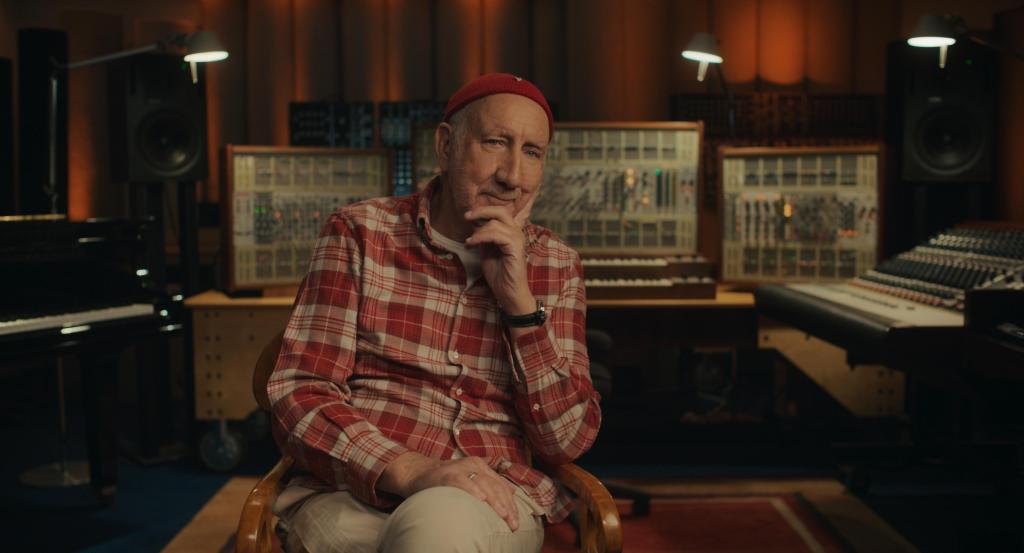
The British invasion of the mid-1960s was a multi-pronged attack, an assault led above all by The Beatles, The Rolling Stones, and The Who. Their seismic impact on American and world culture has been well documented. But of the leaders of those three mega-bands, perhaps the most mysterious remains Pete Townshend, The Who’s songwriter and enigmatic eminence, thrashing chords and smashing guitars while Roger Daltry handled lead vocals.
His sheer brilliance and rock innovation is captured in the documentary Pete Townshend: Behind Blue Eyes, which held its world premiere at the Telluride Film Festival. It’s directed by Frank Marshall (The Bee Gees: How Can You Mend a Broken Heart) and Nigel Sinclair (producer, Billy Preston: That’s the Way God Planned It). Despite the enormity of The Who’s success – the rock operas Tommy and Quadrophenia, songs “Won’t Get Fooled Again,” “My Generation,” “Love Reign O’er Me” and so many others – somehow the band’s primary creative engine can remain obscured.
“A lot of people, when we say, ‘Oh, Pete wrote all the songs,’ they go, ‘What?’ They don’t understand because Pete’s also very quiet,” Marshall says in an interview at his home in Telluride. “He’s not the front man. Roger’s the front man… So, I do feel he’s underappreciated.”

Pete Townshend in Paris, August 1972.
Michael Putland/Getty Images
Key to understanding Townshend, as the film explores, is his background as an artist. He studied at Ealing Art College as a teenager and absorbed lessons from a teacher there, Roy Ascott, who propounded theories of technology and consciousness that would deeply influence Townshend. An exercise at Ealing in “auto-destruction,” where students smashed up pianos or other musical instruments, would lead to Townshend’s signature move with The Who, destroying his guitar at the end of performances.
“Actually, I have one of those smashed guitars, which I had a guitar builder lay out in an exposed frame like a skeleton,” Sinclair tells us. Smashing instruments “became a habit in shows. Obviously, in that club on Goldhawk Road, [Townshend] didn’t intend to do anything. His guitar went up into the ceiling and broke through cheap, old fashioned kind of stuff — with asbestos in those days. And it crumbled on Pete — the guitar and the neck was tipped over. So, he just threw it on the ground and smashed it. That was the first time. And the audience and Roger and the other [band members] are genuinely thinking, ‘What is he doing?’ And then [Keith] Moon, who only takes him about half a millisecond to tack, immediately started smashing his drum kit.”
The Who’s Pete Townshend smashes a guitar against an amplifier at a UK club on March 13, 1967.
Chris Morphet/Redferns
More than mere theatrics, the frenetic smashing of instruments and The Who’s music itself, written by Townshend, channeled the sense of rage, frustration and angst felt by so many young British people in that post-war period of crumbled empire and dwindling opportunity.
“We see it in that first [Who] song, ‘Can’t Explain,’ when somebody said to him, ‘You’re expressing what we all feel and that connection,’” Marshall comments. “And he didn’t even know, but he was, as an artist, taking what was happening and channeling it into a song.”
Pete Townshend: Behind Blue Eyes contains remarkable archive footage of the band in private moments and on stage, material unseen for decades. Archival producers Kate Griffiths and Catalina Curbishley were key to unearthing it.
Portrait of English rock band The Who, standing in front of flags wearing mod clothing, London, circa 1966. (L-R) Keith Moon, Pete Townshend, Roger Daltrey, John Entwistle.
The Visualeyes Archive/Redferns
“The Who had actually put all of their assets in frozen storage back in the ’80s. It’s in this house, in somebody’s back garden,” says producer Cassidy Hartmann. “Our team actually went in there and sorted through everything and found this material and we were able to transfer it. And once we saw it, of course we were astounded at what was there because it’s like the dream of every documentary filmmaker to find something like this that no one’s ever seen.”
“The treasure chest,” Marshall says.
Pete Townshend of The Who pictured playing an acoustic guitar with his father Cliff Townshend (1916-1986), saxophone player with the Squadronaires, at home in London on March 30, 1966.
Larry Ellis/Daily Express/Hulton Archive/Getty Images
Townshend was born in West London in May 1945, just days before Germany’s surrender, to musical parents – his father a professional saxophonist and his mother a singer. His parents’ marriage was a rocky one and as a small boy, Pete was sent to live with his maternal grandmother, a woman he would later describe as “clinically insane.” That devastating experience would unconsciously inform Tommy, the rock opera about a “deaf, dumb, and blind kid” who becomes a pinball wizard.
“A big part of our approach to the film was surrounding this idea of Pete as two people, as this divided person,” Hartmann observes. “And I think the trauma speaks to that. He says, ‘I divided then back when I was a kid and became this introverted, imaginative writer person.’ And then of course he also becomes this rock star on stage. And I think a big part of the tension in the film that we were interested in was that contradiction between those two sides of himself and his struggle to kind of reconcile those.”
Pete Townshend: Behind Blue Eyes screens Saturday and Sunday at the Hamptons International Film Festival in New York. It also screens Sunday on the other side of the country – at the Mill Valley Film Festival in Northern California. “Behind Blue Eyes,” of course, is one of Townshend’s greatest compositions, a song at times plaintive and reflective, at other moments ferocious in its anger. That, and “Going Mobile,” “Baba O’Riley,” and “Won’t Get Fooled Again” were written for Lifehouse, a kind of futuristic rock opera Townshend created after Tommy. It was his single most ambitious project (which is saying something) but never came to fruition, for reasons explored in the film. Lifehouse remains the great white whale of Townshend’s career, and a narrative thread throughout the documentary.
Director Frank Marshall on June 23, 2025 in New York City.
John Nacion/Variety via Getty Images
“The engine for us was once we realized that he wants to feature this abandoned project, Lifehouse — which is quite hard to understand and of course collapsed for a number of reasons over the years — but it’s incredibly important to him,” Sinclair says. “It’s an itch that he never stops scratching… Frank said we needed to actually explore Pete as a person because what’s interesting about Lifehouse is it’s so important to him. That’s what drives [the film].”
Distribution plans for the documentary are pending. Given the track record of Marshall, Sinclair (Wilder, David Frost Vs.) and Hartmann (The Apollo, Lilith Fair: Building a Mystery), optimism on that front seems warranted. Marshall, a five-time Oscar nominee and six-time Primetime Emmy nominee is one of the top producers in motion picture history. At Telluride, the film became a hot ticket, generating interest from festival-goers including a certain Oscar-winning director, who had his own film in the festival, Ink.
Producer Cassidy Hartmann and director Nigel Sinclair attend the Telluride Film Festival on September 4, 2026.
Vivien Killilea/Getty Images
“Danny Boyle was over there saying, ‘I’ve got to see the Townshend film,’” Sinclair reports. “So I spoke to him and said, ‘If you can’t see here, I’ll send you a link.’ So we’re feeling pretty good about getting it placed.”
Hartmann was born after the height of The Who’s success. “I learned a lot on this project. I developed a deep affection for Pete especially. And I did see an opportunity to introduce the band to a younger generation,” she notes. “I thought that there was an opportunity there for that to connect with a bigger audience than just The Who fan base. There was something relatable and universal in Pete’s story for anyone who’s a creative person trying to do something in the world.”
