


Nine years since his last film, several of them spent slowly recovering in Germany from a bout of Covid that all but extinguished his lungs, Andrey Zvyagintsev, the greatest of all the living Russian directors, is back in Cannes with a chronicle of crime and — for the rich, the influential and the crafty – the conspicuous absence of any punishment.
Zvyagintsev has never cast himself as a dissident; his dense stories of corrupt authority and moral turpitude could arguably be told anywhere. Indeed, Minotaur, in Cannes’ competition, is actually based on a French film, Claude Chabrol’s The Unfaithful Wife, which was released in 1969. Its key elements — a jealous husband, a frustrated wife, a meticulous account of how difficult it can be to dispose of a dead body — follow the French auteur’s template; spurned lovers are the same the world over.
In its details, atmosphere and moral force, however, Minotaur is unmistakably Russian. Watch those Russian nouveaux-riches quaff their imported wine as the ladies congratulate each other on their excellent plastic surgery. See yet another local official destroy ordinary workers’ lives to protect his own booze-raddled skin. Read the graffiti on the bridge where that dead body is tipped into the swamp, a little squiggle saying, “F*ck your war.” There is no question about where we are. It is 2022; Russia has just marched into Ukraine.
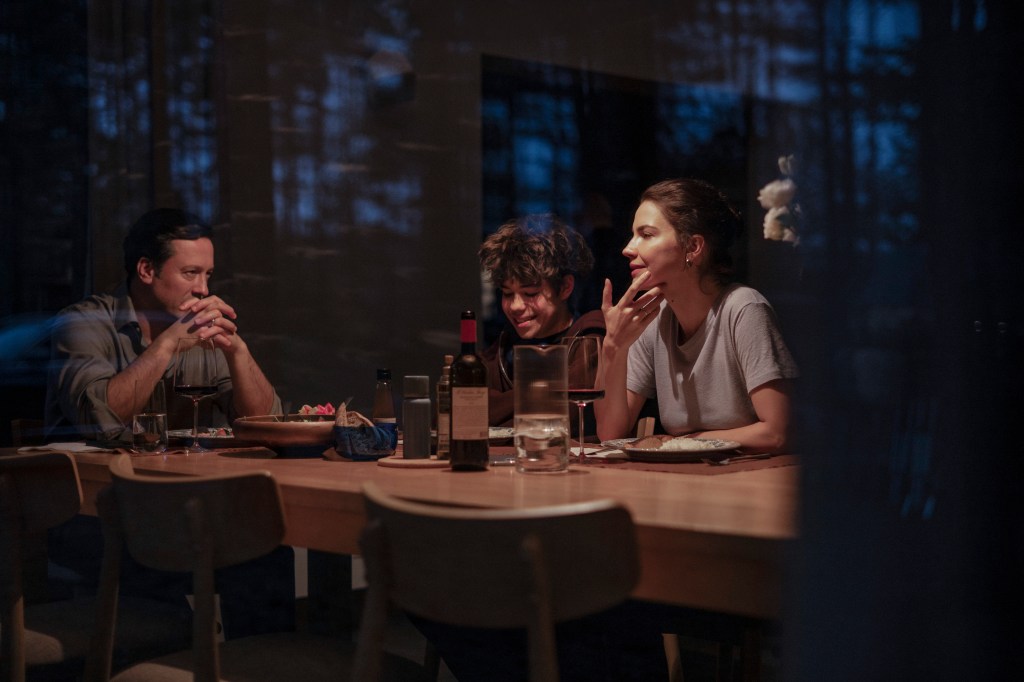
That war is everywhere, like fog rising from the lake where Gleb (Dmitriy Mazurov) and Galina (Iris Lebedeva) live with their withdrawn teenage son in isolated, dreary luxury. Overnight, it has poisoned Gleb’s export business; the European borders are closed. It has taken over City Hall, where the drunken mayor is acting on orders to provide Moscow with a fair share of cannon fodder. All too believably, he is answering that call by levying a set number of conscripts from every local company, demanding that managers like Gleb provide lists of workers they are prepared, quite literally, to sacrifice.
The war is also helping drive Gleb mad. With no recognizable rules, there is nothing to tether him. He senses that Galina is having an affair. He isn’t exactly angry. He is simply going to obliterate the problem, like a tank rolling into a village on the Ukraine border. Mazurov, in a terrific performance, conveys a man in the throes of both burnout and shock. Too wasted to summon great expostulations of emotion, he focuses on devilish details. We live every moment with him as he tries to wipe blood from a parquet floor. No, Gleb, paper towels won’t work. That’s right, get the fluffy ones from the bathroom! The camera — and by extension, the audience — becomes his accomplice.
This is essentially the spirit of Minotaur. As the teller of a moral tale, Zvyagintsev doesn’t go all in, guns blazing. He doesn’t deliver a final judgment. His gaze, however, is unremittingly stern, as if he were holding the scales of justice in his hand, waiting to see the balance tip. We observe everything with him, whether through a long lens like a police detective, or in domestic scenes where it is as if we were sitting on the opposite side the bedroom, seeing Gleb approach Galina sitting at the dressing table and enfolding her in a hug so that all we can see is her leg twitching in rebellious revulsion. His office is a maze of glass partitions where offices are closed but nothing is private; the house has no curtains, so we can spy on them as they eat together in silence.
Zvyagintsev is not afraid of silence. Nor are his characters, for whom it can be both refuge and weapon. Galina barely speaks at home, which makes her longest outburst, railing against her son for choosing to order a margarita pizza — “Order something else for once! I can’t stand this!” — poignant in its absurd desperation. Music is doled out note by note, sometimes stripped back to a one-finger descending scale on the piano, often absent altogether. Minotaur is a masterclass in directorial discipline.
This strict weighting of elements may prove a challenging watch for viewers who can’t see the point of a pause. There are no firm conclusions, for all that the story smolders with outrage; it doesn’t make a political point, which may also feel frustrating. But that is to be expected; Leviathan, Zvyagintsev’s 2014 masterpiece, was similarly ambiguous. Minotaur doesn’t quite match that film’s moral sweep or exquisite skewering of a system that ensures that crime pays, but it is a great piece of work. Zvyaginstsev lives in France now, having decided while he was ill that he would not return to Russia while it pursued a war that shamed him. He is 62. Long may he prosper.
Title: Minotaur
Festival: Cannes (Competition)
Director-screenwriter: Andrey Zvyagintsev
Cast: Iris Lebedeva, Dmitriy Mazurov, Varvara Shmykova, Juris Žagars
Sales agent: Les Films Du Losange
Running time: 2 hr 20 mins
