


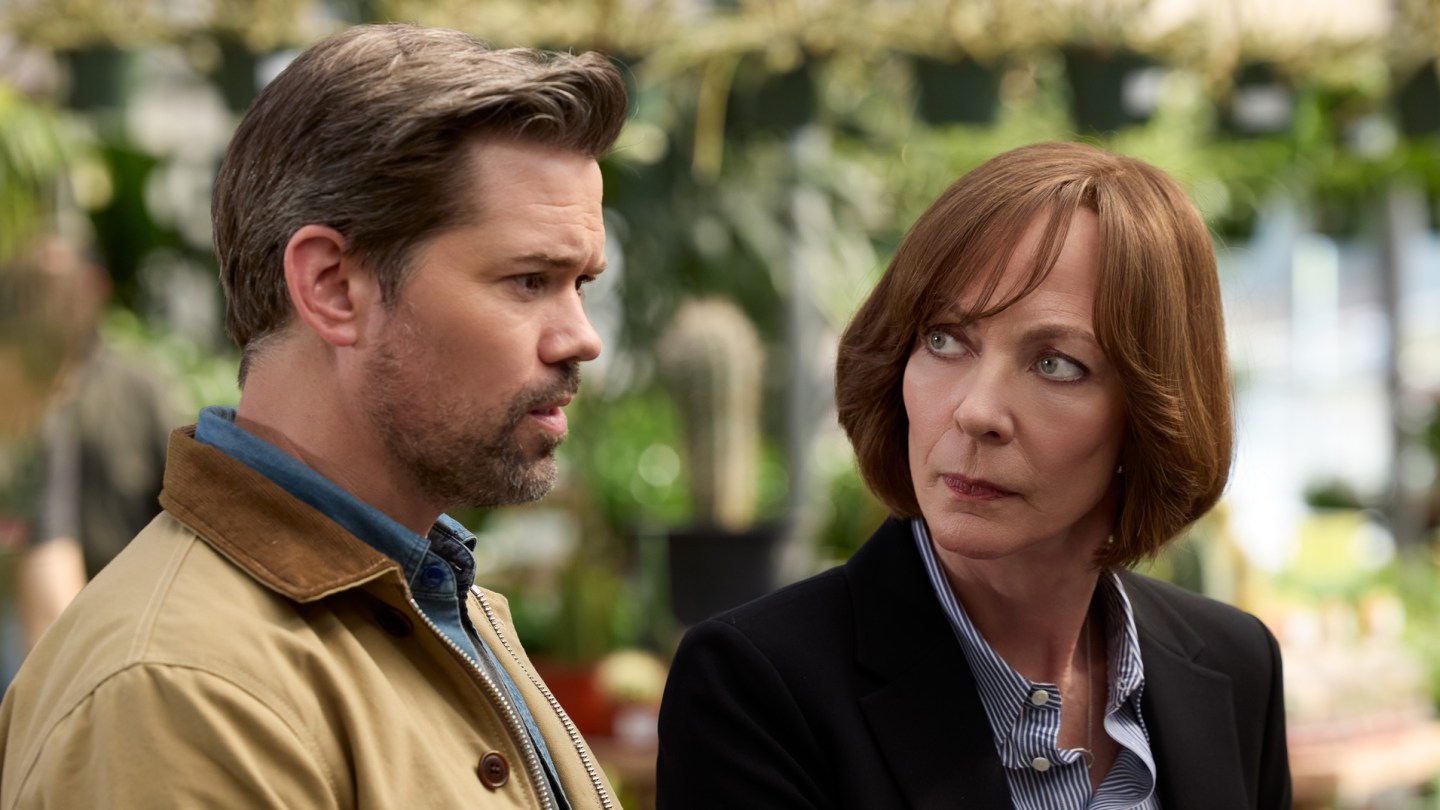
It takes some time to work out exactly who Jamie (Andrew Rannells) and Diane (Allison Janney), the two lost and lonely leads of HBO’s Miss You, Love You, are to each other. She might be his mother, but then she asks his name when he enters her home. He could be some sort of consultant, except he seems no more confident than she does when she asks how “this” is supposed to work.
As it turns out, it’s not just us: Diane and Jamie don’t really know who they are to each other, either. They are strangers, linked socially by a person who is not present and situationally by another who has passed. It’s a clever conceit, using the very nebulousness of their dynamic as a way to explore their messy, even ugly feelings surrounding the people who really matter most to them. But an overly mannered affect undermines the rawness of the emotions, keeping them from landing with the impact they ought.
Miss You, Love You
The Bottom Line
Raw emotions, overcooked execution.
Release date: 8 p.m. Friday, May 29 (HBO)
Cast: Allison Janney, Andrew Rannells
Director-screenwriter: Jim Rash
1 hour 37 minutes
The script by Jim Rash (who also directed) reveals the actual explanation for Jamie’s presence at Diane’s in pieces. Eventually, it becomes apparent that Diane has very recently lost her husband of 24 years, Henry. Jamie is the assistant to her son, Tyler, here to help with funeral arrangements while Tyler is stuck abroad for work. On paper, Jamie would seem to be the dream aide for a devastated widow — he’s competent, empathetic, almost pathologically insistent on being of use. But Jamie is no replacement for Diane’s semi-estranged son and they both know it, even if she snaps, “You’d be surprised how low that bar is,” when Jamie tries to acknowledge as much.
Diane’s prickliness is not limited to Jamie, and not new. Since moving to New Mexico from New York three years earlier, she says, “Henry made friends here. I made acquaintances.” With no one else for her to turn to but Jamie, Miss You, Love You unfolds almost as a two-hander, notwithstanding brief appearances by Bonnie Hunt, Oscar Nuñez and Suzy Nakamura as various townspeople. And most of their interactions take place within the confines of her tasteful two-bed-one-bath abode, notwithstanding occasional detours to the diner or grocery store.
The tiny cast and closed setting give Miss You, Love You almost the feeling of a stage play, to the extent that I was surprised to learn it’s not based on one. That sense is augmented by performances that feel slightly too heightened for the intimate drama this actually is, that might feel more at home before rows of theatergoers. The dialogue unfolds in exchanges too precisely rhythmic to feel natural and monologues that sound more like acting exercises than spontaneous expressions of emotion. Even the blocking and camerawork (by Daniel Moder) seem designed to prioritize our understanding of the characters, rather than the one they have of each other.
Still, within the constraints of a TV movie that seems to wish it were a play, the performances are good enough to keep things interesting. Janney knows just how to embody Diane, her posture braced against a world that can’t seem to stop dealing her blows and her face fixed in a semi-permanent state of pre-emptive disapproval. On the receiving end of Diane’s brusque, acidic comments (this is a woman who demands to know, “Am I a lot?” and then, when reassured she’s not, retorts, “That’s a shame, because I’m trying to be”), Rannells absorbs each blow with a compassion so determined it borders on desperate.
Miss You, Love You is hardly what you’d call unpredictable; if you’ve seen one indie drama about an unlikely friendship between two strangers, you can guess the basic outline of this one. But it benefits from the fact that there’s no pre-existing template or obvious destination for the relationship between a widow and her son’s personal assistant. The story is able to wander freely through their hurts, swerving or doubling back as needed.
Mostly, it winds up circling the two men who are so front of mind that their very absences become presences in themselves. The loss of Henry is as ambient and essential as air, felt not only in Diane’s grief but in the physical artifacts he left behind: the unfinished painting in a corner of a room, the succulent plant withering without his green thumb, the empty bowls he’d insisted on continuing to leave out for a cat who’d been taken by an owl weeks before his own death. If he seems more like an idealized memory of a person than a real person, that’s the point.
Tyler’s is a more intrusive sort of absence, announcing itself with the sharp pings of text messages that Diane cannot help but notice only ever seem to find their way to Jamie’s phone and not hers. More so than Henry, Tyler is the gaping hole around which Diane and Jamie’s connection grows, each of them sensing the other’s complicated feelings about him before they’re even able to admit them to themselves.
If Tyler seems more like a projection than a person who presumably has his own perspective on his relationships with them — to the point that I started to feel a bit sorry for the guy getting a ragging in absentia — maybe that’s also the point. When their emotions do finally boil over in the third act, Miss You, Love You is most effective for the way Rash, who won an Oscar for co-writing Alexander Payne’s offbeat grief dramedy The Descendants, refuses to pave over it with comforting platitudes or tidy life lessons.
“I’m not saying that for sympathy. I’m not saying that to excuse,” cries Jamie after spilling his deepest fears and regrets to Diane. “I just don’t know where else to put it.” There’s catharsis in simply allowing himself to finally feel and express those emotions. If only Miss You, Love You had been more able to allow us to feel them, too.
