


‘Resistance’
Igor Levit, piano; Kammerakademie Potsdam; Antonello Manacorda, conductor; Dörte Lyssewski, speaker (No Silence)
▶ Listen on Spotify, Apple Music Classical or YouTube Music
This recording, one of three inaugural releases from Igor Levit’s label, No Silence, combines two pieces of resistance, “where the soul of ‘no silence’ is central,” he told The New York Times. Schoenberg’s “Ode to Napoleon,” a wartime setting of Byron’s excoriation of Europe’s would-be conqueror, is followed by Beethoven’s “Eroica” Symphony, in Liszt’s solo piano arrangement. If Napoleon is the obvious historical link — Beethoven originally dedicated the symphony to him, and then angrily scratched it out when Napoleon crowned himself emperor of France — the pairing has more contemporary resonance when made by a pianist who has never been silent about his political stances.
Even apart from politics, this is an extraordinary release. Levit and the Potsdam strings make the Schoenberg a thing of terrifying force, slashing through the composer’s knotty score with both abandon and control. The actress Dörte Lyssewski is similarly ferocious in the spoken recitation. As for Liszt’s version of the “Eroica,” Levit, in a commanding performance, makes it seem like one of Beethoven’s great middle-period sonatas, with every dimension — technical difficulty, dynamic range, expressive power, sheer physical intensity — turned up to 11. In other words, he makes it sound wholly pianistic, perhaps the album’s greatest achievement.
— David Weininger
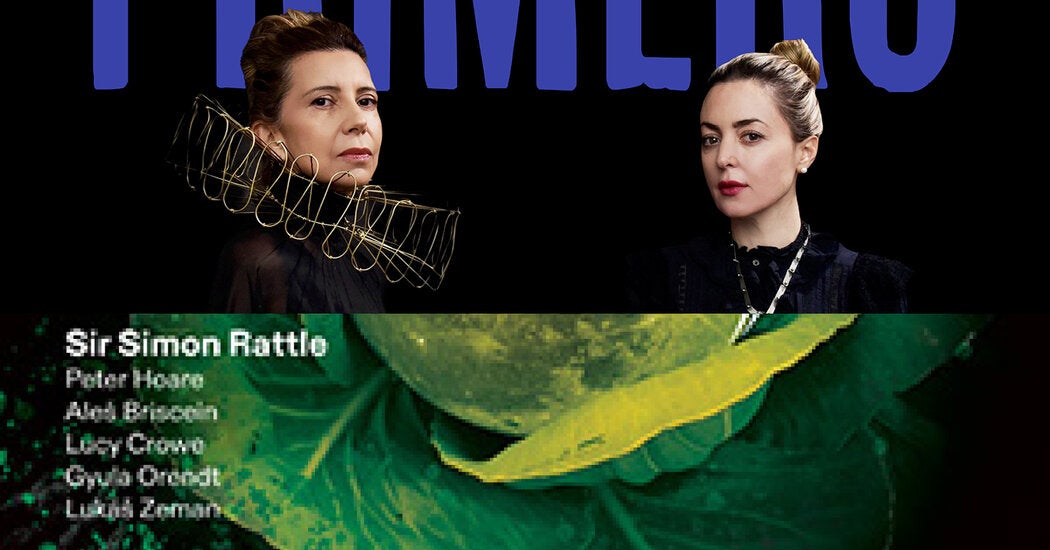
Paola Prestini and Magos Herrera: ‘Primero Sueño’
Ensemble Sjaella (VIA)
▶ Listen on Spotify, Apple Music Classical or YouTube Music
In 1692, a Mexican nun named Sor Juana Inés de la Cruz wrote a poem for herself: “Primero Sueño.” Her magnum opus, it contains more than 900 lines about dreams, the nature of knowledge and feminism, shot through with visions of a soul that arcs above the sleeping landscape to survey all with divine perspective.
In Paola Prestini and Magos Herrera’s metatextual operatic treatment of the poem, Sor Juana’s journey of the soul is also the journey of an artist, a woman struggling against repressive male authority to insist on her own way of knowing the world. The words are Sor Juana’s, but heard through Prestini and Herrera’s pared-down musical palette, they seem as if written anew. Strums of a guitar evoke both Baroque song and jazz; electronics and icy, clustered harmonies for Sjaella, the vocal ensemble that serves as Sor Juana’s fellow nuns as well as her muses, bring together contemporary techniques with a medieval tinge. But everything spins around Herrera, the acclaimed jazz singer and songwriter, who voices Sor Juana with vulnerable earthiness. In her voice, the mystic becomes undeniably material. “Primero Sueño” is vivid and hypnotic, worthy of its poet.
— Gabrielle Ferrari
‘English Dancing Master’
Phaedra Ensemble (Leo Chadburn)
▶ Listen on Spotify, Apple Music Classical or YouTube Music
After “Sleep in the Shadow of the Alternator” (2025), a haunting four-movement lullaby that travels through the seasons, Leo Chadburn continues his series of work in radiophonic composition on this album with Phaedra Ensemble.
“English Dancing Master,” a 26-minute piece for string quartet and narrator, is named after a popular volume of country dances published in 1651 by John Playford. His manual took in around 100 dances; Chadburn’s narrator introduces 20, but in a discursive piece more concerned with jumping off in new directions than with making a pastiche of antique styles. It takes the form of a constantly corrupting radio documentary, which dives enthusiastically into new subjects, restarting just as it threatens to digress.
For Chadburn, dance — and movement more broadly — is a fascinating aesthetic experience and a means of talking about other subjects. His narrator, also highly corruptible, conjures the alchemical thrill of dancing, without ever needing to imitate it musically. The string writing is simple and minimal, with a touch of John Adams.
Chadburn’s departures are diverse and inquisitive — including both the political history of British rave culture and how animals dance — though the through line is never lost. The piece is confidently realized, well-proportioned and individual.
— Hugh Morris
‘The Deeps Have Music’
Beth Taylor, mezzo-soprano; Hamish Brown, piano (Linn)
▶ Listen on Spotify, Apple Music Classical or YouTube Music
Without even reading the dedication, you could tell that Cameron Biles-Liddell wrote his two-song cycle “The Breakers” especially for the Scottish mezzo-soprano Beth Taylor and the pianist Hamish Brown.
The first song, “The Storm,” starts in the piano’s nether reaches, and Taylor intones a low F sharp with baritonal huskiness. Her voice rises through its break to a lovely, curling head voice. She bears down on the melody with a reinforced belt, and then leaps to a high F sharp, her voice vibrating freely. Brown transforms Biles-Liddell’s economical piano writing into sea depths.
“The Storm” provides a showcase for Taylor’s capacious yet precise voice. It’s generous in its production but tasteful in its application, conveying amplitude despite a fast vibrato. Brown’s understated playing, which at times recedes into the album’s recorded mix, is haunting and emphatic.
The album abounds with treasures by Hedwige Chrétien (check out the gently rapturous “La Barque”), Ethel Smyth and Hamilton Harty. German songs by Schubert and Alma Mahler don’t contribute much. A classical recital themed around the sea is thoroughly conventional — and, at 22 tracks, overlong — but the metaphor is apt: When Taylor sings of the mysteries of the deep, she sings of herself.
— Oussama Zahr
Janacek: ‘The Excursions of Mr. Broucek’
Various singers; London Symphony Orchestra; Simon Rattle, conductor (London Symphony Orchestra)
▶ Listen on Spotify, Apple Music Classical or YouTube Music
Janacek’s opera “The Excursions of Mr. Broucek” is a psychedelically strange satire, concerned with the distance between a man’s opinion of himself and the evidence that may or may not support it. Mr. Broucek, in his beer-soaked delirium, travels first to the moon, and then to 15th-century Prague amid the Hussite Wars, discovering in both places the inconvenience of a world organized around principles other than his own comfort. His great talent, it turns out, is for remaining unchanged.
Splintered motifs and sudden harmonic shifts give the music the restless celerity of conversation, as though the orchestra were interrupting its own thoughts. Simon Rattle approaches this unruly score with sterling theatrical intelligence, drawing extraordinary rhythmic precision and tonal variety from the London Symphony Orchestra.
Peter Hoare is a bumptious Mr. Broucek, mixing farce and fantasy with a pleasing mix of vocal colors, and deftly capturing this character’s self-importance and bewilderment. The soprano Lucy Crowe is the most enchanting cast member, with silvery elegance and dramatic distinction in each of the three roles she sings.
“Mr. Broucek” is often treated as a curiosity. But this recording makes a persuasive argument for it as one of Janacek’s most inventive operas.
— Arya Roshanian
