


The San Sebastian film festival will draw to a close on September 26, eight days after kicking off with the well-received world premiere of Fatih Akin’s Ghost Song.
Screen reflects on the key talking points from the festival.
La Bola Negra builds Oscar and box-office hype
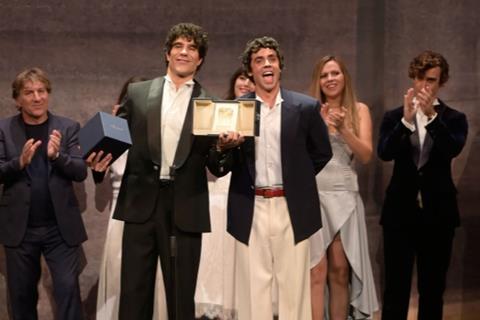
Los Javis, as directors Javier Calvo and Javier Ambrossi are known in Spain, were greeted by festival audiences as the A-list stars they are at home, as La Bola Negra had its Spanish premiere ahead of its theatrical release in the country today (September 25) via Elastica Films.
Box-office expectations are high and there is rising Oscar buzz around the film, Spain’s submission to the Academy Awards.
At the San Sebastián screening, Cannes’ Thierry Frémaux presented Calvo and Ambrossi with a copy of the best director award they won in Cannes ex aequo with Paweł Pawlikowski, meaning the three had to share a single trophy. Frémaux did the same for Pawlikowski, who was in town to present Fatherland.
Upbeat Spanish industry
San Sebastian was notable for the positive mood of the Spanish industry, with a strong line-up of local films and new figures confirming a production and investment boom. Amid the optimism, Spain Film Commission president Juan Manuel Guimeráns stressed the need for the industry and government to remain ‘vigilant’ in the face of a highly competitive, rapidly evolving global market – one that this week saw US legislators introduce plans for a federal tax incentive to stem runaway productions – to Spain, among other international territories.
Funding promise
The scale of the Spanish government’s support for the sector was underlined at the festival by Óscar López, minister for digital transformation and public service, who announced public backing for the audiovisual industry would continue through the new España Crece (Spain Grows) sovereign fund. A key role has been played by the Spanish Society for Technological Transformation (SETT), an agency attached to López’s ministry, which has invested €240m in 12 Spanish audiovisual companies over the past two years. The next stage will put the audiovisual industry among the strategic sectors eligible for €1.7bn support from España Crece, managed by the state-owned bank ICO. No specific allocation, timetable or eligibility conditions for audiovisual companies have yet been disclosed, but the promise of continuity was welcomed by the local industry.
Brad Pitt’s red carpet marathon
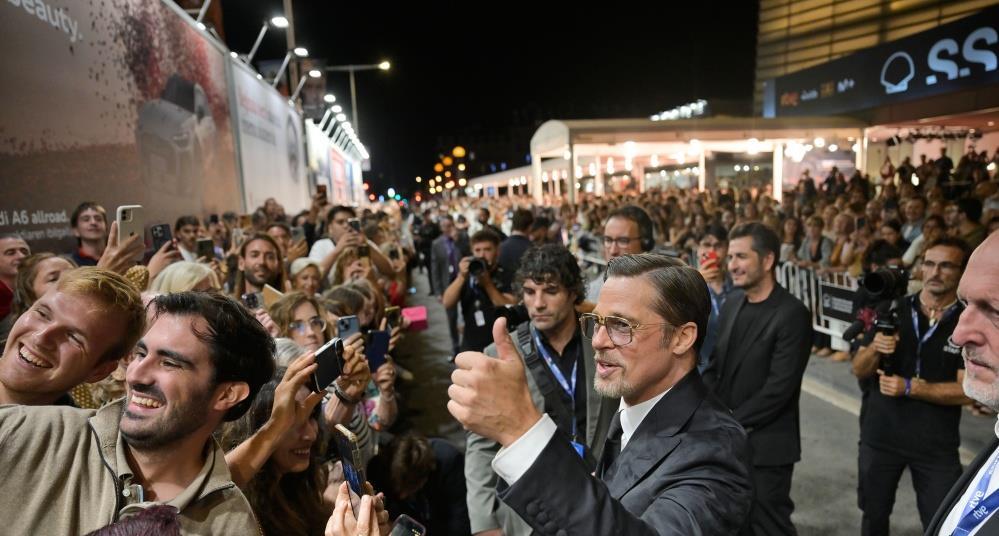
2026 has been one of the festival’s starriest editions, with Brad Pitt the biggest draw on the red carpet alongside Orlando Bloom, in town to give the honorary Donostia award to Werner Herzog on opening night; Naomi Watts, recipient of another Donostia Award; Penélope Cruz, Marion Cotillard, Ricardo Darín, Rami Malek and Diego Luna. Pitt was in town for the premiere of David Ayer’s survival thriller Heart Of The Beast, which he stars in and produces through his company Plan B company for Paramount Pictures. Pitt embraced the occasion, putting in a marathon autograph and selfie session on the red carpet that lasted more than an hour and a half.
José Luis Rebordinos bows out
After 16 years at the head of San Sebastian and a total 31 years working at the festival, this is José Luis Rebordinos last edition as director. He will leave on December 31, with Maialen Beloki taking over at the start of 2027. Beloki has worked closely with Rebordinos as co-deputy director since 2016 and will be the first woman to head the Spanish festival in its 74-year history. Both have been sharing talks and the spotlight this year to ensure a smooth transition. One of Rebordinos key legacies will be the huge growth of San Sebastian’s industry activities and its mentoring programmes that support talents and projects year round. The Europe-Latin America co-production forum and the Creative Investors Conference have attracted more and more professionals to San Sebastian, from around 600 when he started to over 2,400 this year, making the festival an important meeting point for the international and Spanish industries.
All about recovery
The fifth edition of the Creative Investors Conference, co-organised with CAA, had a sense of optimism thanks to this year’s box office recovery. With receipts at this summer’s North American box office officially the biggest of all time, there was a distinct sense of confidence in the comments from US executives in particular. Neon’s chief distribution officer Elissa Federoff called the recovery a “phenomenal result” in the face of significant challenges such as strikes, theatre closures and competition from gaming, streaming and social media platforms.
“Every year since the pandemic we have seen growth,” she said. For many of the speakers, the recovery has come from finding new ways to attract audiences, whether promoting effectively through social media or working directly with influencers. Streaming platforms are also acting as a discovery tool for the back catalogues of filmmakers, like Park Chan-wook, with young audiences then following the directors to the theatre for their new films.
Obsessed with Obsession
Time after time, speakers at the Creative Investors Conference trotted out Curry Barker’s Obsession and Kane Parsons’ Backrooms as examples of films by YouTube creators that have succeeded in drawing huge Gen Z crowds to cinemas. But the films’ success has led to issues for the industry: “We’re getting a lot of filmmakers who’ve never done anything at all, who have one YouTube channel, saying ‘I want a million dollars’”, said 193 CEOPatrick Wachsberger. A few execs warned everyone is overly obsessed with Obsession, but the creator link might be overplayed. “Horror has always been there, and it’s connected to the fact that the horror audience is pretty straightforward,” said Logical Pictures’ Frederic Fiore, while noting Obsession is a “great movie and that makes a difference.”
Doses of realism
There were plenty of doses of realism at the Creative Investors conference though. Adele Romanski, co-founder of US producer Pastel Pictures said distributors are keen for movies they can “create conversations around” but “everyone seems so risk averse, and it’s something we can’t quite figure out how to overcome.” I
It’s particularly hard to finance mid-budget films, with investors pushing for sub-$10m budgets in the US – or better still, around $5m – making it hard for filmmakers to achieve the scale, scope and audience appeal that distributors want from their films.
The merger of Paramount and Warner Bros was also an issue for many of the US execs, with one pointing out Disney’s 2017 acquisition of Fox led to fewer studio movies being made and released. (Although some said that this might create more space for independent and international films). Meanwhile, Chilean producer Juan de Dios Larraín and his brother, director Pablo Larraín – who earlier this year launched Pijama, the indie streaming platform for undistributed films- noted gloomily 80% of films do not secure meaningful distribution.
Bright spot
Federoff emphasised the “global landscape” was “more important today than ever before”, noting Neon’s expansion into international sales has made “taking on the risk of production so much better for us because now we have the full pie, not just a piece of it…it has given us the ability to do more pre-buys and more productions, and to be at the helm of all the marketing for it, so that we can really have a global voice out there for our campaigns.”
She was talking just months after a seventh Neon-backed film in a row, Fjord, won the Palme d’Or at Cannes. Romanski said Cannes had become even more important as a launchpad and a market for films for US executives. “It is the world-class festival to premiere movies at,” she said, adding that for up-and-coming filmmakers, the international exposure that Cannes can provide is invaluable and helps to unlock vital financing opportunities from international markets.
Meanwhile, Brazilian producer Rodrigo Teixeira said international films would soon dominate the best picture category at the US Academy Awards. “I believe in five years the international films are going to be bigger than American films.”
The Latin American connection
The Spain-Latin America connection ran strongly through this year’s festival programme and industry activities. Chilean director Pablo Larraín’s My Sad Dead, Argentinian filmmaker Benjamín Naishtat’s Glaxo and Brazilian director Gabriel Martins’ On Behalf Of My Son played in competition, while Spanish companies partnered on WIP Latam award-winners Lovers Go Home! by Colombia’s Juan Sebastián Mesa and Galerna by Mexico’s Tatiana Huezo.
Highlighting the Latin American connection, 14 European production companies were involved in Latin American projects presented in San Sebastian’s industry strand: 10 in the Europe-Latin America Co-Production Forum and four in WIP Latam. More Ibero-American links were visible in San Sebastian’s Zabaltegi section, with Argentina-Spain co-pro Sometimes Sadness, Sometimes Rebellion, Cine Vivo: Un Artefacto (Argentina-Chile-Spain) and Far From The Trees (Spain-Peru-Italy), while the animated feature Winnipeg, Seeds Of Hope, a Spain-Chile-Argentina co-pro, played in Zinemira. Meanwhile, the festival’s Horizontes Latinos section has only strengthened during festival director Rebordinos’ tenure.
