


US President Donald Trump on Monday announced a 25% tariff on any country that does business with Iran “effectively immediately.”
Trump wrote on his Truth Social platform that “any Country doing business with the Islamic Republic of Iran will pay a Tariff of 25% on any and all business being done with the United States of America,” while giving few other details.
The move comes as the Iran faces its largest and most sustained anti‑government protests in years, triggering a brutal crackdown that has killed hundreds and led to the arrest of more than 10,000 people.
The tariffs appear to signal Washington’s response to the unrest, coming after the Trump administration publicly ruled out military action against Tehran.
Why will China be impacted most by the new tariff?
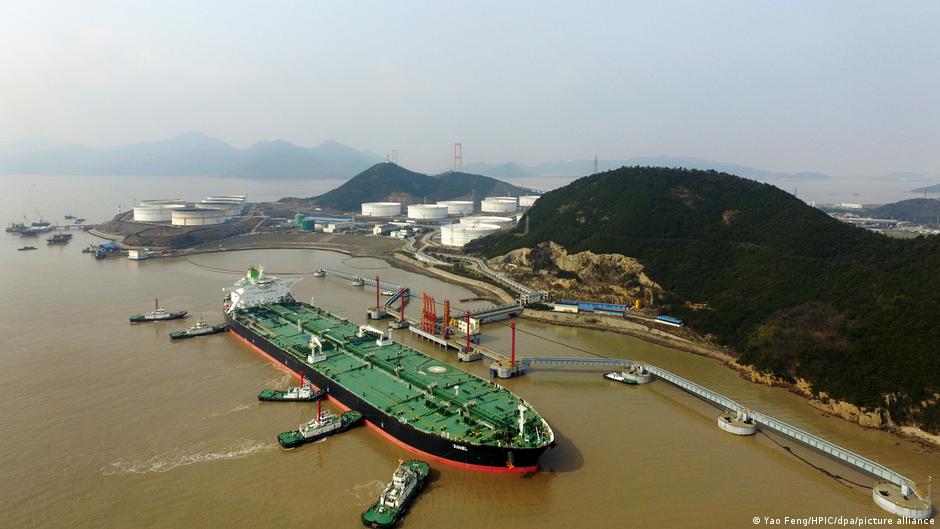
China is the primary buyer of Iranian oil, which remains under international sanctions over Tehran’s nuclear program. China received around 80% of Iran’s crude exports last year, according to energy-tracking firm Kpler in Brussels, Belgium.
To keep sanctioned oil flowing, Iran relies on a sophisticated shadow-fleet network, including ship-to-ship transfers — often in Southeast Asian or Arabian Gulf waters — and the relabeling of oil cargoes as originating from other countries, such as Malaysia or the United Arab Emirates (UAE).
An oil tanker tracker by the US nonprofit United Against Nuclear Iran estimated that China received 19.5 million barrels of Iranian oil last year. The shadow trade is estimated to generate $43 billion (€37 billion) annually in unreported revenue for the Iranian government, according to the US Energy Information Administration (EIA).
This income is a lifeline for the Iranian economy, propping up an isolated regime squeezed by sanctions, chronic inflation and a rapidly devaluing currency.
Beyond oil, Iran exported $12.9 billion worth of goods globally in 2024, with more than a third of those non-oil exports destined for China, according to the UN’s Trade Intelligence and Negotiation Adviser (TINA). Nearly 40% of Iran’s goods imports ($8.95 billion) also came from China in the same period, underscoring the depth of the economic relationship.
Other major trading partners of Iran to be likely hit by the new 25% tariff include Turkey, India, the UAE and Pakistan.
How does Trump’s latest tariff fuel tensions with China?
Although it is unclear whether Trump’s new tariff would apply only to goods, include services like banking and shipping, target indirect business ties, or set any minimum thresholds for “doing business” with Iran, the new tariff could bring significant risks for China.
It would raise the cost of Chinese exports to the US by an additional 25%, potentially pushing total duties to 45% or more on top of existing rates, making them less competitive in the US market.
The new levy also risks derailing the fragile US-China trade truce, agreed in October, when the two powers stepped back from an all-out trade war by putting new tariff hikes on hold, pausing China’s rare-earth export controls and committing to resume major US soybean purchases.
Trump’s move could spark a major retaliation from China, which was among the few countries to hit back at Washington with full tit-for-tat measures on US imports last year.
On Tuesday, Beijing labeled the new tariff “illicit unilateral sanctions” and vowed to protect its national interests, while analysts have warned the levy could disrupt global supply chains and oil markets.
Oil prices jumped on the news, with US benchmark West Texas Intermediate (WTI) crude up 2% to $60.74 by late morning European time on Tuesday.
Will Trump risk progress in trade talks with Beijing?
Whether the Trump administration would exempt China from the new tariff is far from clear. Creating a carve‑out for Beijing would undermine the tariff’s stated purpose, which is to pressure Tehran by isolating its remaining economic allies.
Enforcing the tariff strictly, however, risks provoking a major confrontation with Beijing at a moment when US trade talks are already fragile. As one of the US’s largest export markets, China retains considerable leverage in negotiations with Washington, especially for agriculture and manufacturing.
As well as its dominance of rare earth minerals — needed to produce electric vehiclesand high-end technology — Beijing also controls critical supply chains for key industrial components, which gives Chinese negotiators tools to apply pressure if negotiations sour.
Former US Trade Advisor Wendy Cutler warned that the new tariff “underscores just how fragile the trade truce is between Washington and Beijing,” telling news agency Bloomberg that even if Trump backs down, “some damage has already been done” to trust between the two sides.
Mohammad Ghaedi, a Middle East expert at George Washington University, wrote on social media platform X that the key issue would be “enforceability,” as China uses so-called teapot refineries — non-state-owned facilities — to process Iranian oil and buys via front companies based in third countries.
Ghaedi said if implemented, Trump’s tariff “could seriously reshape China’s calculations,” as Beijing may reevaluate whether the benefits of cheap Iranian oil outweigh the hit to its US trade relations.
Maurice Obstfeld, former chief economist for the International Monetary Fund (IMF), told the US daily Washington Post that the Iran tariff would be “profoundly self-harming for the U.S.” rather than China and would “not change the Iranians’ behavior one iota.”
Edited by: Uwe Hessler
