

The Venice Film Festival has become synonymous with the Oscar launch. If you have a movie with awards season pretensions — think La La Land, The Shape of Water, Poor Things or The Brutalist — you take it to the Lido.
This year feels different. Politics, not awards campaigns, has taken center stage. Venice’s 83rd edition is packed with films focused on right-wing media moguls and the crackdown on immigration, on the conflicts in Israel, Iran and Russia, on the abuses of capitalism and the rise of authoritarian power. The lineup, according to artistic director Alberto Barbera, is Venice’s “most political ever.”
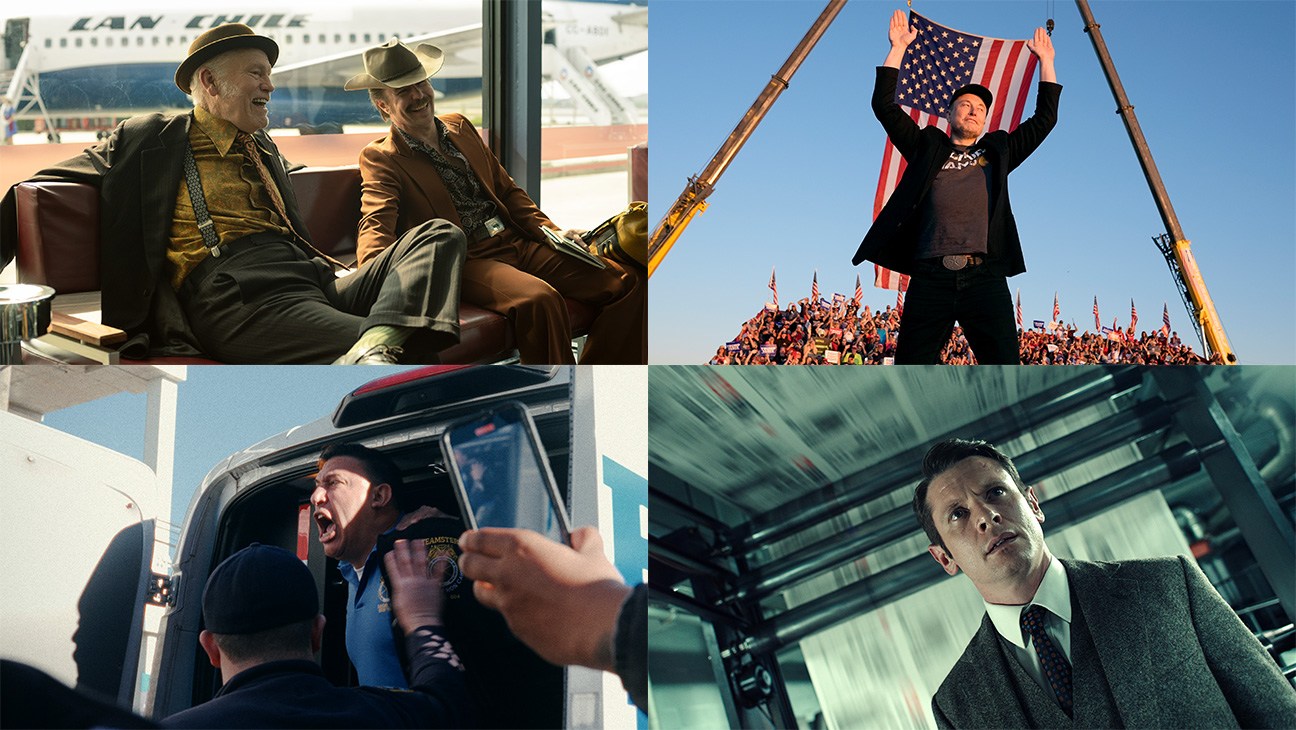
It all kicks off with Ink, Danny Boyle’s opening-night drama about Rupert Murdoch and his 1969 acquisition of The Sun, the tabloid whose combination of sex-scandal sensationalism and right-wing populism became the playbook for the New York Post and Fox News. Guy Pearce plays Murdoch, with Jack O’Connell as Sun editor Larry Lamb.

‘Musk’
Courtesy of the Venice Film Festival
It continues with Musk, Alex Gibney’s four-hour documentary profile of the world’s wealthiest person, right-wing agitator and troll, which Elon Musk — sight unseen — has already decried on X as a “hit piece”; and They’re Here, a short doc “horror film” from Laura Poitras (Citizenfour, All the Beauty and the Bloodshed), made with Rachel Lauren Mueller, which looks at ICE’s crackdown in Minneapolis and includes previously undisclosed footage.
That’s just the opening act. Politics are everywhere in the lineup, with films examining the wars and occupations reshaping the Middle East, ones tracing the authoritarian drift across the former Soviet sphere, and those focused on capitalism buckling under its own contradictions.
The Middle East material is everywhere. An Iranian doctor whose life is dismantled by the Tehran regime anchors A Bit of Light from Ali Asgari, whose Divine Comedy won the Venice Horizons Award last year. In Citizen Osama, Ahmed Hassouna profiles a photojournalist navigating survival and fatherhood in besieged Gaza. Muayad Alayan’s Conversation With the Sea follows a Palestinian man caught in Israeli bureaucracy, while Road to Jericho, a documentary from Israeli director Amos Gitai, tracks the fate of Khan al-Ahmar, a Bedouin hamlet outside Jerusalem on the verge of being erased.
Just ahead of the festival, Venice added another politically charged documentary, NAZA, from No Other Land filmmakers Yuval Abraham and Rachel Szor, to its competition lineup.
Iranian director Ali Asgari’s A Bit of Light.
Courtesy of Venice Film Festival
Farther east, the throughline is repression. Julia Loktev examines Vladimir Putin’s crackdown on independent journalists in My Undesirable Friends: Part II — Exile, following 2024’s acclaimed My Undesirable Friends: Part I — Last Air in Moscow. Belarusian filmmaker Andrei Kutsila explores state repression in Listy (Letters From the Silenced Country), told through correspondence from five political prisoners. Ukrainian director Sergei Loznitsa presents Imperium, about a film commissioned by the Italian Communist Party to glorify Soviet triumph that ended up exposing its contradictions instead. And Russian-born director Ilya Khrzhanovsky brings DAU, an experimental epic on Soviet life and authoritarianism already stirring controversy ahead of its competition premiere.
Then there’s capitalism in crisis. Korean auteur Lee Chang-dong (Burning) offers Possible Love, about the family of a laid-off worker and the affluent documentary filmmaker chronicling their story. Stéphane Brizé’s Un bon petit soldat stars Alba Rohrwacher as an HR executive caught between toxic management and her boss, played by Vincent Lindon. And Barbara Kopple’s out-of-competition documentary Union Town, about the growing U.S. labor movement, closes a trilogy that began with her Oscar-winning Harlan County, USA and American Dream.
‘Union Town’
Courtesy of the Venice Film Festival
Even the glossier titles this year have a political charge. Wild Horse Nine, the new dark comedy from Martin McDonagh (Three Billboards Outside Ebbing, Missouri; The Banshees of Inisherin), stars John Malkovich and Sam Rockwell as CIA agents in Chile on the eve of Pinochet’s U.S.-backed coup. In Bunker, from French playwright-director Florian Zeller (The Father, The Son), real-life spouses Penélope Cruz and Javier Bardem play a publisher and architect at odds after a billionaire commissions an underground bunker built to survive nuclear war.
Venice was founded under Benito Mussolini’s Fascist regime, and this year’s programming suggests Barbera sees that history less as an embarrassment than as a mandate. In the past, Venice has been the launchpad for some of cinema’s defining political works — Gillo Pontecorvo’s The Battle of Algiers won the Golden Lion here back in 1966 — and art house cinema has always had a political edge.
But these days, filmmakers and industry figures say, that edge feels sharper.
“These are turbulent times, and a festival should try to reflect the polarization of the societies we observe and continue the conversation using artistic means,” says Alexander Rodnyansky, producer of Road to Jericho. “I think Barbera inherited that legacy and has continued to enrich it in a brilliant way. [Venice] is one of the very few international cultural platforms that has the ability to invite filmmakers with very different — or even opposite — political positions and cultural points of view, and put their work in conversation … It belongs to the old-fashioned tradition of a film festival that appreciates filmmakers with their own distinctive points of view — especially when it involves having the courage to stand up against the policies of their own governments.”
“Cinema has always been anti-authoritarian,” adds Irish producer Mike Downey (Green Border), “very much in the same way that totalitarian regimes have historically used film to manufacture consent and glorify leadership. All we need to do is look at the most recent films from Jafar Panahi (It Was Just an Accident), Paul Thomas Anderson (One Battle After Another) [and] Kaouther Ben Hania’s extraordinary The Voice of Hind Rajab to see that. As global headlines swirl with the reckless, divisive actions of leaders like Putin, Trump and Netanyahu, contemporary filmmakers are sending a clear, urgent signal: The status quo is anything but acceptable.”
‘NAZA’
Naza/The Guardian
It isn’t only what’s onscreen that has grown more political. The festivals themselves have become arenas for protest and platforms for social media activism.
At times the debates have overshadowed the films. That’s what happened at this year’s Berlinale, where arguments over the war in Gaza — and whether the festival tilted too pro-Israel or too pro-Palestinian — crowded out any real discussion of cinema.
Jury president Wim Wenders’ comment that filmmakers “have to stay out of politics” set off a furious backlash online.
Venice has had its own version of this. Last year, the world premiere of The Voice of Hind Rajab had the feel of a political rally. The audience gave a festival-best 22-minute standing ovation to the ticking-clock docudrama about efforts to save a 5-year-old Palestinian girl killed by the IDF. The crowd waved Palestinian flags and chanted “Free Palestine.”
Days earlier, thousands had marched on the Lido to protest Israeli military action in Gaza, and a group of international filmmakers and artists had pressed Barbera to take a “clear and unambiguous stand” by condemning the war as a “genocide.”
He didn’t, though he expressed his “huge sadness and suffering vis-à-vis what is happening in Gaza and Palestine.”
Gaza protestors in Venice last year
Penelope Roxborough
Israel-Palestine will inevitably be a major talking point in Venice again this year. Just days ahead of the festival, the Venice4Palestine collective, the group behind last year’s Lido protest, published another open letter calling on festival, its parent body the Venice Biennale and the audiovisual world in general to take concrete action in support of Palestine. Signatures included Pink Floyd co-founder Roger Waters, Nobel Prize-winning writer Annie Ernaux and directors Matteo Garrone and Isabel Coixet.
This year’s The Voice of Hind Rajab could be NAZA, from directors Abraham and Szor. The documentary builds on published revelations about, as the film’s producers put it, “the systems behind Israel’s calculated mass killing of Palestinian civilians in Gaza.” James Wilson (The Zone of Interest) produced, with Zone director Jonathan Glazer as an EP.
As with Road to Jericho, NAZA is a documentary from Israeli filmmakers that is sharply critical of the Israeli government.
“I’m looking forward to seeing the reaction of the audience [to Road to Jericho],” says Rodnyansky. “Last year [we saw] huge anti-Israeli and pro-Palestinian demonstrations on the Lido. So this year, I can understand that it’s not the easiest thing for the festival to program an Israeli film — but still they did it.”
Gitai, he notes, has “always been known for holding a critical stance toward the policies of his own state” while remaining, in Rodnyansky’s words, “a passionate Israeli who wants the best for his own country. Both these things are very much in his new movie.”
‘DAU’
Ilya Khrzhanovsky
Another political flashpoint in Venice this year is Russia- Ukraine. Barbera has come under fire for programming Khrzhanovsky’s DAU, with critics tying the director, the film’s financiers and Greek-Russian actor Teodor Currentzis to Putin’s Russia. The Ukrainian Ministry of Foreign Affairs, the Ministry of Culture and the Ukrainian Embassy in Italy issued a joint statement warning that showing the film “at the time when Russia is continuing its war of aggression against Ukraine … sends a deeply worrying signal.”
Barbera has pushed back, calling the criticism a “smear campaign against a film that its accusers have evidently not even seen yet.” But the framing has already stuck, and both DAU and the war in Ukraine are likely to be major talking points on the Lido this year.
“As the political climate we live in has become increasingly polarized, we can see the film festivals are now being caught in the crossfire,” says Marijke de Valck, an associate professor of film and media studies at Utrecht University in the Netherlands. “But I see the fact that film festivals are being targeted by certain activist groups as a clear sign that the work that they do, providing an open space for discussion and debate, is actually very important.”
Venice’s embrace of the political moment extends beyond the official selection. The Venice Critics’ Week sidebar this year includes Our Share of Sand, an examination of inequality and environmental exploitation in India from director Shalini Adnani; the dystopian drama The H@llow Man from Tunisian director Kamel Laaridhi, which looks at authoritarian control through technology; and London, a queer drama about disability, sexuality and self-determination from Brazilian directors Victor Di Marco and Márcio Picoli.
‘Our Share Of Sand’
Fifth Mirror Pictures/Suitable Pictures/Heretic
“I didn’t feel we were in the position this year to choose a rom-com,” says Critics’ Week artistic director Beatrice Fiorentino. “I feel we are in the middle of a global crisis. There are so many aspects — of colonialism, imperialism, capitalism, all the isms, and fascism, which is coming back — that avoiding politics would be anti-historical. I don’t want to pretend everything is fine.”
So far, however, political cinema hasn’t translated into sales. The Voice of Hind Rajab was last year’s Venice sensation and won the Silver Lion, yet it didn’t trigger a U.S. bidding war. It eventually self-released through Willa, the distribution arm of one of its production partners, echoing the path taken by No Other Land. That Berlin- and Oscar-winning documentary about the Israeli military’s destruction of Palestinian villages in the West Bank struggled to find a traditional distributor before self-releasing in a rollout coordinated by Cinetic Media and Michael Tuckman Media.
Ali Abbasi’s Donald Trump drama The Apprentice hit similar resistance at Cannes in 2024, with major distributors wary of the legal and political risk, before landing at Briarcliff Entertainment.
‘The Voice of Hind Rajab’
Venice Film Fesitval
Selling the politics of a film can be a challenge, notes Nicolai Korsgaard, sales director at TrustNordisk, which is handling world sales for May el-Toukhy’s Venice competition title Woman Unknown. “We’ve found focusing on a director, or genre elements, is more effective.”
Even films without an obvious political hook can get caught in the crossfire. Luca Guadagnino’s Artificial, a dramatization of the boardroom turmoil at OpenAI and Sam Altman’s brief ouster, was dropped by Amazon MGM shortly after Amazon deepened its strategic relationship with OpenAI. Neon later acquired worldwide rights, pulling the film back into this year’s awards conversation after its absence from Venice had become one of the summer’s biggest industry talking points.
“Some films are sidelined or shelved by mainstream buyers wary of political controversy or PR risk,” Downey says. “Usually it’s business, not conspiracy.”
Political documentaries and provocative biopics, he argues, increasingly depend on independent distributors willing to absorb both the commercial uncertainty and the potential backlash. “Political films win prizes at festivals, but that rarely translates into box office. Social relevance is all well and good, but these movies struggle commercially due to niche appeal, limited marketing and the old chestnut of audience preference for escapism.”
None of that seems likely to deter Venice. This year’s lineup suggests Barbera sees the festival’s activist history not as a footnote but as an ongoing mission. “Everything is political,” Fiorentino says. “We are people, workers in a society and in an industry. I will not hide my head in the sand.”
Patrick Brzeski contributed to this report.
This story appeared in the Aug. 12 issue of The Hollywood Reporter magazine. Click here to subscribe.
