


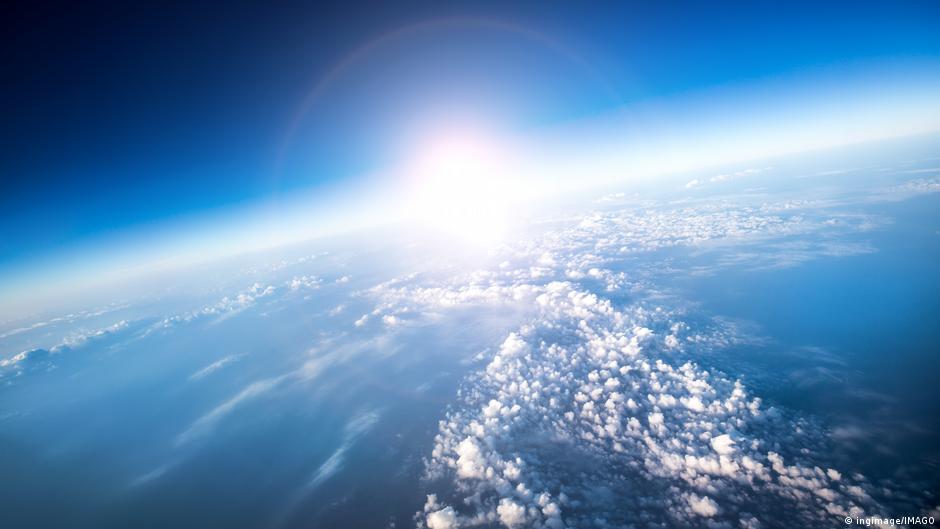
As global heating worsens, interest in solar engineering is rising, including from private companies and investors. But the technique remains controversial and lacks regulation.
The planet is heating up faster than expected. Greenhouse gas concentrations continue to rise at record rates, leaving the world off track to limit warming below 2 degrees Celsius (3.6 degrees Fahrenheit) above pre-industrial levels. The latest data shows 2025 was the third hottest year on record.
That growing gap between climate targets and reality is fueling renewed interest in geoengineering — interventions that intentionally alter the Earth’s climate system. Among them is solar geoengineering, which aims to cool the planet by reflecting sunlight back into space.
The technology remains largely experimental and could have far-reaching social, political, and environmental impacts if deployed at scale, according to scientists.
Until recently, most solar geoengineering research was carried out by nonprofits and public research institutions, funded by governments and philanthropies. But that landscape is shifting.
Over the past three years, two commercial startups — Israeli-US Stardust Solutions and California-based Make Sunsets — have emerged. As reported by media outlet Heatmap News, Stardust Solutions recently announced it had raised $60 million (around €52 million) in venture capital.
Yet scientists and researchers, even those who support solar geoengineering, are concerned about for-profit companies entering a field that lacks proper regulation.
“What is worrying is private money coming in that’s not accountable to anyone, in sums that potentially could far exceed what has been on the table thus far from governments,” said Cynthia Scharf, a senior climate fellow at independent think tank, the Center for Future Generations.
What is stratospheric aerosol injection?
The most widely studied solar engineering technique is stratospheric aerosol injection (SAI).
It involves the injection of highly reflective particles into the stratosphere — the atmospheric layer between 4 to 30 miles (6 to 50 kilometers) above Earth’s surface — to reflect a small amount of sunlight back into space.
This mimics the cooling effects of volcanic eruptions, which spew droplets of sulfur gases into the stratosphere. These gases mix with water vapor to form tiny reflective particles called aerosols. The 1991 eruption of Mount Pinatubo in the Philippines resulted in global cooling of 0.5 C for a few years.
So far, SAI has mostly been tested in labs and computer simulations. Since 2008, two outdoor experiments involving the release of small amounts of aerosols have been completed in Russia and the UK. Other planned university-led experiments in the UK and Sweden were canceled following opposition from civil society and community groups.
Make Sunsets began launching balloons filled with sulfur dioxide over Mexico and the US in 2022. As a result, the Mexican government issued a ban on solar geoengineering deployments above its territory.
The company says on its website it has so far released 213 balloons, selling them to companies and individuals as “cooling credits.” It remains unclear who is buying the credits, but the quantities are too small to have any measurable benefit to the climate, according to Silverlining, a nonprofit focused on near-term climate risks. DW reached out to Make Sunsets for comment, but the company hadn’t responded by time of publication.
But a large-scale SAI deployment would entail sending high-altitude aircraft or balloons to release the particles continuously for decades, since aerosols typically remain in the stratosphere for only months to a few years. Once injected, they would be carried around the globe by the jet stream, dispersing widely but not evenly.
“There’ll be a global decrease of maybe half a degree Celsius, but that decrease will be very patchy,” said James Dyke, Associate Professor in Earth System Science at the University of Exeter. It could also cause unpredictable precipitation patterns and weather extremes in different parts of the world, he added.
The need for transparency in research
Much of the SAI research to date has focused on injection of sulfate particles — the same type emitted by volcanoes. However, there are side effects associated with sulfate aerosols, including possible damage to the ozone layer and increased air pollution. This could in turn lead to higher rates of respiratory illnesses.
“We don’t believe this is a safe or responsible option for policymakers to consider,” said Stardust Solutions CEO Yanai Yedvab in an emailed response.
Stardust Solutions claims it has developed a different kind of particle, made of components that are “abundant in nature, chemically inert in the stratosphere, and safe for humans and ecosystems.”
The company has so far not released any information about the composition of the particle it is developing. Yedvab said they will begin publishing research this year. But some scientists are skeptical about the safety claims.
“Even if you put something into the atmosphere which is safe in the stratosphere, by the time it’s processed and come down to the lower atmosphere, it may be an active particle that’s dangerous,” said David Keith, a professor of geophysical science at the University of Chicago.
Yedvab said no outdoor testing will take place for now.
Balancing private interests and global safety
Stardust Solutions sees its role as “technological enablers,” providing governments and the international community with the tools and evidence needed to make informed decisions amid an escalating climate crisis.
“The last thing anyone who takes this crisis seriously should want is for governments to realize in a decade that they need to deploy SRT (sunlight reflection technology) and for the research, engineering, and de-risking not to be complete,” said Yedvab.
But Keith says technology as complex and uncertain as SAI — and marked by significant “unknown unknowns” — requires public confidence above all else.
“I think free-market capital competition can be great when what you’re producing is something that’s easy to test,” he said. “But for things where the whole issue is trust … I’m much more skeptical about the role of private money.”
Stardust Solutions will be seeking a patent to claim intellectual property rights for its particle, and recent reporting by energy and environment-focused news outlet E&E News revealed the company has been working with a law firm to lobby the US government.
“We’ve been informing policymakers about our work and the need for appropriate and robust oversight of sunlight reflection research and development,” said Yedvab.
While US President Donald Trump’s anti-climate stance has been underscored by his decision to withdraw the US from dozens of major climate pacts, it is unclear what the administration’s thoughts are on solar geoengineering.
Yedvab said Stardust Solutions would only work with governments that have “adequate regulatory frameworks, which meet high global standards,” and that any discussion and decision on demonstrations and deployment would be conducted by governments and policymakers.
Currently, there is no specific international treaty to regulate SAI research or deployment, and most governments have no regulations either. Some experts have called for an international non-use agreement.
Ocean iron fertilization, another geoengineering method with potentially global effects, was regulated in 2013 following strong opposition from environmental groups and governments. By adding iron to the ocean, the technique aims to boost carbon-absorbing plankton, but risks disrupting delicate marine ecosystems. While research is still permitted, commercialization is not.
Before the ban, several US-based startups had announced their intentions to invest in the technology and start selling carbon credits.
Edited by: Tamsin Walker
