


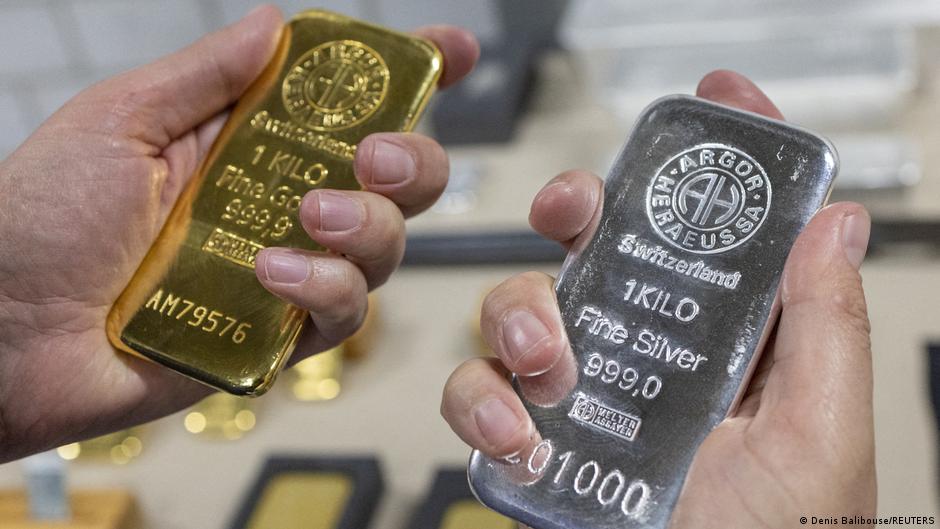
What happened to gold and silver prices over the past week?
After surging to a record high above $5,580 (€4,705) per ounce on Thursday, gold Suffered its steepest one‑day decline in years on Friday, dropping by around 9%. The sell-off didn’t stop there. By Monday, the slide had deepened, with the metal losing another 3.3% to $4,545 per ounce, before recovering.
The new record before the steep decline in the precious metal came as investors piled into safe-haven assets amid stubborn inflation in major economies and geopolitical tensions over US-China trade ties, US President Donald Trump’s Greenland ambitions, Russia’s war in Ukraine and Iran’s role in regional conflicts.
Financial markets also reacted to expectations of imminent interest cuts by the US Federal Reserve. This move typically weakens the dollar and boosts demand for gold.
Another force driving prices higher was a wave of buying of call options — contracts that give traders the right to buy financial products like gold at a set price in the future. This forced option sellers to buy the metal itself to hedge against possible losses, creating a loop that pushed prices even higher.
Silver, meanwhile, staged an unexpected rally of its own last week, hitting a record $121.64 per ounce on Thursday before plunging by nearly a third shortly after. By Monday, it had dropped by around 41% in total to around $72, before starting to recover.
Silver’s extreme rally was fueled by speculative trading and unexpectedly strong expectations for industrial demand as silver is increasingly used in electronics, artificial intelligence (AI) and clean-energy production.
In China, a rush of speculative money had also tightened the domestic silver supply, pushing prices even higher.
Why the sudden and dramatic price reversal?
The abrupt shift in price stemmed primarily from two announcements that flipped market sentiment and triggered widespread forced selling.
First, Donald Trump on Friday nominated Kevin Warsh as the next Federal Reserve chair. Warsh, who will succeed Jerome Powell as the head of the US central bank, is seen as a pragmatic, independent voice with economic crisis-era experience.
Markets interpreted this as a more orthodox pick unlikely to yield to calls from the White House for drastic, immediate rate cuts, demands that Trump has repeatedly directed at Powell.
Warsh’s nomination sent the US dollar higher, in contrast to investors’ bets that the Trump administration would tolerate a weaker currency.
Among the shortlist of Fed chair candidates, traders view Warsh as the most hawkish on inflation, lifting expectations of tighter monetary policy that would bolster the dollar and pressure gold, which is traded in dollars.
Over the weekend, the Chicago Mercantile Exchange, where gold and silver futures trade heavily via COMEX (Commodity Exchange, Inc.), raised margin requirements. This is the minimum collateral that traders must maintain for their leveraged or debt-funded positions.
The announcement was an attempt to curb excessive risk-taking and ensure market stability. The changes are expected to take effect after the markets close on Monday.
How have traders reacted to the price drops?
The speed and scale of the sell-off in precious metals rattled traders and prompted a rapid unwinding of leveraged positions and a sharp pullback in risk appetite.
“The scale of the unwind unfolding in gold today is something I haven’t witnessed since the dark days of the 2008 global financial crisis,” IG market analyst Tony Sycamore told Reuters news agency.
Following the collapse of Lehman Brothers in 2008, gold initially plunged by more than a quarter from its peak near $1,000 to a low of around $700 per ounce. The metal later recovered strongly as it was seen as a safe-haven asset as global central banks launched massive economic stimulus measures, including quantitative easing (QE), and slashed interest rates to near zero.
During the current rout, several traders said liquidity evaporated during the heaviest selling on Friday, magnifying price swings and making it harder to exit positions without moving the market.
Other analysts pointed to overcrowded bullish bets that left the precious metals market exposed once prices turned.
Bloomberg cited former JPMorgan precious metals trader Robert Gottlieb as saying that, “The bottom line is that the trade was way too crowded,” adding that the fallout could keep prices in check as traders grow more reluctant to take on fresh exposure.
Is this the end of the gold and silver rally?
The dramatic price swing has left traders debating whether the boom is truly over or simply pausing after an overheated run-up.
“The question everyone is now asking is what happens next?” Michael Brown, senior research strategist at Australian financial broker Pepperstone, was cited by the AFP news agency as saying.
“I would flag that, in a similar manner to the rally seen in recent weeks, there is now a solid argument that the pullback has also run ‘too far, too fast’.”
Christopher Forbes, head of Asia and the Middle East at CMC Markets, also thinks gold’s sharp retreat looks more like a classic correction after an extraordinary surge than a collapse in the longer-term trend.
“Renewed dollar weakness or confirmation of a dovish Warsh would bring dip-buyers back,” said Forbes, who thinks gold can retrace recent highs over the next 12 months.
In a report published Monday, Deutsche Bank wrote that investor motivations for buying gold are “broader” than in previous price surges and “not likely to be allayed.”
Beyond institutional investors, Germany’s largest lender highlighted continued appetite from central banks — including China, Poland and South Korea — which it expects to remain a major source of demand.
Central banks buy gold to diversify reserves and protect against currency and geopolitical risks.
Deutsche Bank also pointed to resilient buying from individual investors, particularly in Asia, who treat gold as a hedge against currency depreciation and a portable store of wealth.
Many analysts think silver’s rally has further to run because its fundamentals look stronger than gold’s. Industrial demand is still rising and supply remains tight after years of underinvestment in exploration and mining.
Edited by: Ashutosh Pandey
