


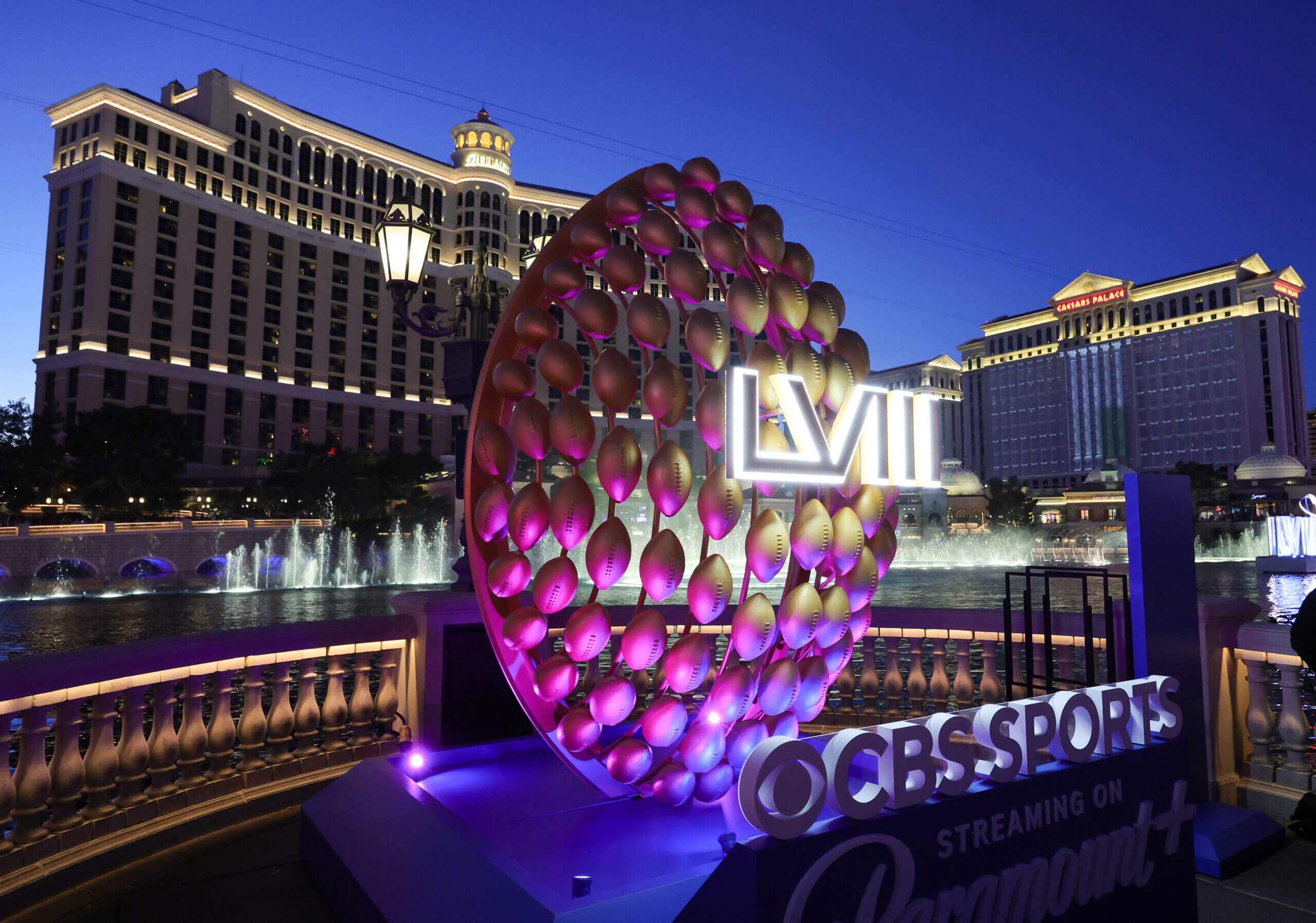
The NFL’s gambling rules have drawn widespread criticism and questions ahead of the Super Bowl in Las Vegas as the league seeks to balance its sports betting partnerships with policies that prevent players from betting on games.
Gambling was a major topic during NFL Commissioner Roger Goodell’s annual Super Bowl press conference on Monday, where he said the “integrity of the league” was a top priority.
“We want to make sure that when people watch an NFL game, they know that the action on the field is real and free from any outside influence,” Goodell said.
With just days to go before a major sporting event in America’s betting hub, it’s worth revisiting the NFL’s policies toward its players and how the league’s stance has changed over time.
NFL rules on sports betting
The league has long insisted that players are not allowed to bet on NFL games. Its 2023 gambling policy states that players may not place bets, solicit or facilitate bets on “any NFL game, practice or other event (such as the combine or draft), directly or through a third party.”
Players are also prohibited from participating in anyone’s NFL betting activities, such as asking someone to place NFL-related bets on their behalf or allowing others to use their account to place NFL-related bets.
Additionally, the rules state that players are not allowed to enter sportsbooks during the NFL season (from the Hall of Fame Game to the Super Bowl) “unless entering an area outside the sportsbook.” For example, players can access separate parts of entertainment, casino or hotel complexes “if necessary” through sports betting.
The Kansas City Chiefs and San Francisco 49ers will both play in the Super Bowl about 25 miles east of Lake Las Vegas.

deeper
Why the Chiefs and 49ers live in Lake Las Vegas instead of the Strip
League rules also specify when and where players can gamble.
Gambling activities by players while participating in NFL games or in-season teams are prohibited at team or league facilities (such as training facilities, stadiums and offices) or while traveling with the team (such as on team aircraft or team hotels).
Can NFL players bet on other sports?
In states where betting is legal, players may place bets on sports events outside of the NFL, subject to the NFL’s rules regarding access to sports betting and wagering in the workplace.
For example, players may not place bets from NFL facilities even if the bet is not on an NFL game. Detroit Lions receiver Jameson Williams and Tennessee Titans offensive tackle Nicholas Pettit-Freel were disciplined for rule violations this season. They were initially suspended six games, but the league updated its gambling policy in September, reducing the penalty from six to four games.
Betting on non-NFL games at work or while currently employed will result in a two-game suspension for a first offense, a six-game penalty for a second offense, and a minimum penalty of one year for a third offense.
What are the gambling rules for the Super Bowl?
Members of the two Super Bowl teams, the Chiefs and 49ers, are prohibited from participating in any form of gambling, including casino games and betting on any sporting event.
The league says players from the other 30 teams can participate in “legal gambling,” but not the NFL, and they can’t participate in sports betting until after the Super Bowl.
Jeff Miller, the NFL’s executive vice president of communications, public affairs and policy, said last week: “For players and other personnel on participating teams, these rules are no different than any other game: when traveling Gambling, whether in the form of sports betting or otherwise, is prohibited.
“Any player, coach, staff member, yours truly, who is caught or caught gambling in a casino is eligible for disciplinary action, which will be addressed in the normal disciplinary process as we would with anyone gambling in a casino. players or other personnel. There is evidence that gambling rules have been breached.”
NFL Disciplinary Procedures for Gambling Violations
Under the 2023 Rules, violations of the NFL’s gambling policy will be determined by Goodell or his designee on a case-by-case basis.
The rules state: “Discipline may include, but is not limited to, fines, suspension, termination of employment and/or lifetime expulsion from the NFL.”
The following are baseline suspensions for violations of the gambling policy, which “may be adjusted upward or downward,” according to the rules, which state: “Nothing in this policy will prevent the commissioner from imposing additional discipline for other types of prohibited conduct.”
- NFL Betting: Players who place bets on NFL games involving their team are banned indefinitely, with a minimum of one year or a minimum of two years
- Actual or attempted game fixes: Permanently banished from NFL
- Insider tips and tips: Suspended indefinitely, at least one year
- Third party or agent betting: Suspended indefinitely, at least one year
- Betting in the workplace or at work (except NFL):
- First violation: suspension with pay for two games
- Second violation: six games suspended without pay
- Third violation: suspension without pay for at least one year
How has the NFL’s stance on gambling changed?
Competitor’s Mike Jones explained how the NFL’s complicated relationship with sports betting has evolved in a recent article:
Since sports betting was legalized, the NFL has been walking a tightrope in partnering with companies like Caesars, FanDuel and DraftKings and ensuring players avoid activities that compromise the integrity of the game. The league has not released figures on how much revenue it generates from working with bookmakers, but according to the American Gaming Association (AGA), the NFL brings in $2.3 billion in revenue annually from these deals.
League officials have long frowned upon betting on NFL games and worried that participation would raise questions about player involvement and the temptation to fix games. But when the Supreme Court struck down the Professional and Amateur Sports Protection Act in 2018, they also felt the need for reform.
“The league’s relationship with sports betting has changed for one specific reason, and that is the world has changed,” Miller said of the league’s efforts to promote responsible sports betting practices. “It’s been five years and a few months since the Supreme Court struck down (the Professional and Amateur Sports Protection Act) in 2018. So we’ve had to rethink how we participate in legalized sports betting, and that’s what we did. … We will continue to study and examine how we do this and hopefully we can do our best to protect the integrity of the game in a world where the rules are changing.”
Must read
(Photo: Ethan Miller/Getty Images)
