


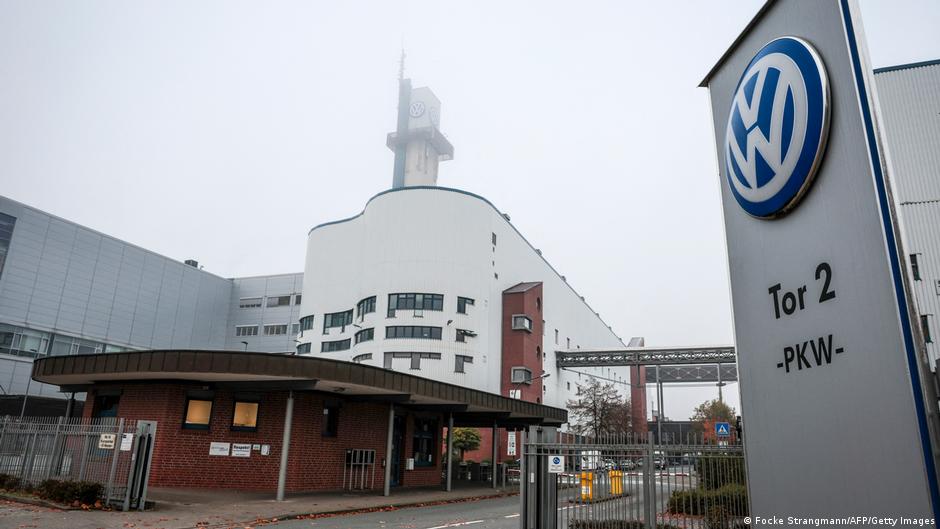
Volkswagen (VW) is in talks with the Israeli defense firm Rafael Advanced Defense Systems over a possible collaboration which would see production switch from cars to defense equipment at a key VW plant, according to a report in the Financial Times.
The exclusive report in the newspaper, quoting people familiar with the plan, says the companies plan to convert Volkswagen’s struggling Osnabrück plant into a facility which makes components for the Israeli state-owned company’s Iron Dome air defense system.
In response to queries from DW, a spokesperson for Volkswagen said “the production of weapons by Volkswagen AG remains ruled out for the future, and we do not engage in speculation regarding further plans for the Osnabrück site.”
However, with the Osnabrück site scheduled to phase out its current production in 2027, the spokesperson said the company “continues to explore viable options” and is talking to various “market players.”
“This is part of an open review process for the period after 2027,” the spokesperson said. “There are currently no concrete decisions or conclusions regarding the future direction of the site. We are also keeping local employees informed about the status of this process.”
A struggling factory
Volkswagen has been looking for solutions to save around 2,300 jobs at the Osnabrück plant in the state of Lower Saxony since the 2024 decision to pivot away from current production by 2027. Last September, VW took the decision to shorten the working week by a day at the facility as part of broader cost-cutting measures.
The factory at Osnabrück produces the T-Roc Cabriolet brand, as well as the Porsche Cayman and Porsche Boxster models. The VW spokesperson said the company was still looking at ways to continue producing vehicles at the site into the future.
“The Volkswagen plant in Osnabrück has developed various vehicle concepts in recent months to explore potential market opportunities and prospects,” they said. “Whether and to what extent these will result in concrete projects remains to be seen.”
Earlier this month, the Volkswagen Group said it plans to cut 50,000 jobs in Germany by 2030, after profits hit their lowest level in a decade. European carmakers have battled a range of challenges in recent years, from struggles associated with electrification, to increased competition from China.
The German auto giant’s CEO Oliver Blume told shareholders recently that the Volkswagen Group, which owns the Volkswagen, Porsche, Skoda and Audi brands among others, was “operating in a fundamentally different environment.”
According to the Financial Times report, the plan aims to save all 2,300 jobs in Osnabrück. The article quotes one of the people familiar with the plans as saying: “The aim is to save everybody, maybe even to grow. The potential is so high. But it’s also an individual decision for the workers if they want to be part of the idea.”
The report adds that the German government actively supports the plan. Although Germany’s federal government has no stake in Volkswagen, the state of Lower Saxony holds nearly 12% of the shares and 20% of the voting rights.
Tapping into the booming defense sector
If confirmed, the tie-up between Volkswagen and Rafael Advanced Defense Systems would be the biggest example yet of a major industrial company pivoting from its traditional business to the now booming defense sector.
Since Russia’s full-scale invasion of Ukraine in February 2022, European defense companies have doubled and, in some cases, even tripled in value. Meanwhile, European governments are ramping up military spending, with EU member states having spent almost €400 billion ($463 billion) on defense in 2025 alone.
Volkswagen has so far not made a major pivot towards defense. Its subsidiary MAN makes military trucks with German defense major Rheinmetall. However, if the plans with Rafael Advanced Defense Systems were confirmed, it would represent Volkswagen’s deepest commitment to the arms industry since it produced vehicles and bombs for the Nazis during World War II.
According to the Financial Times report, the factory would make military vehicles and other components for the Iron Dome, but not missiles themselves.
With the car industry and other industrial sectors across Europe and Germany currently battling various headwinds, a pivot towards a defense sector flush with cash and primed for government investment has become increasingly attractive.
Paolo Surico, a professor of economics at the London Business School who focuses on defense-related innovation, said the pivoting of industrial firms towards defense is “crucial” if the defense spending scale-up is to provide wider ecomomic benefits.
However, he cautioned that bureaucracy and long waits for companies to receive the necessary permits to produce for the defense sector could complicate the process.
Hans Christoph Atzpodien, general manager of the German Federal Association of the Security and Defense Industry, agrees. He previously told DW that while the qualifications of car industry workers will often meet the requirements of defense companies, retraining and security clearance requirements may slow down the process.
“The timelines for issuing these authorizations are currently nowhere near fast enough to enable a rapid transition of the relevant personnel,” he told DW last year.
Surico also said it’s important that production remains open to multiple firms, rather than one big player, for a wider pivot from sectors such as the car industry to defense to work.
“Give the same procurement, the same contract to multiple firms in which each one exploits their comparative advantage along the supply chain,” he told DW. “Each one can exploit this comparative advantage and therefore make production more efficient and the economic benefits more widespread.”
According to the Financial Times report, production at Osnabrück for Rafael Advanced Defense Systems could begin within 12 to 18 months.
However, a possible stumbling block could be getting workers to agree to switch to weapons production, according to a person familiar with the discussions.
Edited by: Srinivas Mazumdaru
