


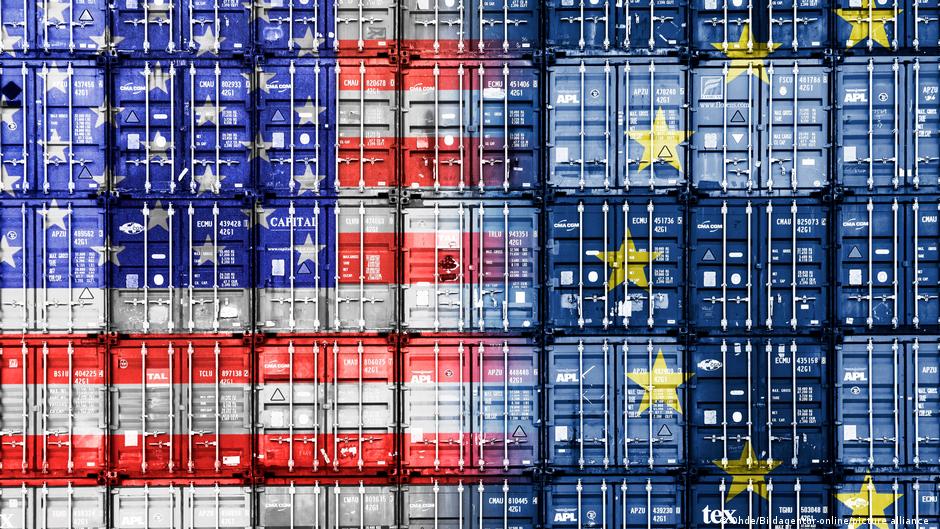
US President Donald Trump argues that the US economy is disadvantaged in global markets and wants to reduce the trade deficit through tariffs. Taken together, the 27 member states of the European Union form the United States’ largest trading partner.
Below are the key questions and answers on trade disputes and mutual dependence.
How large is trade between the EU and the US?
Together, the EU and the US account for more than 40% of global economic output and nearly one-third of world trade. In 2024, they exchanged goods worth more than $975 billion (€867 billion).
Including services, total transatlantic trade reached €1.68 trillion ($1.97 trillion), according to a report by the European Council, the body representing EU heads of state and government.
Does the US run a trade deficit with the EU?
Yes. The US imports significantly more goods from the EU than it exports to the bloc. The deficit widened from €156 billion in 2023 to €197 billion in 2024.
On a global scale, the US trade deficit totaled roughly $1.17 trillion, according to the US Census Bureau.
The EU posts sizable surpluses in vehicles and pharmaceuticals. The US, by contrast, runs surpluses only in oil, gas and coal.
What about trade in services?
In services, the US records a substantial surplus, driven by the growing dominance of tech giants such as Apple, Amazon, Microsoft, Meta and Google.
Financial and IT-related services, particularly licensing revenues, also play a major role. In 2024, the US services surplus with the EU amounted to €148 billion.
When goods and services are combined, the overall US deficit shrinks to around €50 billion. The transatlantic trade relationship is therefore far more balanced than Trump often suggests.
Where is the US vulnerable in trade disputes?
Given the rising importance of digital services, tariffs or taxes in this area could hit the US particularly hard. The EU could act through its so-called Anti-Coercion Instrument (ACI) — a set of measures aiming to protect EU member states from economic coercion — often dubbed as the bloc’s “trade bazooka.” However, the tool has never been used.
Does the US need the EU as an export market?
Yes, especially for its energy sector where the US runs large surpluses.
Liquefied natural gas (LNG) is a prime example. Since Russia’s invasion of Ukraine in 2022, Europe has sharply increased LNG imports from the US, with purchases having reached 81 billion cubic meters in 2025, according to data from the Institute for Energy Economics and Financial Analysis (IEEFA) in Cleveland, United States. As a result, more than half of all US LNG exports now go to the EU.
This growing dependence cuts both ways. Any disruption would hit not only Europe, but also US LNG producers and gas companies — an industry that counts among Trump’s supporters.
How exposed is US agriculture?
Soybeans illustrate another disruption risk. The US is the world’s second-largest soybean producer after Brazil, with China and the EU among its biggest buyers.
EU countertariffs temporarily under discussion, totaling €93 billion, included levies on soybeans. Such measures could hurt US farmers and soybean exports, while the EU could offset losses by importing more soy from Brazil.
Does the US rely on Europe to finance its debt?
Yes. The US carries the highest public debt in the world. According to the US Treasury, total federal debt stood at $38.4 trillion on January 7, of which $6.79 trillion, or 17.7%, is held by foreign creditors.
As of November 2025, Japan remained the largest foreign holder of US Treasury bonds at $1.2 trillion, followed by the United Kingdom. Taken together, European creditors hold nearly half of all US debt owned abroad.
Do Trump’s tariffs weaken the dollar?
Yes. Tariffs increase inflation risks in the US, while disputes over trade policy, budget deficits and interest rates add to global economic and political uncertainty.
Experts expect the dollar’s decline against the euro, seen last year, to continue into 2026. They anticipate further interest rate cuts by the US Federal Reserve, after the Fed lowered its benchmark rate from 4.25% to 3.75% in 2025.
A weaker dollar is a double-edged sword. For the US, it makes exports cheaper and more competitive but it also raises import costs, fueling inflation.
For the EU, lower-priced US energy imports help curb inflation and reduce corporate energy costs. At the same time, a weaker dollar makes EU exports to the US more expensive, undermining the competitiveness of European companies.
This article was originally written in German.
