


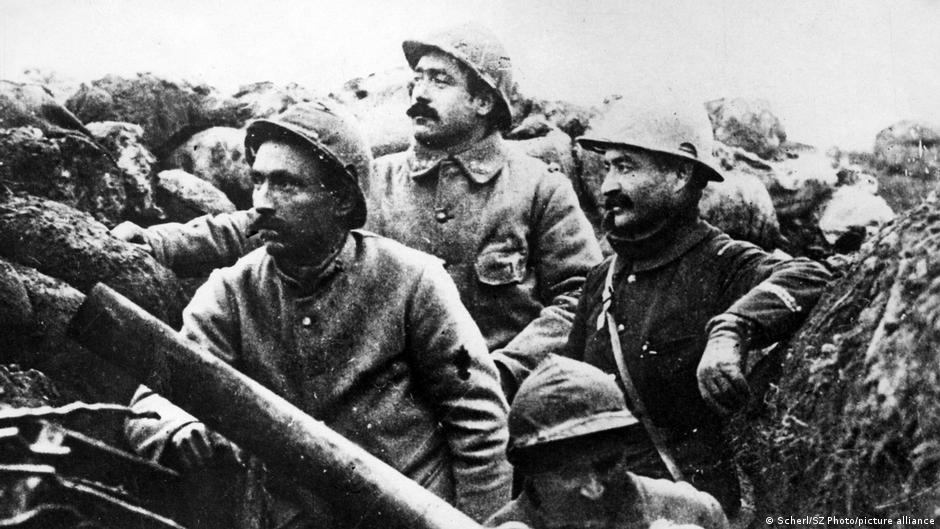
It was still early in the morning when a rain of fire fell on the forts and trenches of Verdun.
With 300 trainloads of ammunition, the Germans had been firing their artillery for hours on end. The thundering of cannons could be heard 150 kilometers (93 miles) away.The chief of the German General Staff, Erich von Falkenhayn, had given the order to attack the French.
He wanted to end the trench warfare that had been raging along the Western Front between Belgium and France since September 1914, a few months after World War I broke out. His idea was to break through the front and return to mobile warfare, explains historian Olaf Jessen, author of “Verdun 1916: Urschlacht des Jahrhunderts” (or “Verdun 1916: Primordial Battle of the Century”).
Trapped in the ‘Hell of Verdun’
However, Falkenhayn had miscalculated. The end result was 10 months of brutal combat over every village and hill. The French motto was “On ne passe pas” (“They won’t get through here”). The battle went down in history as the epitome of senseless carnage. Amid grueling trench warfare, the men held out in their holes in the ground, with rats, lice, cold weather and bad food testing their nerves, along with the constant fear of death. The enemy often lurked just 30 meters (98 feet) away.
State-of-the-art artillery was meant to decide the battle: In addition to heavy mortars, flamethrowers and machine guns, 26 million high-explosive shells and 100,000 toxic gas grenades rained down on the trenches in an area of less than 30 square kilometers (11.5 square miles). In the summer months, the battlefield reeked of rotting corpses, while decaying human remains hung from trees due to bomb blasts. In the winter, the soldiers would find themselves in icy water or mud up to their knees. They suffer from extreme thirst, and drink precious water from rain puddles where their comrades had bled to death between the bodies of dead horses.
“This inhumane experience has been burnt into collective memory with terms like ‘meat grinder’ and the ‘hell of Verdun,'” Jessen tells DW. Back then, people were turned into “mere war material.” The horror was also distinctly palpable in the letters soldiers wrote home.
“Verdun, that terrible word! Countless people, young and full of hope, lost their lives here. Their [bones] are now rotting somewhere, between trenches, in mass graves, in cemeteries,” 20-year-old theology student, Paul Boelicke, wrote to his family. “The front shifts around. Today, the enemy holds the high ground, tomorrow we will do so. There’s always bitter fighting going on here somewhere. Some who had just been enjoying the warm sun heard it roaring and howling somewhere nearby. All dreams of peace and home are gone, man becomes a worm and seeks out the deepest hole. Battlefields where nothing can be seen but suffocating smoke, gas, clumps of earth and shreds of cloth swirling wildly through the air: That is Verdun.”
‘The battle was unusually savage’
The brutal trench warfare claimed over 300,000 lives and left 400,000 wounded. In December 1916, after countless artillery strikes, the battlefield resembled a moonscape. “The battle was unusually savage, even for World War I, including the high casualty rates. It was unheard of for so many people to die within so few square kilometers,” explains Jessen.
At the outset, the Germans had made some advances, sustaining heavy losses in the process, but “then the French recaptured almost the entire ground that the Germans had bitterly fought to capture,” Jessen says. “After 300 days and 300 nights, the German side was right back where it had started its offensive in February 1916.” One reason was the long deployment of German soldiers at the front. “The Germans’ morale was in tatters from exhaustion.”
Falkenhayn’s opponent, Philippe Petain, the defender of Verdun, had relied on a rotation principle for his soldiers from the outset. He literally drew the entire nation into the battle in eastern France. According to Jessen, almost every French soldier was sent to the trenches outside Verdun, but was then allowed to leave again after a few days. “The aim was to prevent exhaustion and demoralization from setting in too quickly.”
Bleeding the enemy dry
After Falkenhayn’s offensive strategy failed, he was dismissed as chief of staff of the German Supreme Army Command on August 29, 1916. General Paul von Hindenburg took over his position. German troops were required elsewhere, particularly on the Somme front, where British forces had launched an offensive in June 1916 to relieve the French at Verdun.
The battle at Verdun ended on December 18. Erich von Falkenhayn later attempted in his memoirs to cast his inglorious role and the failed breakthrough in a more favorable light, says Jessen. Among others, the officer wrote: “If five Frenchmen had to bleed for every two dead German soldiers, that’s a good thing.”
“The surviving veterans who had marched to capture Verdun and end the war felt this statement was a betrayal — after all, they had to read that one of their leading generals actually saw them only as human cannon fodder,” explains Jessen.
A turning point in World War I
“It wasn’t a decisive battle, but it was nevertheless a very, very important milestone in the history of World War I,” emphasizes the historian, “the turning point, so to speak, that led to Germany’s defeat in World War I. It also shifted the balance of power in Germany toward military dictatorship and accelerated the United States’ entry into the war.”
The “stab-in-the-back myth” was also fueled by the Battle of Verdun. Known as the “Dolchstoßlegende,” this conspiracy theory falsely claimed the military was undefeated but had been betrayed by civilians, Jews, socialists, and republican politicians who agreed to the armistice in 1918. It would also later serve as a crucial propaganda tool for the Nazi Party’s rise to power.
Places of remembrance
For Germans, Verdun today is synonymous with the utter futility of war, whereas in France, the catastrophe of Verdun is overshadowed by a sense of national unity and victory — even though in reality it was a military stalemate achieved at the cost of inhuman suffering. In 1932, an ossuary was inaugurated to house the remains of countless unknown soldiers. Since 1967, the Memorial de Verdun has commemorated those who fell in the trench warfare.
In 1914, at the start of World War I, British author H.G. Wells coined the phrase, “The war that will end war.” If any of the French or German soldiers who lost their lives at Verdun had believed they were fighting in a “war to end all wars,” they were mistaken.
More than 100 years later, images of a war that has reached a stalemate are reappearing — not in historical black-and-white photos, but in modern images from Ukraine.
“If you look at today’s images from Donbass, you see striking parallels,” says Jessen. “Back then (in World War I), all the players remained glued to the poker table because everyone believed that without ultimate victory, they would not be able to recoup the horrendous losses on their own side, and they waited for the psychological and political collapse of their opponent. And that is very reminiscent of the situation in Ukraine and Russia. There is no breakthrough to be had at the moment.”
The former arch-enemies Germany and France are now allies. Historian Olaf Jessen hopes that lessons will be learned from history.
This article was originally written in German.
