

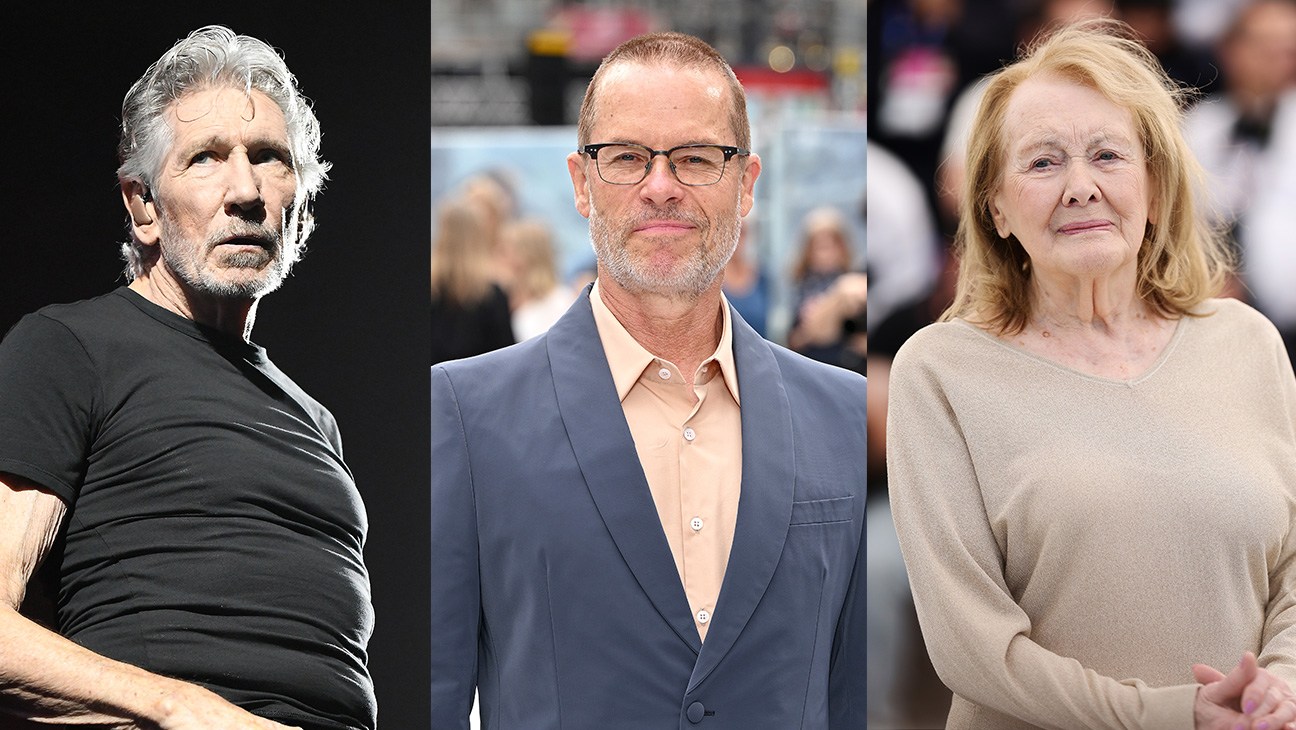
Pink Floyd’s Roger Waters, Nobel-winning writer Annie Ernaux, actor Guy Pearce and a host of Italian and international artists have signed an open letter to the Venice Biennale and the Venice Film Festival calling on the event to take “concrete action” against what they describe as a genocide against the Palestinian people.
The appeal under the Venice4Palestine banner follows a similar open letter to the Venice film festival a year ago that has apparently yielded no tangible results for Gaza. “A new normality… has emerged—thanks in part to a false ceasefire. Israel has not only not stopped, but has continued its atrocities, expanding its firepower toward the West Bank, Syria, Lebanon, and Iran. For the Palestinian people, nothing has changed, and tears are not enough to absolve us: rather, they are evidence that we are unable to draw sufficiently on our collective power of action,” the latest open letter states.
The appeal also calls on Venice to “raise the Palestinian flag for the entire duration of the festival alongside all the other flags representing the films present in the official selection, as is standard practice and as already acknowledged by the festival’s official information sources.”
The 2026 signatories include directors Isabel Coixet, Céline Sciamma and Matteo Garrone, Palestinian directors Arab Nasser and Tarzan Nasser, French-Israeli director Eyan Sivan.
Venice4Palestine representatives will be part of a Sept. 8 panel at Venice, entitled Yet Gaza Continues to Burn, on the Lido.
The full open letter and a full list of signatories follows.
Yet Gaza Continues to Burn
A year has pass…
A year ago, thousands of people joined the Venice4Palestine call to put Palestine in the spotlight at the Venice Film Festival and bring the resistance of the Palestinian people to the center of public discourse: finally, we were talking openly about genocide instead of war . While we were calling on the Biennale and the Venice Film Festival to take a clear stance and on film workers to express their solidarity, the screening of Sawt Hind Rajab ( The Voice of Hind Rajab ), during the festival, suddenly seemed to take on those demands, generating collective emotion and indignation. In the days and weeks that followed, as part of that stream of popular consciousness that had been created, millions of us took to the streets and went to sea in solidarity with the Palestinian people. A wave of participation gave us hope that together we could help stop the genocide.
A new normality, however, has emerged—thanks in part to a false ceasefire.
Israel has not only not stopped, but has continued its atrocities, expanding its firepower toward the West Bank, Syria, Lebanon, and Iran. For the Palestinian people, nothing has changed, and tears are not enough to absolve us: rather, they are evidence that we are unable to draw sufficiently on our collective power of action. Palestine reminds us that “another world is possible.” Twenty-five years ago, we experienced the collective trauma of Genoa 2001. We witnessed one of the most serious suspensions of democracy. The expressions of dissent were silenced with unspeakable violence. A slaughterhouse deliberately exposed as a demonstration, to dictate to the collective memory a precise order for the future: remember the blood and forget the ideas that a community had expressed to change the world.
We find this enormous laboratory of repression increasingly applied today in Italy and in many other states that claim to be democratic. The oppressive bullying of our governments, the repressive actions of their armed forces, the liberticidal laws, the mystifying narratives spread by complacent media represent a wall where the demands for justice, equity, and reciprocity are shattered. However tragic and bitter it may seem, however, the Palestinian resistance has reconnected us with the idea that “another world is possible.” The Palestinian people continue to resist and create, to narrate the present reality at the risk of their own lives, to preserve memory and nurture the possibility of a different and more just tomorrow: we have a duty to embrace and practice this teaching. The militarized cities and the unconstitutional laws that criminalize dissent betray the fear of a dehumanizing system faced with the strength of a conscious and determined community. We must not allow these reprisals to paralyze and divide us. The increased repression is proof that our actions are having an impact. We must therefore continue to persist.
Dockworkers are blocking weapons shipments, asserting the right to conscientious objection as a means of protection from unjustified charges and disciplinary action. At the Venice Art Biennale, thanks in part to the action of ANGA (Art Not Genocide Alliance), the international jury resigned en masse, and workers protested the opening of the Israeli pavilion, striking for the first time in the institution’s history. In international waters, the Global Sumud Flotilla challenged the Israeli siege, transforming solidarity into concrete action, revealing the true face of a criminal state. These are all struggles moving in the same direction: refusing to be a cog in the wheel of normalization. As workers in the film, audiovisual, and cultural sectors, we believe it is time to organize ourselves in collective action to have a concrete impact on the mechanisms of complicity and normalization.
1- Trace the supply chain, break the complicity
Cinema, like many other sectors of art and culture, relies on supply chains: funding, co-productions, distribution agreements, sales, festivals and events, partnerships with festivals and sponsors. Each of these steps can contribute to the normalization of ongoing barbarism or, on the contrary, oppose and halt it. It is therefore necessary to demand transparency at every stage of the supply chain, suspending
all agreements with entities and institutions linked to the Israeli government. The exceptional nature of the historical moment we live in requires us to isolate Israel diplomatically,
culturally, and economically. The boycott, as a tool to pressure institutions
and as a form of resistance (responding to the call launched in 2005 by
Palestinian civil society through PACBI and BDS*), does not target identity as
such but rather acts precisely on the mechanisms of complicity. This will continue until the
Israeli government complies with international law and accepts at least the three
main conditions expressed in the original BDS call:
– end the occupation and colonization of Palestine;
– recognize the fundamental rights of Arab Palestinian citizens of Israel;
– respect the right of Palestinian refugees to return to their homes as stipulated
in UN Resolution 194.
2- From awareness to shared practice
We call on all stakeholders and associations in the film, information, and culture sectors to unite to build a protective structure that will defend workers in the sector from the professional risks of a concrete commitment against genocide, thus breaking the employment blackmail that currently discourages disobedience. Out of the need for joint action, we have developed, together with a legal team, a first instrument that allows every film worker to dissociate themselves from complicity in the crimes that Israel continues to commit with impunity.
This document combines the Italian Constitution, international law, and copyright law, in response to the recent controversy surrounding the Italian film retrospective in Israel and the sense of impotence expressed by the authors involved regarding the management and exploitation of their works and their image.
3- Palestine is not forgotten
To honor the presence of the two Palestinian films, Al Mowaten Osama by Ahmed Hassouna and Hiwar ma’ albahr by Muayad Alayan, we ask the Festival to also raise the Palestinian flag for the entire duration of the festival alongside all the other flags representing the films present in the official selection, as is standard practice and as already acknowledged by the Festival’s official information sources. Last year, we expressed the need to highlight the voices of Palestinian artists during the opening and closing ceremonies of the Exhibition. This request was accepted by the Biennale presidency and the Exhibition’s artistic direction, not by giving space to Palestinian voices, but by inviting those who worked in Palestine and witnessed what was happening. The recent statements of Cardinal Pizzaballa, who already spoke on stage at the Exhibition a year ago, lead us to ask, today with even greater urgency, to renew that testimony on the same occasion, giving voice to those who resist alongside the Palestinian people and continue to speak out about the incessant destruction that the European Union and its member states still have no intention of countering.
Finally, we urge all film and culture workers to continue to bring Palestine to the spotlight of the Festival and to the center of public conversation, using every means at their disposal. We invite everyone to the panel “Yet Gaza Continues to Burn,” which we will hold on Tuesday, September 8, at 5:30 p.m. at the Casa degli Autori, Via Pietro Buratti 1, Lido di Venezia . We will be guests of the Venice Days, where we will be present with our legal team to illustrate the document we are working on and to discuss it with activists from PACBI, BDS, the Global Sumud Flotilla, CALP USB, ANGA, CRED, Artisti #NoBavaglio, and the Gaza International Festival for Women’s Cinema, to build new paths for concrete action together.
Annie Ernaux – Nobel Prize-winning writer (France)
Roger Waters – musician (United Kingdom)
Saleh Bakri – actor (Palestine)
Yanis Varoufakis – economist and professor, former minister (Greece)
Matteo Garrone – director (Italy)
Fabrizio Gifuni – actor and theatre director (Italy)
Anna Foglietta – actress and director (Italy)
Laura Morante – actress and director (Italy)
Luigi Lo Cascio – actor (Italy)
Sergio Rubini – actor and director (Italy)
Greta Scarano – actress, director, godmother of the 83rd Venice Film Festival (Italy)
Moni Ovadia – actor, author, singer-songwriter (Italy)
Tomaso Montanari – art historian, essayist, rector at the University for Foreigners of Siena (Italy)
Ascanio Celestini – actor, director and playwright (Italy)
Guy Pearce – actor (United Kingdom)
Jasmine Trinca – actress (Italy)
Céline Sciamma – director, screenwriter (France)
Andrea Occhipinti – producer and distributor (Italy)
Lino Musella – actor, director (Italy)
Tecla Insolia – actress (Italy)
Nan Goldin – artist, photographer and activist (USA)
Isabel Coixet – director and screenwriter (Spain)
Paul Laverty – screenwriter (UK)
Adèle Haenel – actress, author (France)
Teona Strugar Mitevska – filmmaker (North Macedonia)
Benedikt Erlingsson – director, screenwriter (Iceland)
Igor Bezinović director (Croatia)
Sonia Bergamasco – actress and director (Italy)
Alessio Boni – actor and theatre director (Italy)
Antonietta De Lillo – director (Italy)
Pino Arlacchi – sociologist – former UN undersecretary (Italy)
Silvia Scola – author and screenwriter (Italy)
Arab Nasser – director (Palestine)
Tarzan Nasser – director (Palestine)
Eyal Sivan – filmmaker (Israel – France)
Motaz Malhees, actor (Palestine)
Dalia Ismail – journalist (Palestine)
Indya Moore – actress and activist (USA)
Paola Caridi – essayist and journalist (Italy)
Raffaele Oriani – journalist, writer (Italy)
Giacomo Durzi – screenwriter (Italy)
Giulia Minoli – writer and activist una nessuna centomila (Italy)
Monica Maurer – director (Italy)
Vincenzo Vita – president of Aamod (Italy)
Stefania Brai – journalist (Italy)
Insaf Rezagui – associate researcher at the Institut français du Proche-Orient (Algeria-France)
Sbeih Sbeih – sociologist (Palestine-France)
Paolo Briguglia – actor (Italy)
Claudio Noce – director (Italy)
Manuela Mandracchia – actress (Italy)
Paola Freddi – editor (Italy)
Sara Petraglia – director (Italy)
Stefano Sardo – producer, director and screenwriter (Italy)
Francesca Fornario – journalist (Italy)
Fausto Paravidino – actor, playwright (Italy)
Pietro Sermonti – actor (Italy)
Maria Grazia Calandrone – writer (Italy)
Paola Minaccioni – actress (Italy)
Dalal Suleiman – actress (Italy)
Veronica Pivetti – actress (Italy)
Michela Occhipinti – director (Italy)
Céline Salette – actress, director (France)
Marco Simon Puccioni – director (Italy)
Anna Di Francisca – director (Italy)
Paolo Spina – producer (Italy)
Christian Carmosino Mereu – director (Italy)
Mariano Lamberti – director (Italy)
Daniela Giordano – actress (Italy)
Marco Bonini – actor (Italy)
Daniela Poggi – actress (Italy)
Gabriella Gallozzi – editor of Bookciak Magazine (Italy)
Carmine Amoroso – director and screenwriter (Italy)
Daniele Coluccini – director and producer (Italy)
Alessio Maria Federici – director (Italy)
Federico Greco – filmmaker (Italy)
Emanuele Gerosa – director (Italy)
Ivan Gergolet – director (Italy)
Raquel Schefer – programmer, filmmaker and researcher (Portugal)
Agata Iacono – sociologist, anthropologist, journalist (Italy)
Gabriele Guzzi – university professor and president of L’Indispensabile (Italy)
Paolo Cornetti – editor of La Fionda (Italy)
Nello Preterossi – professor of Philosophy of Law (Italy)
Alessandro Somma – professor of Comparative Law (Italy)
Giulio Di Donato – editor-in-chief of La fionda (Italy)
Thomas Fazi – journalist and essayist (Italy)
Francesco Bolo Rossini – actor (Italy)
Deborah Zuin – actress (Italy)
Stefano Scherini – actor (Italy)
Sonia Barbadoro – actress (Italy)
Giorgio Lupano – actor (Italy)
Francesca Ciocchetti – actress (Italy)
Laura Nardi – actress (Italy)
Marina Remi – actress (Italy)
Cristian Giammarini – actor (Italy)
Aurora Palandrani – director Premio Zavattini (Italy)
Benedetta Buccellato – actress (Italy)
Diego De Santis – sound engineer (Italy)
Nan van Houte – Cultural Boycott Israel (Netherlands / Belgium)
Sruti Bala – Cultural Boycott Israel (Netherlands / Belgium)
Giovanna Scardoni – playwright and theatre director (Italy)
Tony Allotta – performer and mediator (Italy)
Milena Fiore – technical manager and editor Aamod (Italy)
Marco Dentici – director and set designer (Italy)
Alia Shawkat – actress (USA)
Ezzadeen Shalh – president Gaza International Festival for Women’s cinema (Palestine)
Marco Pozzi – director (Italy)
Cristina Pasqua – writer (Italy)
Dror Warschawski – researcher Sorbonne Université (France)
Giovanni Greco – author and director (Italy)
Mirco Rocchi – set designer (Italy)
Andrea Gropplero di Troppenburg – director (Italy)
Giovanni Alfieri – actor (Italy)
Federica Alderighi – producer (Italy)
Maria Teresa De Vito – director (Italy)
Maud Wyler – actress (France)
Hervé Loichemol – director (France)
Livia Bonifazi – actress (Italy)
Franco Angeli – director (Italy)
Khalil Cherti – director (France)
Claudio Casazza – director (Italy)
Beppe Leonetti – editor (Italy)
Fabiomassimo Lozzi – director and screenwriter (Italy)
Mazzino Montinari – festival selector and critic (Italy)
Valentina Pellitteri – filmmaker (Italy)
Patrizia Roletti – producer (Italy)
Marisella Rossetti- festival (Belgium)
Silvia Pegah Scaglione – actress and theatre director (Italy)
Giorgia Villa – editor (Italy)
