


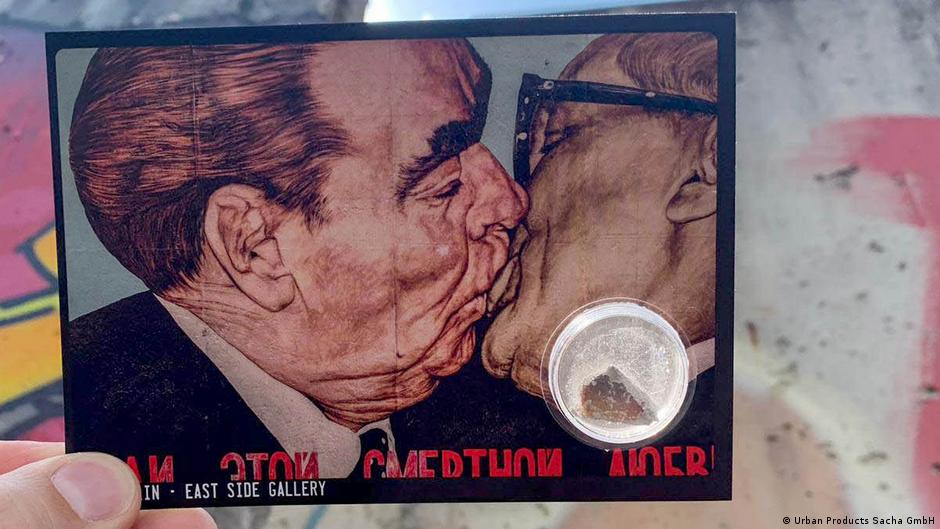
When the Berlin Wall fell in 1989, it sealed the fate of East Germany. People wasted no time and started hacking away at the monstrosity with hammers and chisels. Those people chipping away at the former border barricade were known as “Mauerspechte,” or wall woodpeckers. By June 1990, most of the Berlin Wall had been taken care of by bulldozers. Only a few sections of it have survived to this day; at the official Berlin Wall Memorial or the East Side Gallery, for example.
Still, fragments of the Wall keep turning up in large amounts all over the city. The Checkpoint Charlie Museum, souvenir stores and even hotels have thousands of pieces for sale. Almost 40 years since the fall of the wall, supply of the concrete chunks — brightly painted, made into fridge magnets or stuck onto postcards — shows no signs of slowing down. But, how can that be? Could these pieces of rubble perhaps come from much less significant and historical origins?
Made of concrete — or plaster
“There definitely are fake bits of wall that are made of plaster,” explains Julian Sacha in conversation with DW. Most of the pieces on sale are genuine, though, and he should know: His company is the main supplier of authentic pieces of the Berlin Wall. He and his brother Sebastian run Urban Products Sacha Ltd. in the Berlin district of Reinickendorf. It’s been a family business since 1992, when Sebastian Sacha’s father-in-law secured a large number of fragments of the wall and began breaking down the concrete slabs for sale.
“We supply a large souvenir chain in Berlin; that’s our main customer,” Sacha says, “But we also ship pieces all over the world through our online store.” Most go to the US, UK and China. There’s also an exhibition that’s been touring Europe since 2024 and is currently in Barcelona: “The Berlin Wall. A World Divided.” Pieces of the wall, supplied directly from Reinickendorf, are sold alongside the exhibit.
New color, old wall
On their website, Urban Products makes no secret of the fact that their pieces of the wall have been spray painted in vivid colors — it adds to the aesthetic appeal. Prices start at €9.90 ($11.70), with a certificate of authenticity to confirm that the chunk of wall is in fact original. The German parliament is even among the firm’s customers.
Business isn’t showing any signs of drying up soon. “We’ve still got 40 to 45 sections of the wall in storage,” says Sacha, “30 of those are still whole, 10 to 15 have already been broken up to be ready for sale.” More pieces of this former 155-kilometer (96-mile) concrete barricade are scattered around the globe, too. Over the years, many sections of it — in slabs 3.6 meters high and 1.2 meters wide — have been shipped all over the world, though the whereabouts of many remain a mystery.
“We can get more!” Julian Sacha says. If they should ever need them, that is. Over the past few years, demand has been dropping off. That’s why Urban Products has begun shifting its focus away from the concrete keepsakes. The Berlin company’s core business is slowly moving to vintage tin signs, Berlin key rings and other mementos.
This article was translated from German.
